Why Sticker Price Is the Wrong Starting Point
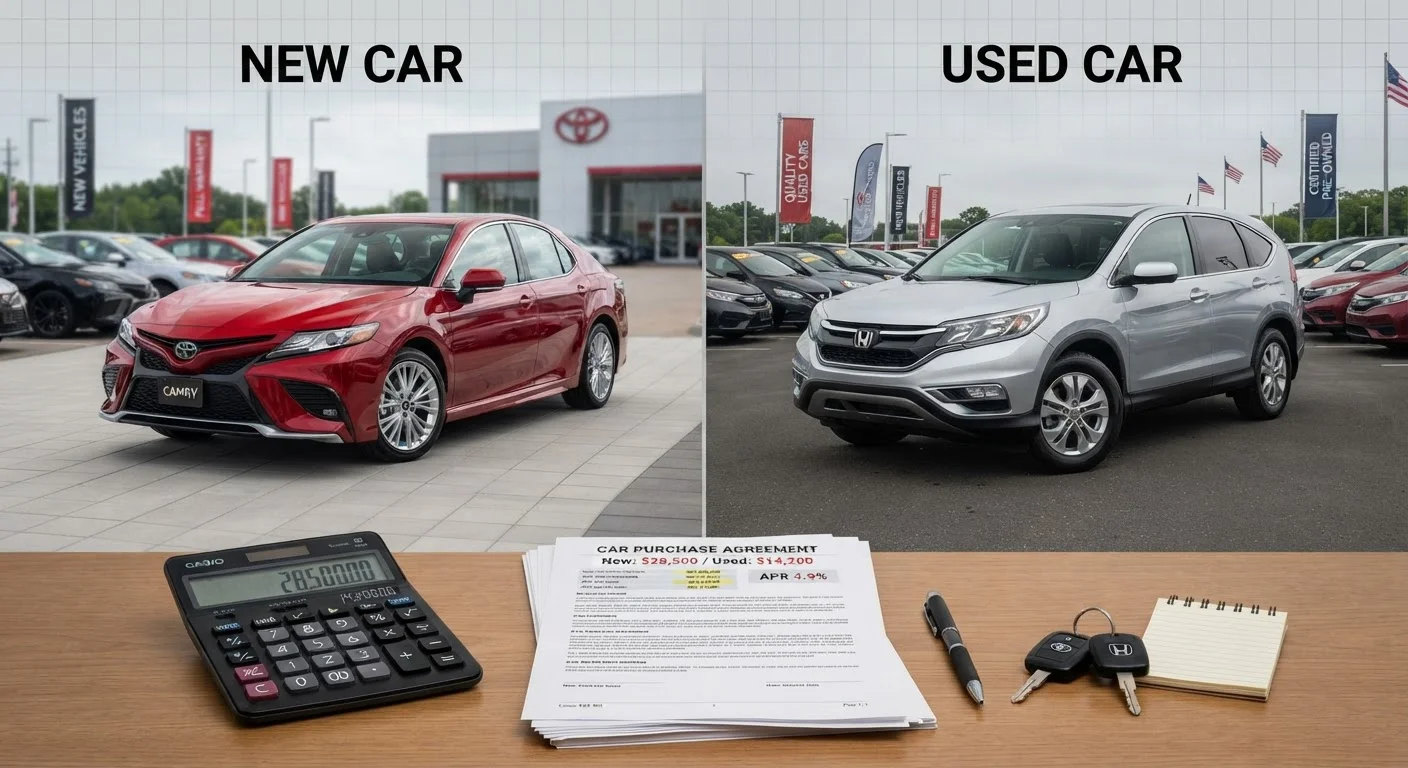
When most buyers compare new and used cars, they start - and often stop - at the purchase price. A used vehicle listed several thousand dollars below a new equivalent looks like an obvious win. But the sticker price captures only a single moment in what is actually a multi-year financial relationship with your vehicle.
The true measure of affordability is total cost of ownership: the sum of every dollar the vehicle costs you from purchase to sale or trade-in. That figure includes depreciation, loan interest, insurance, fuel, scheduled maintenance, and unplanned repairs - costs that behave very differently depending on whether the car is new or used.
Understanding these cost categories separately - and then adding them up - is what separates a confident buying decision from one that looks reasonable on paper but strains your budget 18 months later.
Depreciation: The Largest Hidden Cost
Depreciation is the single largest expense most vehicle owners never directly pay as a bill, which is exactly why it gets overlooked. It represents the value the car loses over time - and that loss is most severe in the earliest years of a new vehicle's life.
A new car that sits on a dealership lot has its highest value at the moment of purchase. Once it's driven off the lot, that value begins declining - and in the first two to three years, the drop can be substantial. Buyers who purchase a vehicle that is two to four years old effectively let the original owner absorb that steepest portion of the depreciation curve.
That said, depreciation isn't entirely bad news for new-car buyers. If you plan to keep a vehicle for eight to ten years, the total depreciation spread over a long ownership period looks less dramatic per year. The depreciation disadvantage of buying new narrows the longer you hold the car.
For a deeper look at how this single factor shapes the new-vs-used calculation, see our article on depreciation and the car-buying decision.
15-25%
Typical new-car value loss in year one
Industry estimates consistently place first-year depreciation for new vehicles in this range, though exact figures vary by make, model, and market conditions.
~60%
Value retained after 5 years (average new car)
Many vehicles retain roughly 40-60% of their original value after five years, meaning a significant portion of the purchase price is lost to depreciation over that window.
1-3%+
Typical APR premium on used car loans
Lenders commonly charge higher interest rates on used vehicle loans compared to new, though the exact spread depends on credit profile, lender, and loan term.
Financing, Insurance, and the Costs That Compound
Two recurring costs - financing and insurance - often get treated as fixed background expenses. In reality, they vary considerably based on whether the vehicle is new or used, and they compound over time.
Financing: Lenders typically offer lower annual percentage rates (APRs) on new vehicles than on used ones. This can seem counterintuitive - a used car is cheaper, so why does it cost more to borrow for? Lenders view used vehicles as higher collateral risk, partly because their value is harder to predict. The practical result is that a used car loan may carry a meaningfully higher interest rate, which can erode the purchase-price savings over a multi-year loan term. See how the numbers play out in detail in our guide to financing a new car vs. a used car.
Insurance: Many buyers assume a used car is automatically cheaper to insure. Coverage costs depend on a range of factors - the vehicle's market value, repair costs, safety ratings, and your personal driving profile - not just its age. A newer vehicle with a higher replacement value typically carries higher comprehensive and collision premiums. For a full breakdown, review our explainer on insurance costs for new vs. used cars.
Maintenance, Repairs, and the Warranty Cushion
New vehicles come with manufacturer warranties that typically cover three years or 36,000 miles for basic repairs, and five years or 60,000 miles for powertrain issues - though specific terms vary by manufacturer. That warranty coverage acts as a financial buffer against unexpected repair costs during the ownership period.
Used vehicles - particularly those outside certified pre-owned (CPO) programs - are often sold as-is or with limited coverage. As a car ages and accumulates miles, the statistical likelihood of repair needs increases. Routine maintenance costs (brakes, tires, fluids) apply to both new and used vehicles, but older cars may also require more substantial component replacements.
CPO programs occupy a middle ground: they offer extended warranty coverage on used vehicles that have passed a manufacturer inspection. However, CPO vehicles carry a price premium over standard used cars. Whether that premium is justified depends on the specific program's coverage terms. Our article on certified pre-owned vs. standard used walks through what those programs actually cover.
The warranty gap between new and used vehicles is one of the most meaningful - and most underestimated - financial differences between the two options. Learn more in our guide to the warranty gap between new and used vehicles.
Building a Side-by-Side Cost Comparison
Rather than reacting to sticker prices, build a structured comparison across five cost categories for each vehicle you're considering: depreciation impact, loan interest, insurance, scheduled maintenance, and estimated repairs. Projecting these over your expected ownership period - three, five, or seven years - often reveals that the financially superior choice depends heavily on your specific situation.
For some buyers, a new car with a long ownership horizon, low financing rate, and minimal repair risk genuinely costs less over time than a used car with a higher loan rate and aging components. For others, a well-maintained used vehicle with moderate mileage and minimal remaining depreciation offers the clear advantage. There is no universal answer - only an analysis that fits your circumstances.
For a structured framework that goes beyond price alone, see the decision framework for new vs. used cars. And if you're exploring situations where new actually wins financially, our article on scenarios where buying new makes more financial sense is worth reading before you decide.
This article is for general informational purposes only and does not constitute personalized financial advice. Consult a qualified financial professional for guidance tailored to your individual circumstances.