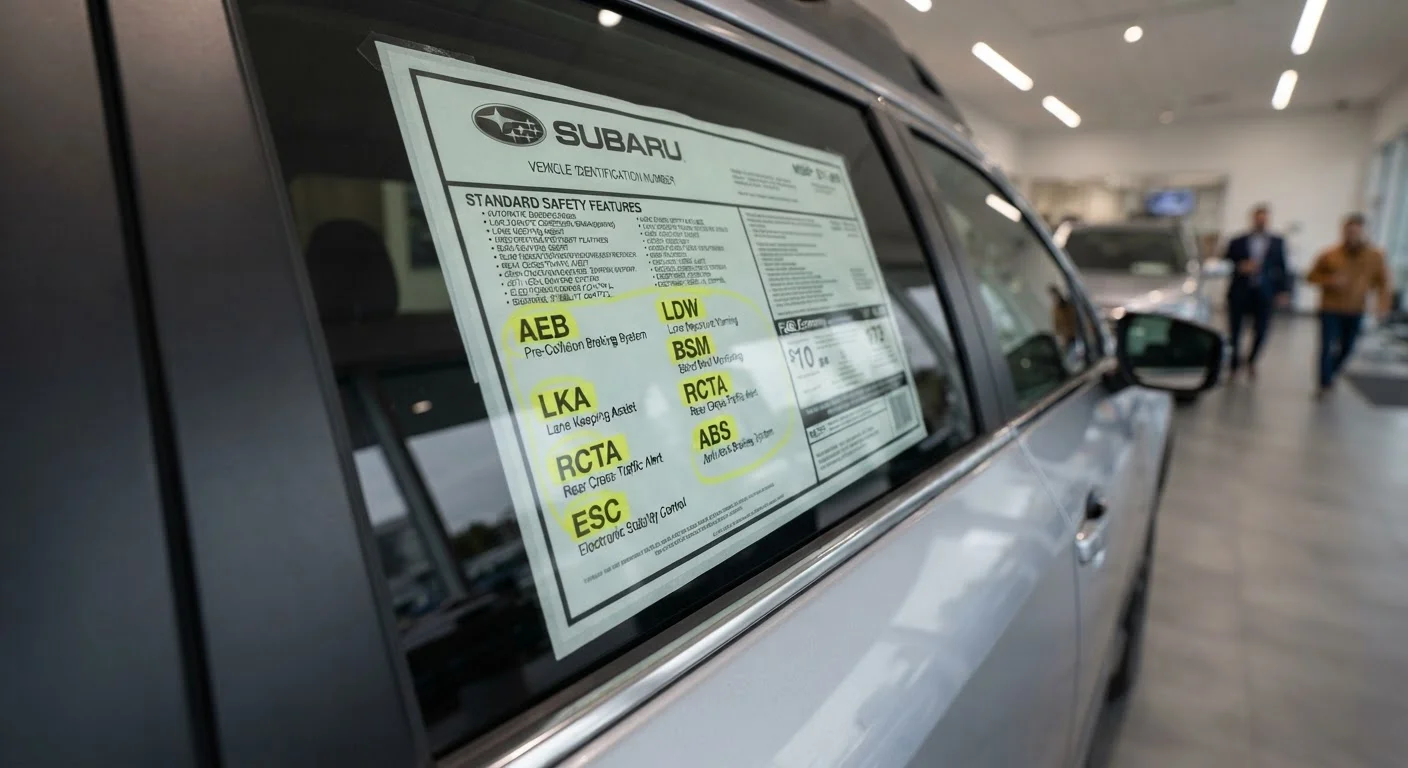
How to Use This Glossary
Window stickers list safety features in ways that mix manufacturer brand names, government-standard acronyms, and plain descriptions — sometimes for the exact same technology. This glossary defines every common term by what the system actually does, not what it's called on a particular sticker. Use it alongside our ADAS reference card when comparing trim levels, and see our plain-language safety tech field guide for deeper explanations of how these systems interact in real driving situations.
Feature Names Vary by Automaker
Automakers frequently brand these technologies under proprietary names — for example, one manufacturer's "ProPilot Assist" is functionally another's "Adaptive Cruise Control with Lane Centering." Always cross-reference the marketing name against the underlying function, not the badge. The NHTSA and IIHS publish standardized functional descriptions that are useful reference points when comparing vehicles across brands.
A key distinction to keep in mind throughout: warning systems alert you and leave braking or steering to you; intervention systems act on their own if you don't respond. Both matter, but they serve different roles in a crash scenario.
The Complete ADAS Term Reference
Beyond the core terms above, you may encounter these additional acronyms on window stickers and spec sheets:
- LKAS (Lane Keeping Assist System)
- A variant label used by some automakers for what is functionally the same as LKA — steering intervention to keep the vehicle centered in its lane.
- LCA (Lane Change Assist)
- Monitors adjacent lanes and warns or resists steering if a lane change is initiated while another vehicle is detected in the target lane — related to BSM but focused on the active merge maneuver.
- ICA / LCC (Intelligent Cruise Assist / Lane Centering Control)
- An enhancement layered over ACC that adds continuous steering input to keep the vehicle centered in its lane, not just at a set speed. Sometimes marketed as "hands-on" highway driving assist.
- IHBC (Intelligent High-Beam Control) / AHB (Automatic High-Beam)
- Switches between high and low beams automatically based on detected oncoming or preceding vehicle headlights, improving night visibility without blinding other drivers.
- PEB / PCTA (Pedestrian Emergency Braking / Pedestrian Cross-Traffic Alert)
- An extension of AEB tuned to detect pedestrians and cyclists in the vehicle's path, with some systems also covering perpendicular movement at low speeds.
- ESC (Electronic Stability Control)
- Federally mandated on all new US passenger vehicles since 2012. Detects skidding or loss of directional control and selectively applies individual wheel brakes to help the driver maintain intended steering direction.
For specification context beyond safety features — such as powertrain ratings and chassis dimensions — see the spec sheet glossary.
What These Systems Don't Do
Understanding limitations is as important as understanding capabilities. ADAS features are designed to assist an attentive driver — not replace one. Key constraints that apply across most systems:
- Sensor range and weather: Camera-based systems can struggle in heavy rain, snow, or direct sun glare. Radar performs better in adverse weather but has its own detection limits.
- Speed thresholds: AEB systems often operate within a specific speed range (e.g., effective below 50 mph for pedestrian detection). Above those thresholds, intervention may be limited or absent.
- Map and marking dependency: LKA and LCC rely on visible lane markings. Faded lines, construction zones, or unmarked roads can cause the system to disengage or behave unpredictably.
- Driver override: All current production ADAS systems are designed to be overridden by deliberate driver steering or braking input.
| Standard AEB requirement (new US vehicles) | Voluntary industry commitment covers most light vehicles; federal mandate phased in from 2029 (NHTSA final rule, 2024) |
| Crash reduction attributed to AEB | Up to 50% reduction in rear-end crashes (IIHS research findings) |
| Typical BSM sensor type | Short-range radar (most vehicles); some use cameras (General industry standard) |
| ACC minimum following distance | Usually 1–4 seconds, driver-selectable (Common system design range) |
| DMS regulatory push | Required in new EU vehicles from 2024; under NHTSA review in US (European General Safety Regulation) |
When evaluating a vehicle's safety package, independent testing results from bodies like the IIHS often reveal meaningful differences in how well a listed feature actually performs — not just whether it's present. For a broader look at vehicle research vocabulary, the Car Features Explained hub covers both safety and non-safety systems in plain language.