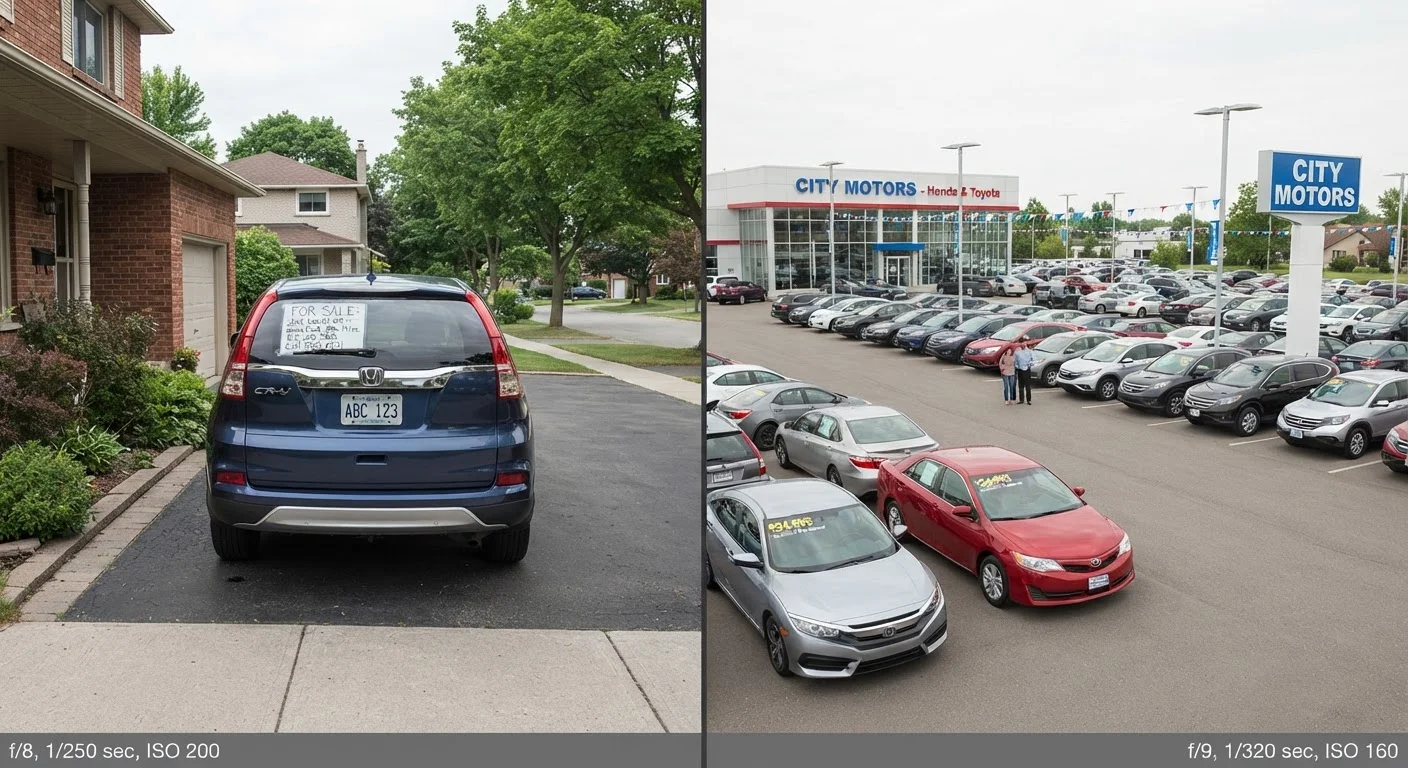
How Price and Value Differ Between the Two Routes
Price is the most immediate difference buyers notice. Private sellers set asking prices without the overhead costs that dealers carry — no reconditioning labor, no lot fees, no documentation charges. The result is that comparable vehicles frequently list lower in private sales, sometimes by several thousand dollars depending on make, model, and condition.
That said, lower sticker price doesn't automatically mean better value. A privately listed vehicle may have deferred maintenance, an incomplete service history, or undisclosed cosmetic repairs. A dealer-reconditioned car may cost more upfront but arrive with documented repairs and a basic inspection on record. The comparison is rarely apples-to-apples.
When evaluating any listing, independent valuation tools — which aggregate market data across active listings — give you a realistic baseline. Use these figures as a reference point, not an absolute, since regional supply, mileage, and condition all affect actual market value. For a broader look at how pricing and negotiation dynamics work across the used car market, see used car deals resources available through this site.
| Criterion | Private Seller | Dealership |
|---|---|---|
| Typical price level | Generally lower | Includes dealer margin and fees |
| Consumer legal protections | Minimal (as-is in most states) | FTC Buyers Guide; implied warranties |
| Vehicle history disclosure | Buyer must self-verify | Often provided; verify independently |
| Pre-sale inspection | Buyer arranges at own expense | Basic inspection typically included |
| Financing options | Requires external pre-approval | On-site financing available |
| Title and paperwork | Buyer handles independently | Dealer typically manages transfer |
| Negotiation dynamic | Direct with owner; often flexible | Structured process; some flexibility |
| Fraud risk | Higher; fewer verification checkpoints | Lower; licensed and regulated |
Consumer Protections: What Each Route Actually Offers
This is where the two routes diverge most significantly. Under the FTC's Used Car Rule, dealers selling used vehicles in the US are required to display a Buyers Guide disclosing whether the car is sold as-is or with a warranty, and what that warranty covers. If a dealer makes verbal promises about the car's condition, that Buyers Guide is the document that governs. Many states layer additional protections on top of federal rules, including implied warranties of merchantability that can give buyers recourse if a vehicle has a defect the seller knew about.
Private sales operate under a fundamentally different framework. Most states treat them as as-is transactions by default, meaning the buyer accepts the vehicle in its current condition. Fraud protections do exist — a seller who deliberately misrepresents a material fact (such as concealing a salvage title or rolled-back odometer) can face legal liability — but proving this and pursuing a remedy is time-consuming and uncertain. There is no Buyers Guide, no implied warranty, and typically no cooling-off period.
This protection gap means that thorough due diligence before a private purchase is not optional. Running a vehicle history report, obtaining a pre-purchase inspection from an independent mechanic, and asking detailed questions about ownership and service history are baseline steps, not extras. Our guide on questions worth asking every private used car seller covers the specific areas most worth probing.
Vetting, Inspection, and the Due Diligence Gap
The inspection process looks different depending on who you're buying from, and the stakes are higher in a private sale. With a dealer, you're often dealing with a vehicle that has passed at least a basic safety inspection — though the depth of that check varies significantly between independent used car lots and franchised dealers. Many dealers will also allow, or even facilitate, a third-party inspection before purchase.
In a private sale, you're responsible for arranging everything yourself. That means requesting maintenance records, running a VIN-based history report through a recognized service, and — critically — having the car examined by an independent mechanic before committing. Skipping the pre-purchase inspection on a private sale is one of the more predictable ways buyers end up absorbing expensive post-purchase repairs.
The vetting differences extend beyond the physical inspection. Title status, lien checks, and odometer disclosures all require more active verification when no dealer is involved. For a detailed breakdown of how your inspection and history-check approach should shift depending on the source, see private sale vs. dealer purchase vetting differences.
~$2,000–$3,000
Typical private vs. dealer price gap
Industry observers and consumer advocates commonly note private listings run several thousand dollars below dealer asking prices for comparable vehicles, though the actual gap varies by market and model.
1 in 5
Used cars with undisclosed prior damage
Vehicle history data providers have reported that a significant share of used vehicles on the market carry prior accident or damage records not proactively disclosed in listings.
50 states
Jurisdictions with varying as-is rules
Private sale protections differ materially by state; several states provide implied warranty coverage even for private transactions, making it important to check your state's specific rules before purchasing.
Financing, Paperwork, and Logistics
Financing a private purchase requires more legwork. Banks and credit unions do offer pre-approved auto loans usable on private party sales, but the process involves more coordination — you'll need to handle the title transfer and registration independently, which varies in complexity by state. Some buyers find this straightforward; others find it a significant friction point.
Dealerships bundle the paperwork into the transaction, handling title transfer and often registration on the buyer's behalf. Dealer financing is available on-site, but it's worth noting that dealer-arranged loans carry their own considerations. Dealers may mark up the interest rate above what the lender actually requires, capturing additional margin. Arriving with a pre-approved loan from your own bank or credit union gives you a concrete rate to compare against. Dealer finance vs. your own lender covers the trade-offs in more detail.
If you're weighing a broader view of sourcing options — including auctions and other channels — the used car market explained is a useful reference for understanding where private sellers and dealers fit within the overall landscape.
This article provides general educational information about used car purchasing channels. It is not legal or financial advice. Readers should consult qualified professionals for guidance specific to their circumstances.