Why Your Questions Do More Work Than the Listing
A private seller listing tells you what the seller wants you to know. Your questions determine everything else. Unlike dealerships, private sellers in most U.S. states operate under an "as-is" standard — meaning once money changes hands, the car is yours, along with any problems that came with it. There's no implied warranty, no return policy, and often no recourse.
That shifts the burden squarely onto you as the buyer. The questions below aren't meant to be confrontational — they're designed to prompt honest, specific answers that help you make a well-informed decision. If a seller is evasive, inconsistent, or visibly irritated by reasonable questions, that response itself is useful information.
Before you call or meet, it's worth reviewing what the listing signals on its own terms. Then use these questions to fill the gaps.
Why are you selling the car?
This is the most open-ended question on this list — and often the most revealing. Legitimate reasons are common: upgrading, moving, financial change, a household no longer needs two vehicles. But sellers who struggle to explain their reason, or whose explanation shifts across the conversation, deserve closer scrutiny.
A seller offloading a car quickly due to a recurring problem they haven't disclosed is a real scenario. "It just needs a little work" paired with urgency to sell fast is a combination worth probing further.
Urgency paired with a vague reason for selling is a combination worth probing further.
How long have you owned it, and are you the original owner?
Ownership history affects how much a seller can actually tell you about the car. An original owner who bought new and kept it for eight years can speak to the vehicle's full life. A seller who bought it six months ago at auction may know very little.
Short ownership periods aren't automatically a red flag — but they do limit the seller's knowledge and should prompt you to rely more heavily on independent verification. Multiple recent owner changes showing up on a vehicle history report can indicate underlying issues driving repeated resale.
Short ownership periods limit what a seller can honestly tell you about the car's history.
Has the car been in any accidents or had significant body work?
Ask this directly, even if you plan to run a vehicle history report. Some accidents are never reported to insurers and won't appear in any database. A seller's answer — and their willingness to answer — tells you something that data alone cannot.
Follow up by asking whether any panels or structural components were replaced, and whether repairs were done by a body shop or informally. Mismatched paint, uneven panel gaps, and overspray in the door jambs are physical signs to check during your inspection. The vetting approach for private sales differs meaningfully from what's needed at a dealership.
Some accidents are never reported to insurers and won't appear in any vehicle history report.
What's the maintenance history, and do you have records?
A well-maintained car with documentation is worth more than one without it — not just because the maintenance happened, but because you can confirm it happened. Ask specifically about oil changes, timing belt or chain service (where applicable), brake jobs, and tire replacements.
Sellers who have kept receipts and service records are generally more invested in the car's upkeep. Sellers who can't produce any records aren't necessarily hiding something, but you're accepting more uncertainty about the vehicle's condition going forward.
Documented maintenance records let you confirm care was taken — not just trust that it was.
Are there any current mechanical issues or known problems?
Ask this plainly. Some sellers will volunteer information; others won't unless directly asked. Common issues to probe: warning lights currently on or recently cleared, transmission behavior, AC and heat function, unusual noises under acceleration or braking, and any fluid leaks.
Don't accept "minor issues" as a complete answer. Ask what specifically is minor, how long it's been present, and whether it's been looked at by a mechanic. If the seller mentions having the check engine light cleared before listing — without fixing the underlying code — that's a significant disclosure.
Ask what's specifically wrong, not just whether anything is wrong — vague answers conceal details.
Is the title clean, in your name, and free of liens?
This question protects you from one of the more serious private-sale risks: buying a car the seller doesn't fully own. A lien means a lender has a financial claim on the vehicle. If you buy a car with an undisclosed lien and the seller doesn't pay off that loan, the lender may have grounds to repossess the vehicle — even from you.
Ask to see the title before agreeing to purchase. Verify the name on the title matches the seller's ID. If the title isn't yet in the seller's name, or if they say the bank holds it, understand exactly how the payoff and transfer process will work before handing over any money. Your state's DMV can clarify the title transfer requirements in your jurisdiction.
Buying a car with an undisclosed lien can expose you to repossession even after purchase.
Will you allow an independent pre-purchase inspection?
A seller who refuses a pre-purchase inspection by a mechanic of your choosing is signaling something important. Sellers with nothing to hide generally welcome a third-party check — it confirms their claims and builds buyer confidence. Resistance, excuses about timing, or conditions placed on who can inspect the car are worth noting.
The inspection should happen at an independent shop, not a mechanic the seller recommends. A qualified technician will check the engine, transmission, brakes, suspension, exhaust, and body structure in ways that most buyers cannot replicate on their own. See the full pre-purchase inspection checklist for what a thorough review should cover.
Resistance to an independent inspection is itself a meaningful signal about a seller's confidence.
What to Do With the Answers
Good answers from a seller should be specific, consistent, and verifiable. A seller who says the car "runs great" but can't name the last time the oil was changed, or who claims no accidents but doesn't have a vehicle history report, is giving you vague reassurance — not facts.
Cross-check every significant claim. Run a vehicle history report using the VIN (Vehicle Identification Number) regardless of what the seller tells you. If ownership history, title status, or reported incidents don't line up with the seller's account, press for an explanation before going further.
Bring a Written List to Every Meeting
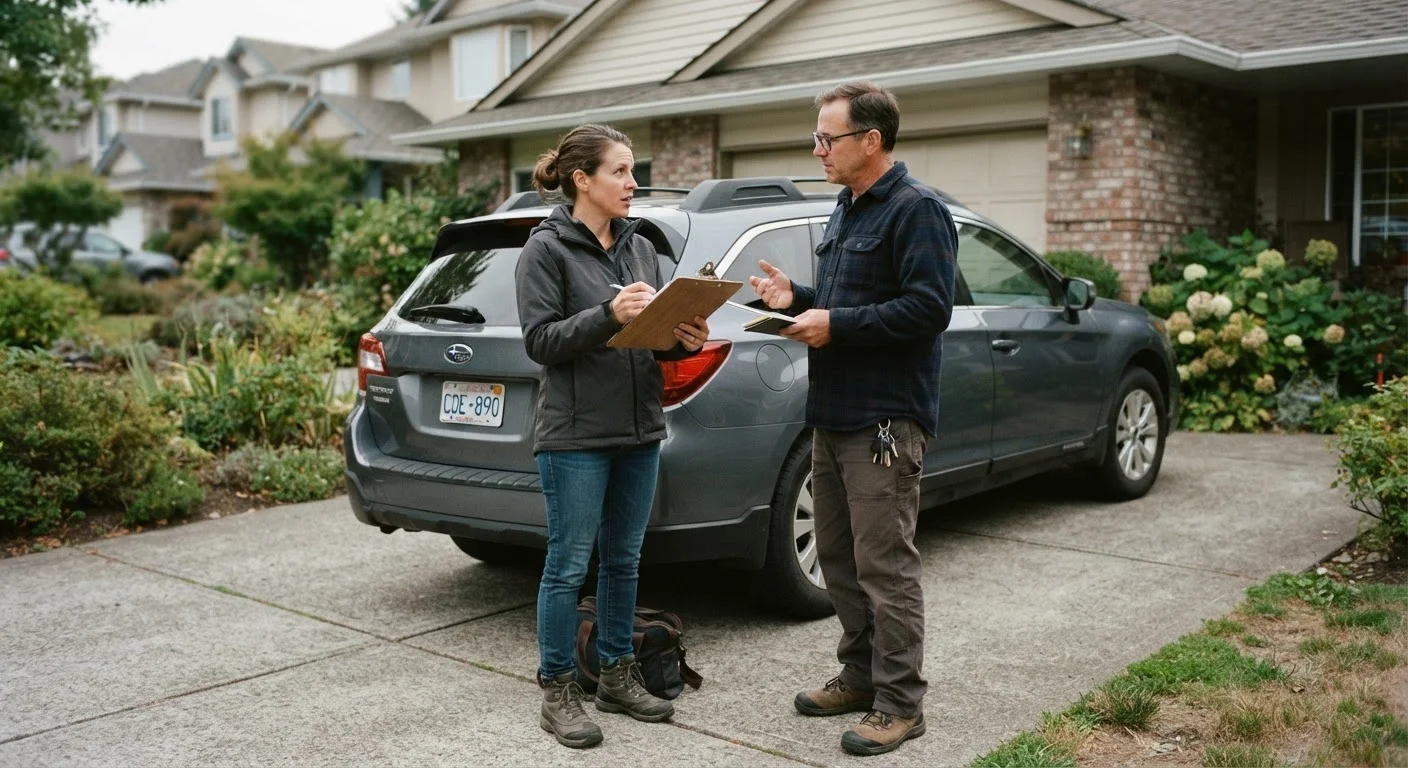
It's easy to forget key questions once you're standing in front of the car. Write your questions down beforehand and refer to them during the meeting — this signals to the seller that you're a serious, prepared buyer, and it ensures you don't leave with gaps. Note the seller's answers in real time so you can cross-check them against the vehicle history report and inspection results later.
Then schedule a pre-purchase inspection with a qualified, independent mechanic before you commit to anything. A good inspection typically costs $100–$200 and can surface issues worth many times that figure. Once you're ready to evaluate the full deal, use a structured pre-offer checklist covering pricing, documentation, and condition before making any commitment.
This article provides general educational guidance for used car buyers and does not constitute legal or financial advice. Consult a qualified professional for advice specific to your situation.