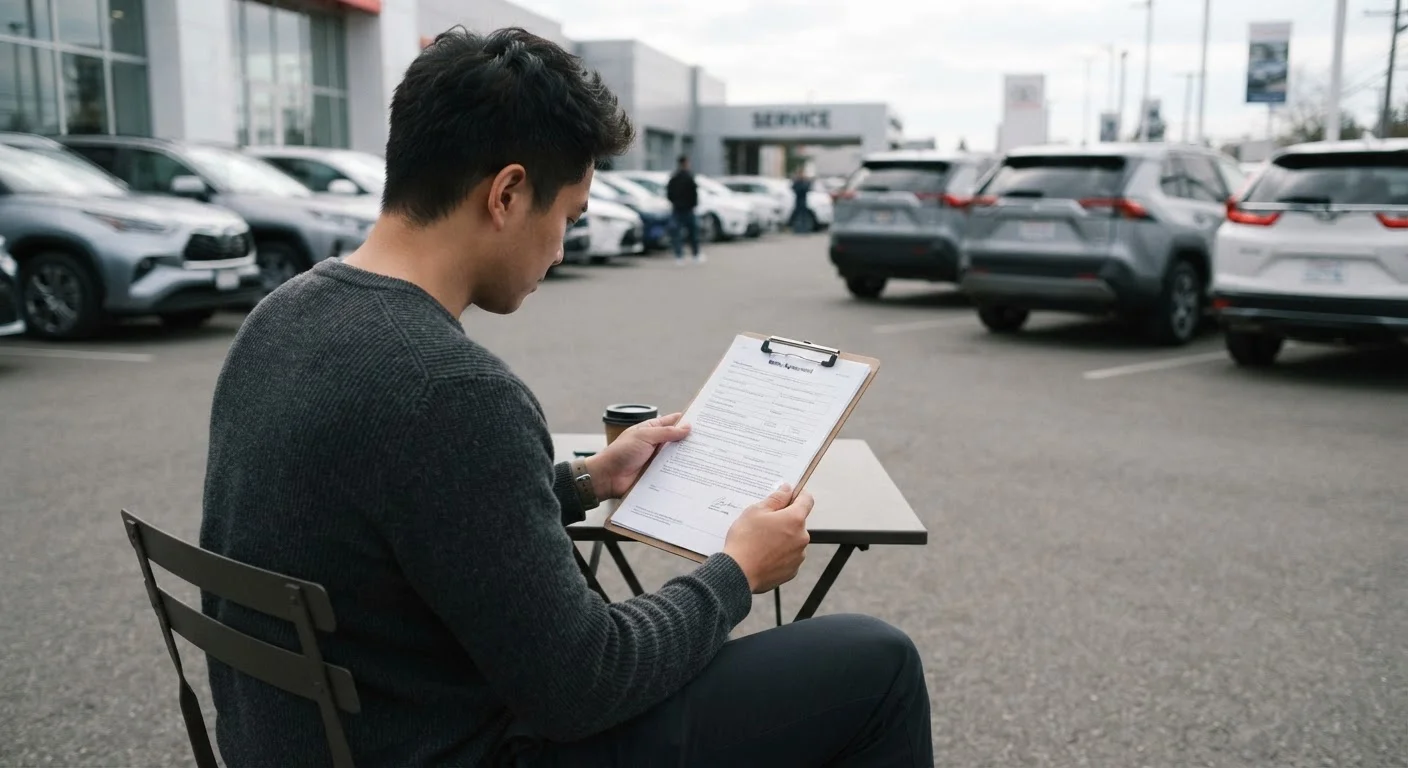
Verify the asking price against at least two independent market data sources before negotiating.
A vehicle history report and independent mechanical inspection are non-negotiable steps for used car buyers.
All fees — not just the sticker price — determine whether a deal is genuinely fair.
Financing terms secured before you arrive at the dealership give you a concrete benchmark to compare against.
Private-party and dealer transactions carry different documentation requirements — know what each demands.
Use this checklist to verify pricing, condition, documentation, and financing before committing to a used car purchase. Covers private and dealer transactions.
Why You Need a Deal Assessment Checklist
Most buyers focus on the sticker price and miss the full picture of what a used car deal actually costs. Fees, financing markups, undisclosed mechanical issues, and incomplete paperwork can erode a seemingly good deal quickly. This checklist gives you a structured way to evaluate every material factor — price, condition, history, and financing — before you put money on the table.
Whether you're buying from a private seller or a franchised dealer, the verification steps are largely the same. The documentation and fee structures differ, which is why this checklist separates those where needed. For a broader walkthrough of the full purchase process, see Understanding Used Car Deals from Start to Finish.
Pricing Verification
Pull market value estimates from at least two independent sources (such as Kelley Blue Book and NADA Guides) for the exact year, trim, mileage, and condition of the vehicle.Must
Compare the asking price to at least three similar active listings in your local market to confirm the price is competitive.Must
Account for mileage deviation — vehicles significantly above or below average annual mileage (roughly 12,000–15,000 miles/year) should reflect a corresponding price adjustment.Should
Calculate total out-of-pocket cost including taxes, title, registration, and dealer fees — not just the sticker price.Must
Vehicle History
Obtain a vehicle history report using the VIN (Vehicle Identification Number) and review it for accident records, title issues, odometer discrepancies, and number of previous owners.Must
Check the title status — confirm it is clean and not branded as salvage, rebuilt, flood, or lemon law buyback.Must
Verify odometer readings in the history report align with the current dashboard reading and service records.Must
Confirm the vehicle has not been listed as stolen by running the VIN through the National Insurance Crime Bureau (NICB) free lookup tool.Should
Mechanical Condition
Arrange an independent pre-purchase inspection (PPI) with a licensed mechanic of your choosing — not one recommended by the seller.Must
Test-drive the vehicle under varied conditions: city speeds, highway speeds, and at least one full stop from 40+ mph to check brakes.Must
Check for active or pending recall notices using the NHTSA recall lookup tool at nhtsa.gov with the vehicle's VIN.Should
Review available service records to confirm scheduled maintenance (oil changes, timing belt, brake service) has been performed.Should
Inspect tires for tread depth, uneven wear patterns, and matching brands across all four positions.Nice to have
Documentation Review
Confirm the seller's name on the title matches their government-issued ID exactly — for dealer transactions, verify the dealership's name and license number.Must
For private-party sales, obtain a bill of sale that includes vehicle description, VIN, agreed price, sale date, and both parties' signatures.Must
Review the buyer's order at a dealer for all itemized fees and ensure no previously undisclosed charges appear on the final contract.Must
Confirm any verbal promises (remaining warranty coverage, agreed repairs, included accessories) are written into the contract before signing.Should
Financing Readiness
Obtain a pre-approval from a bank or credit union before visiting the dealer so you have a baseline APR to compare against dealer-offered financing.Should
Calculate your maximum affordable monthly payment independently using the loan amount, your pre-approved rate, and your desired loan term — do not let the dealer anchor your budget to monthly payment alone.Must
Review the full loan agreement for the APR, total finance charge, prepayment penalty clauses, and any mandatory add-on products bundled into the loan.Must
Confirm the loan terms offered by the dealer do not extend beyond what the vehicle's remaining useful life reasonably supports.Nice to have
Tools You'll Need Before You Start
Running through this checklist efficiently requires a few resources in hand. Gather these before visiting a seller or dealership — some checks should be completed before you even schedule an appointment.
Required
Vehicle History Report Service
Pull a comprehensive history report using the VIN to check for accidents, title brands, and odometer issues.
Required
Market Valuation Tools (e.g., Kelley Blue Book, NADA Guides)
Establish an independent market value range for the specific vehicle based on year, trim, mileage, and condition.
Required
NHTSA Recall Lookup (nhtsa.gov)
Check for open safety recalls tied to the vehicle's VIN at no cost.
Required
NICB VINCheck Tool
Verify the vehicle has not been reported as stolen or salvaged through the National Insurance Crime Bureau's free VIN lookup.
Required
Independent Licensed Mechanic
Conduct a pre-purchase inspection to identify mechanical issues not visible during a standard test drive.
Optional
Pre-Approved Loan Offer
Provides a concrete APR benchmark from your own bank or credit union to compare against any financing the dealer presents.
The out-of-pocket cost of a used car deal routinely runs several hundred dollars above the advertised price once documentation fees, title transfer charges, registration, and optional add-ons are factored in. Some of these fees are legitimate and regulated by state law; others are discretionary and negotiable.
Watch for Fees Added After Negotiation
Some dealers add discretionary charges — such as dealer prep, market adjustment, or VIN etching fees — to the buyer's order after a price has been verbally agreed. Always request a complete itemized breakdown of the buyer's order before finalizing the sales price. Any fee that wasn't part of your negotiated deal is worth questioning directly.
Before you finalize any deal, itemize every line on the buyer's order and question charges that aren't explained. For a detailed breakdown of which fees are standard and which warrant pushback, see The Real Cost of a Used Car Deal: What Fees Are Normal and What to Question. Once you've confirmed pricing and condition, you're ready to move into the negotiation and contract phase — the Negotiation & Paperwork hub covers that process in full.
This article provides general educational information about used car purchasing. It is not personalized financial, legal, or mechanical advice. Consult a qualified mechanic, financial advisor, or attorney for guidance specific to your situation.
The content provided on our blog site traverses numerous categories, offering readers valuable and practical information. Readers can use the editorial team’s research and data to gain more insights into their topics of interest. However, they are requested not to treat the articles as conclusive. The website team cannot be held responsible for differences in data or inaccuracies found across other platforms. Please also note that the site might also miss out on various schemes and offers available that the readers may find more beneficial than the ones we cover.