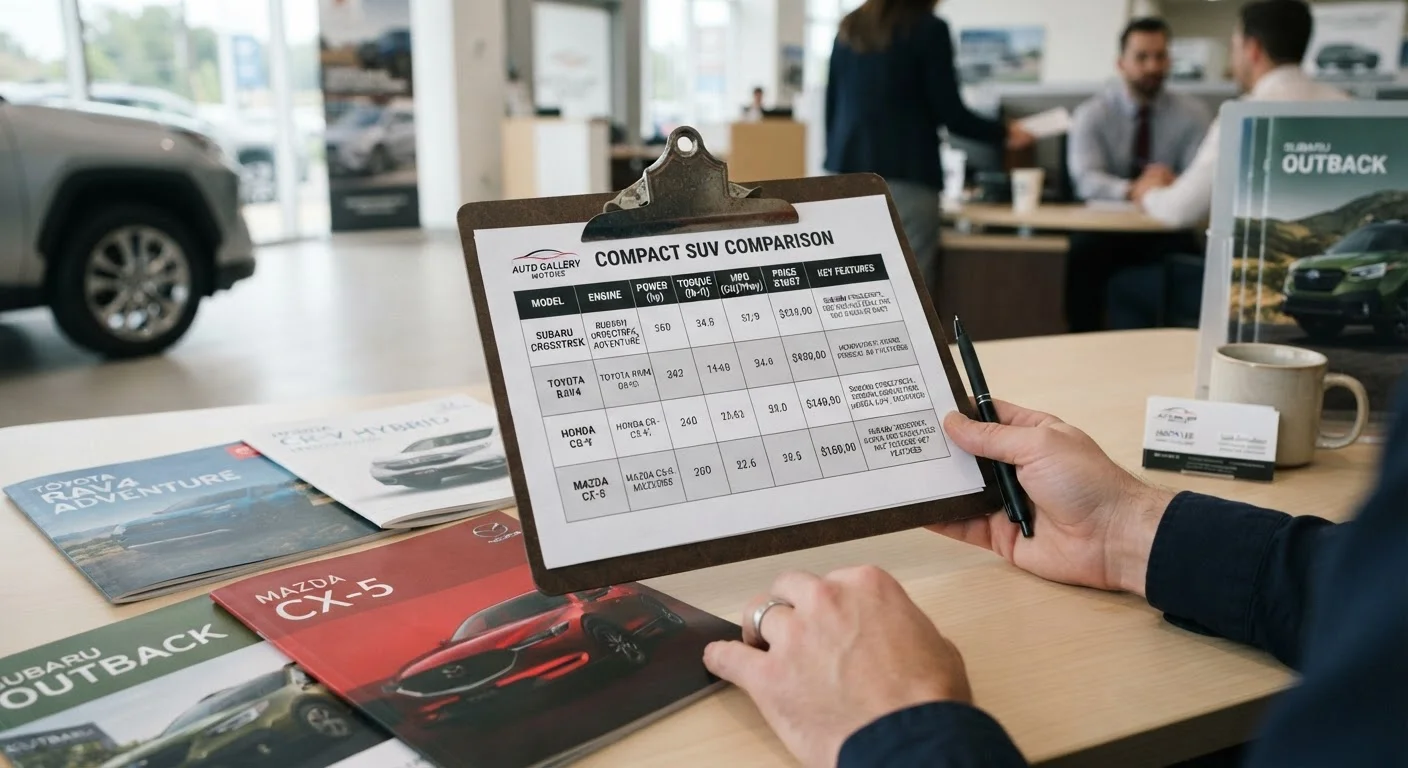
Why Spec Sheets Matter When Comparing Cars
When you pull up a side-by-side vehicle comparison - whether on a manufacturer's website, a consumer review platform, or a dealer's inventory page - you'll encounter rows of numbers and abbreviations that can feel overwhelming. Torque, wheelbase, GVWR, payload, combined MPG: each figure tells you something specific about how a vehicle performs, fits, and functions in everyday use.
This glossary organizes those terms into logical categories so you can use them as a practical decision-making tool, not just a data dump. For a parallel reference on powertrain-specific language, see Powertrain Terminology. If you're also comparing financing options, our Auto Loan Glossary covers the financial side.
Horsepower (hp)
A measure of an engine's power output - specifically, the rate at which it can do work. Higher horsepower generally correlates with higher top-end speed and quicker acceleration.
Torque (lb-ft)
The rotational force an engine produces, measured in pound-feet. High torque at low engine speeds means the vehicle feels strong off the line and can tow or haul heavy loads more capably.
Wheelbase
The distance between the centers of the front and rear axles. A longer wheelbase typically provides a more stable, comfortable ride and more legroom for rear passengers.
GVWR
Gross Vehicle Weight Rating - the maximum safe operating weight of a fully loaded vehicle, including the vehicle itself, all passengers, fuel, and cargo. Exceeding it is unsafe and may be illegal.
Payload Rating
The maximum weight in passengers and cargo a vehicle can carry in addition to its own curb weight. It is calculated by subtracting curb weight from GVWR.
MPGe
Miles Per Gallon Equivalent - a standardized EPA metric that converts the energy in electricity (or other alternative fuels) into a gasoline-equivalent figure, enabling fair fuel-economy comparisons between conventional and electrified vehicles.
Ground Clearance
The vertical distance between the lowest structural point on a vehicle's underside and the road surface. Greater clearance helps a vehicle clear obstacles off-road or on rough terrain.
Curb Weight
The weight of a vehicle as it sits with all standard fluids filled but with no passengers or cargo on board. It serves as the baseline for calculating payload and towing capacity.
Engine and Performance Specs
These figures describe how much power a vehicle produces and how it delivers that power under real driving conditions.
- Horsepower (hp): The rate at which an engine does work. Higher horsepower generally means faster acceleration at higher speeds.
- Torque (lb-ft): Rotational force produced by the engine. High torque at low RPM translates to strong pulling power and responsive acceleration from a stop - critical for trucks and towing.
- Engine displacement (L or cc): The total volume swept by all pistons. Larger displacement often means more power, though turbocharged smaller engines can rival larger naturally aspirated ones.
- RPM (revolutions per minute): The speed at which the engine's crankshaft rotates. Peak horsepower and torque are typically quoted at a specific RPM range.
- Towing capacity: The maximum trailer weight a vehicle is rated to pull. Always verify this against your actual trailer's loaded weight.
- Payload rating: The maximum combined weight of passengers, cargo, and any equipment placed in or on the vehicle. Exceeding this figure is unsafe and may void your warranty.
For a deeper look at drivetrain configurations, visit the Performance & Drivetrain hub.
Fuel Economy and Efficiency
Fuel economy figures come from standardized EPA testing cycles and represent estimated consumption under typical conditions. Real-world results will vary based on driving style, terrain, and load.
| EPA city/highway weighting for Combined MPG | 55% city / 45% highway (U.S. Environmental Protection Agency) |
| NHTSA crash test rating scale | 1 to 5 stars (National Highway Traffic Safety Administration) |
| IIHS top safety designations | Top Safety Pick / Top Safety Pick+ (Insurance Institute for Highway Safety) |
| Cargo volume unit on spec sheets | Cubic feet (cu. ft.) (Standard across U.S. manufacturer specifications) |
| Torque unit used in U.S. spec sheets | Pound-feet (lb-ft) (SAE International standard) |
- City MPG: Estimated miles per gallon in stop-and-go urban driving, where frequent acceleration and braking reduce efficiency.
- Highway MPG: Estimated fuel economy at steady highway speeds, generally the most favorable figure.
- Combined MPG: A weighted average (55% city, 45% highway) that provides the most realistic single-number comparison between vehicles.
- MPGe (miles per gallon equivalent): Used for electric and plug-in hybrid vehicles. It converts electrical energy consumption into a gasoline-equivalent figure for easier comparison.
- Range (EV): The estimated distance an electric vehicle can travel on a full charge under EPA test conditions.
Dimensions and Capacity
These measurements determine whether a vehicle fits your garage, accommodates your passengers, and carries your cargo. They're especially useful when comparing vehicles across different body styles.
- Wheelbase: The distance between the front and rear axle centerlines. A longer wheelbase generally means a smoother ride and more interior room, but tighter turning radius.
- Overall length / width / height: Exterior envelope dimensions. Critical for garage clearance and parking.
- Curb weight: The vehicle's weight with all standard fluids and equipment but no passengers or cargo.
- GVWR (Gross Vehicle Weight Rating): The maximum allowable total weight of the vehicle, including occupants and cargo. Exceeding GVWR is a safety and legal issue.
- Cargo volume (cu. ft.): Usable storage space behind the rear seats (and with seats folded, where applicable). Measured in cubic feet.
- Passenger volume (cu. ft.): Total interior space available to occupants. A rough proxy for interior roominess.
- Ground clearance: The distance between the lowest point of the vehicle's undercarriage and the ground. Higher clearance improves off-road capability.
If you're evaluating used vehicles and encounter terms like salvage title or dealer demo on listings, our Used Car Terminology Glossary defines those as well.
Safety Ratings and Technology Terms
Safety specs appear in two forms: crash-test ratings from independent agencies and active-safety system labels printed on window stickers.
- NHTSA Overall Safety Rating: Star ratings (1-5) assigned by the National Highway Traffic Safety Administration based on crash test performance.
- IIHS ratings: Evaluations from the Insurance Institute for Highway Safety, using categories like Good, Acceptable, Marginal, and Poor. Top Safety Pick and Top Safety Pick+ are the highest designations.
- ADAS (Advanced Driver-Assistance Systems): The umbrella term for semi-automated safety features such as automatic emergency braking, lane-keeping assist, and blind-spot monitoring. For a full acronym reference, see our ADAS Glossary.
Connectivity specs - Bluetooth profiles, USB-C, and in-car Wi-Fi - are detailed in our Car Connectivity Glossary, and broader feature explanations live in the Car Features Explained hub.
This article provides general educational information about vehicle specifications. Always verify figures with the manufacturer or a qualified automotive professional for your specific situation.