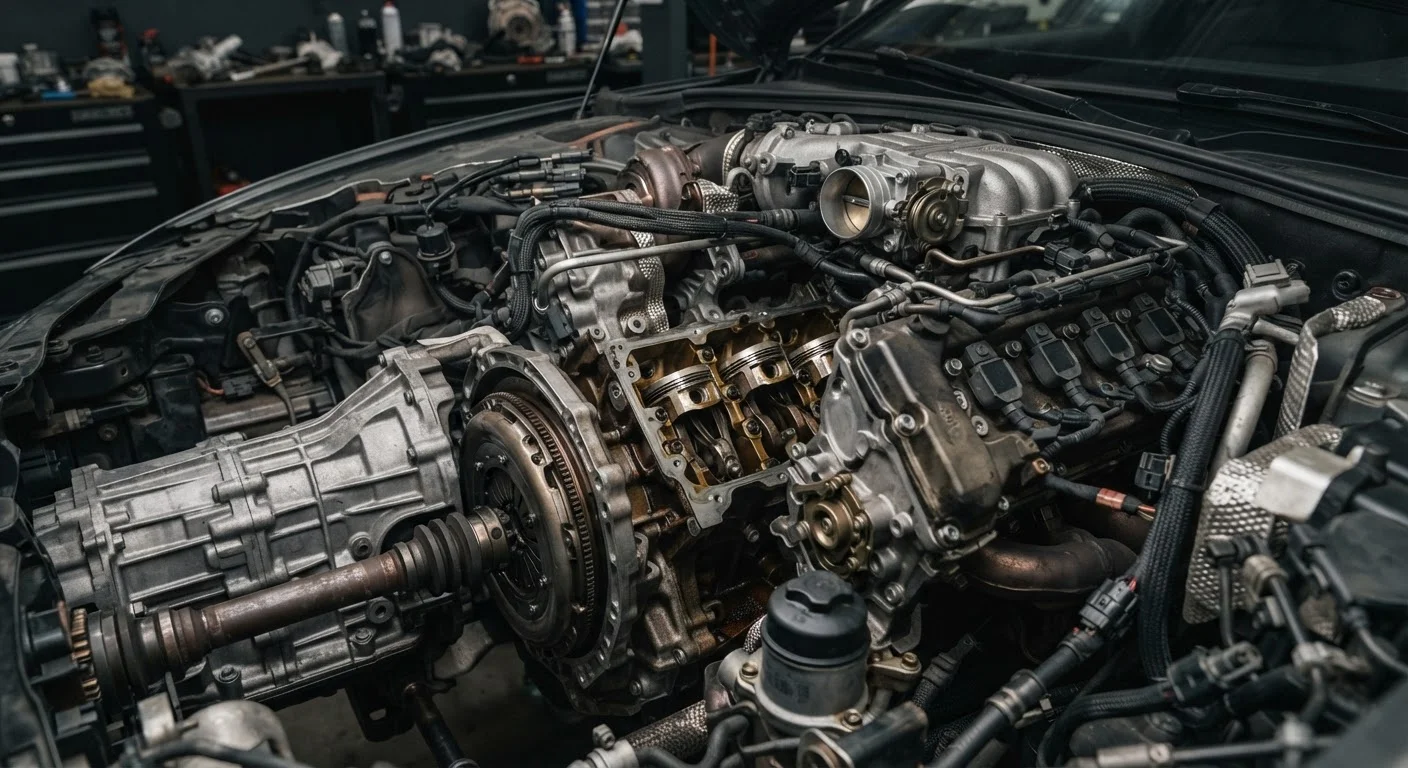
Engine Fundamentals: What the Numbers Actually Mean
When a spec sheet lists a "2.5L four-cylinder," it is describing the engine's displacement — the combined swept volume of all cylinders — and its cylinder count. More cylinders generally means smoother power delivery; larger displacement typically means more available power. But neither number tells the whole story.
Bore and stroke describe each cylinder's geometry. A wide bore allows larger valves and higher airflow, favoring peak power at high RPM — common in sports-oriented engines. A long stroke squeezes more energy from each combustion cycle, producing stronger torque at lower RPM, which suits trucks and family haulers. You rarely see these figures on window stickers, but they explain why two similarly sized engines can feel very different to drive.
Compression ratio measures how tightly the air-fuel mixture is squeezed before ignition. Higher ratios (e.g., 12:1) extract more energy from each combustion cycle and generally improve efficiency, but they typically require premium-grade fuel. Always check the owner's manual specification — using regular fuel in an engine requiring premium can reduce power and, over time, potentially harm engine components.
For a broader look at spec sheet language, see the Spec Sheet Glossary covering every term you'll encounter when comparing vehicles.
Power Output, Forced Induction, and Transmissions
Horsepower and torque are the two figures buyers encounter most. Horsepower governs top-end performance and is most relevant at highway speeds. Torque — measured in pound-feet (lb-ft) in the US — determines how powerfully the engine responds at lower speeds, which is what you feel during everyday acceleration, merging, or towing.
Horsepower vs. Torque: A Practical Note
Advertisers often emphasize peak horsepower figures, but for everyday driving — merging, towing, or climbing grades — torque and the RPM at which it arrives matter just as much. When comparing vehicles, check both the peak value and the RPM it occurs at. A truck rated at 400 lb-ft of torque at 1,600 RPM will feel far more responsive off the line than one that makes its peak torque at 5,000 RPM.
Naturally aspirated engines draw air using only atmospheric pressure. Turbocharged engines use exhaust-driven compressors to force more air into the cylinders, allowing smaller-displacement engines to produce power rivaling larger ones — often with better fuel economy under light throttle. A supercharger does the same job but is driven directly by the engine's crankshaft, providing nearly instant boost response without the slight delay (called turbo lag) that some turbocharged engines exhibit.
Transmission type shapes how an engine's power reaches the wheels. A dual-clutch transmission (DCT) uses two separate clutch packs to pre-select the next gear, enabling very fast, seamless shifts. A CVT eliminates fixed gear steps entirely, keeping the engine in its most efficient RPM range. Traditional stepped automatic transmissions (6- to 10-speed units on most modern vehicles) balance shift quality and efficiency. If you're weighing electrified options, our hybrid and EV powertrain breakdown explains how electric motors change the equation.
| Common engine displacement range (passenger cars) | 1.0L – 4.0L |
| Standard torque unit (US) | Pound-feet (lb-ft) |
| Typical automatic transmission speeds (modern vehicles) | 6 to 10 speeds |
| Compression ratio range (naturally aspirated engines) | 9:1 – 13:1 |
| Turbocharged engine benefit | More power from smaller displacement |
| CVT fuel economy advantage | Generally higher EPA ratings vs. stepped automatics |
Powertrain specs also interact with the drivetrain layout — how power is distributed to the wheels. For a clear explanation of that relationship, see AWD, 4WD, FWD, and RWD explained.