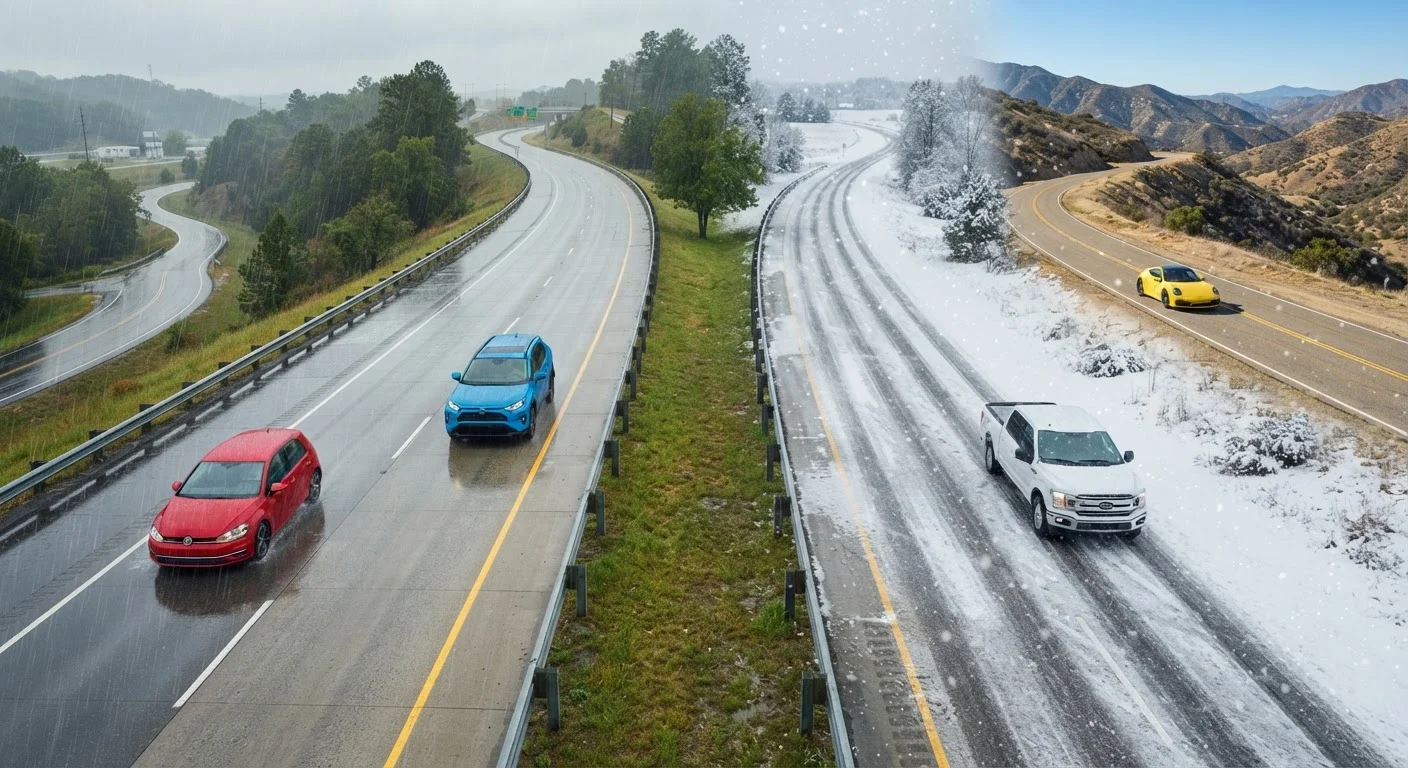
Front-Wheel Drive (FWD): The Everyday Workhorse
Front-wheel drive sends engine power exclusively to the front wheels, which also steer the vehicle. It is the dominant layout in compact cars, minivans, and many crossovers because it packages efficiently - the engine, transmission, and driven axle occupy one compact space at the front, freeing up floor space inside the cabin.
In daily driving, FWD feels intuitive and predictable. Acceleration traction is reasonable in light rain and moderate snow because the weight of the engine sits directly over the driven wheels. The main handling trade-off is understeer: when cornering hard, the front wheels can run wide rather than tracking the intended line. This rarely surfaces in normal commuting but is worth understanding.
FWD is generally the most fuel-efficient and least expensive drivetrain to produce and maintain, making it a practical default for buyers who primarily drive on paved roads. If you want to understand how FWD interacts with your transmission choice, see how different transmission types pair with each drivetrain.
Rear-Wheel Drive (RWD): Balance and Performance
Rear-wheel drive sends power to the back axle while the front wheels steer freely. This separation of duties allows for a more balanced weight distribution between front and rear - typically near the engineering ideal of 50/50 - which is why RWD remains the standard layout for sports cars, performance sedans, and most full-size trucks and body-on-frame SUVs.
On dry pavement, RWD feels naturally responsive. Acceleration loads the rear, which pushes the car forward cleanly. In slippery conditions, the rear can step out if power is applied too aggressively - a characteristic called oversteer. Modern stability control systems intervene quickly, but drivers should be aware that RWD demands slightly more attentiveness in snow or ice.
RWD is also the foundation of most 4WD systems, since adding a front driveshaft to a rear-driven platform is the conventional route to four-wheel capability.
Winter Tires Matter More Than Drivetrain
If you live in a region with genuine winter weather, investing in a dedicated set of winter tires will improve your safety and control more than upgrading from FWD to AWD. AWD helps you accelerate on slippery surfaces but does nothing to shorten your braking distance. Winter tires improve grip in all phases of driving - acceleration, braking, and cornering.
All-Wheel Drive (AWD): Automatic Traction Management
All-wheel drive powers all four wheels, but unlike traditional 4WD, it operates automatically without the driver selecting a mode. Sensors monitor wheel slip, steering input, and throttle application continuously. When the system detects that one axle is losing grip, it redirects torque to the axle with more traction - often in milliseconds.
This makes AWD genuinely useful in wet, snowy, or slippery conditions where traction varies unpredictably. It is the standard choice in most crossovers and SUVs and is increasingly available on sedans and wagons. The trade-off is a moderate increase in fuel consumption and purchase price compared to a comparable FWD or RWD model.
It is important to note that AWD helps with acceleration traction but does not improve braking or cornering grip. A vehicle cannot stop faster or corner more sharply simply because all four wheels are driven. For a closer look at how different AWD systems vary between vehicles, the article on SUV all-wheel drive systems covers the distinctions in plain terms.
~40%
Share of new US vehicles sold with AWD or 4WD
Industry sales data indicates that nearly four in ten new vehicles sold in the US include all-wheel or four-wheel drive as standard or optional equipment, reflecting strong consumer demand for traction confidence.
1-3 MPG
Typical fuel economy penalty for AWD vs FWD
Automotive testing sources consistently document a one-to-three mile-per-gallon reduction when comparing AWD and FWD versions of the same model, though this varies by vehicle weight and AWD system design.
Up to 25%
Braking distance improvement from winter tires vs all-seasons
Tire industry testing has shown that winter tires can reduce stopping distances on snow and ice by up to 25% compared to all-season tires, underscoring that tire selection has a larger safety impact than drivetrain choice alone.
Four-Wheel Drive (4WD): Serious Off-Road and Heavy-Duty Capability
Four-wheel drive traditionally uses a transfer case - a separate gearbox - to mechanically lock the front and rear axles together so they spin at the same rate. This rigid coupling maximizes traction in extreme conditions: deep mud, steep rocky terrain, or heavy towing on unstable surfaces.
Most 4WD systems offer at least two modes. 4H (four-high) is used on slippery paved roads or light off-road surfaces at moderate speeds. 4L (four-low) provides maximum pulling force at very low speeds for the most demanding terrain. Engaging 4WD on dry, hard pavement can stress drivetrain components because the locked axles cannot accommodate the speed difference between inside and outside wheels during turns - a condition called driveline bind.
Buyers who primarily drive on paved roads rarely need true 4WD capability. If you are comparing 4WD and AWD specifically, the AWD vs 4WD breakdown provides a detailed look at when each system is actually engaged and what that means for capability and cost.
Choosing the Right Drivetrain for Your Situation
The right drivetrain depends on where and how you drive, not on which configuration sounds most capable on a spec sheet. A few practical questions help frame the decision:
- Do you drive primarily on paved roads in a mild climate? FWD offers the best value with minimal trade-offs.
- Is handling balance or performance a priority? RWD delivers a more engaging driving character and suits larger vehicles designed around it.
- Do you encounter regular rain, snow, or unpredictable road surfaces? AWD provides automatic traction management without driver intervention.
- Do you off-road, tow heavy loads on variable terrain, or need maximum low-speed pulling power? 4WD is built for those demands.
Keep in mind that tire choice interacts heavily with drivetrain. A FWD vehicle on dedicated winter tires routinely outperforms an AWD vehicle on worn all-season tires in snow. No drivetrain overcomes inadequate tires. For broader context on powertrain terminology encountered during car shopping, the plain-language powertrain reference is a helpful companion resource. You can also explore how your drivetrain interacts with drive mode settings in the guide to drive modes explained.