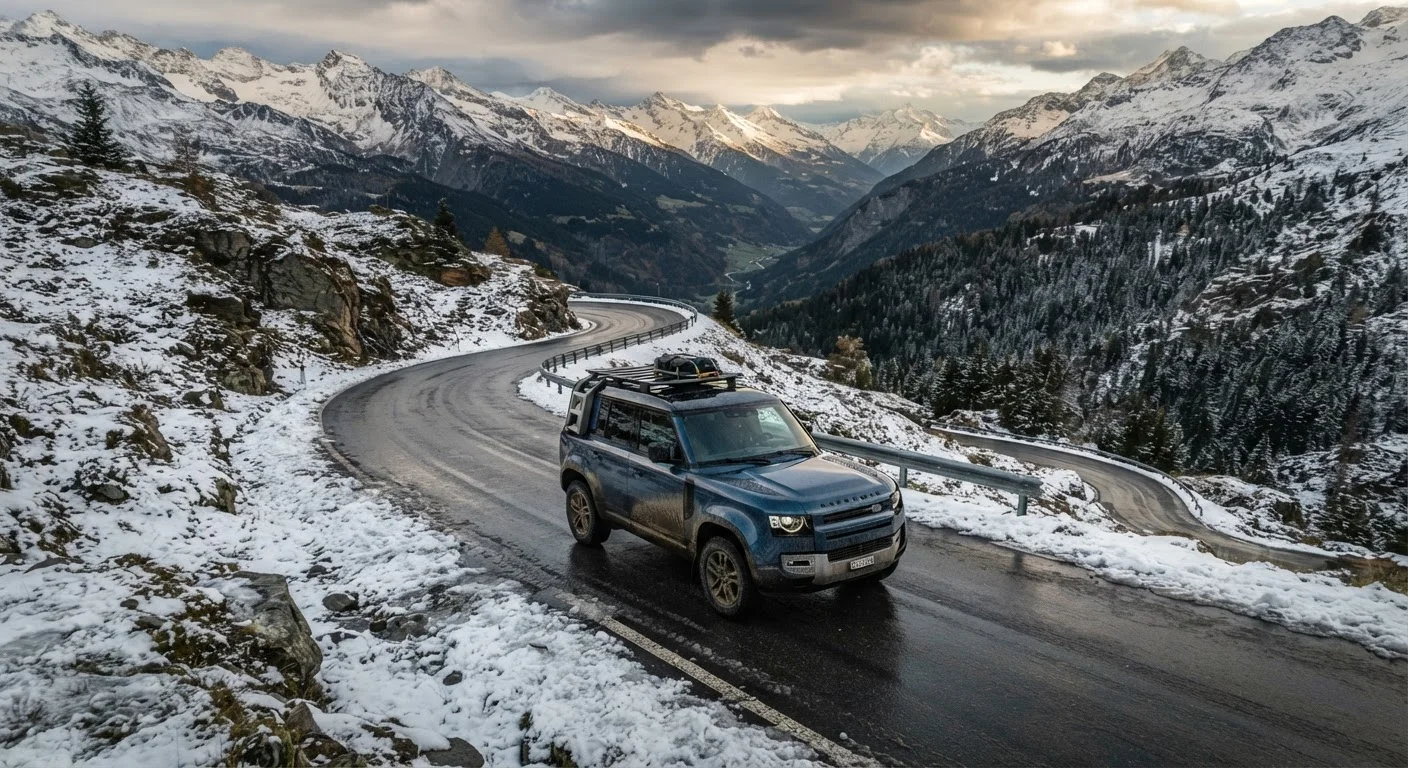
Three Systems, Three Different Jobs
Walk into any SUV showroom and you'll see window stickers touting AWD or 4WD as a headline feature. But those labels cover meaningfully different technologies - and choosing without understanding them can leave you paying for capability you don't need, or lacking the traction you actually do. The drivetrain category breaks into three main configurations worth knowing before you shop.
Full-time AWD routes power to all four wheels at all times. A center differential manages torque split between front and rear axles continuously. This design is seamless and requires zero driver involvement - it's the system you'll find on many car-based crossovers. The trade-off is a constant, modest fuel economy penalty versus two-wheel drive.
Part-time 4WD is the traditional truck-derived setup. In normal conditions, the vehicle runs in two-wheel drive. The driver manually shifts into 4WD High or 4WD Low when conditions demand it - think mud, sand, deep snow, or rock crawling. Low range multiplies torque dramatically for slow-speed obstacles. This system is mechanically robust but not designed for dry pavement in 4WD mode.
On-demand AWD splits the difference. The vehicle defaults to front- or rear-wheel drive for efficiency, then automatically engages the opposite axle when sensors detect wheel slip. Response is fast - typically within milliseconds - but the system is optimized for light off-pavement use rather than sustained off-road stress.
How Each System Performs in the Real World
Understanding the hardware is useful; knowing how it translates to daily driving is what actually matters when you're comparing vehicles.
In rain and light snow, all three systems perform well, though on-demand AWD occasionally introduces a brief delay before the second axle engages - usually imperceptible, but present. Full-time AWD has no delay because all four wheels are always driven. For commuters in northern climates, either option handles ordinary winter roads capably, provided the tires are appropriate for the season. AWD does not improve braking or cornering grip on ice; it only helps with acceleration traction. See our article on traction and stability control for how those separate systems interact with your drivetrain.
In deep snow, mud, or sand, part-time 4WD Low range offers a mechanical advantage no AWD system can replicate. The torque multiplication in Low range allows very slow, controlled movement over obstacles without spinning wheels. Buyers who need genuine off-road capability - trail driving, towing through fields, or rural terrain - should weigh this seriously. This connects directly to the broader question of body-on-frame versus unibody construction, since body-on-frame trucks more commonly carry the part-time 4WD setup.
Tires Matter More Than Drivetrain
AWD and 4WD improve how power reaches the road, but they cannot improve braking or cornering grip. A vehicle with all-season tires in AWD will stop longer on ice than the same vehicle fitted with winter tires in two-wheel drive. Before upgrading to a more capable drivetrain, ensure your tire choice is appropriate for your climate - it often delivers a greater safety return per dollar.
For an extended side-by-side look at these configurations, the dedicated AWD vs. 4WD breakdown covers running costs, limitations, and real-world use cases in more depth.
What to Consider When Comparing SUVs
The right drivetrain depends on your actual driving conditions - not the worst-case scenario you imagine. Most buyers in urban and suburban environments who face occasional snow or rain get sufficient traction from a good on-demand AWD system paired with all-season or winter tires. Upgrading to full-time AWD adds refinement and minor traction improvements; upgrading to part-time 4WD only makes sense if you genuinely drive off-road or tow in challenging terrain regularly.
1-3 mpg
Typical AWD fuel economy penalty vs. FWD
A commonly cited estimate across automotive engineering literature when comparing same-model AWD and front-wheel-drive variants.
~100ms
Typical on-demand AWD engagement time
Electronically controlled clutch-pack systems on modern on-demand AWD vehicles engage the second axle within roughly 100 milliseconds of detected slip.
Fuel economy is a real cost to weigh. AWD versions of a given SUV typically return 1-3 mpg less than their front-wheel-drive counterparts, which adds up meaningfully over 15,000 annual miles. On-demand systems narrow that gap but don't eliminate it.
During a test drive, pay attention to how the vehicle feels when the system transitions - some on-demand setups produce a subtle lurch when the rear axle engages. Ride quality and suspension tuning also shape how traction systems interact with road feel; our guide on evaluating SUV ride quality covers what to notice on a test drive. For a broader look at how SUV body styles affect practicality, the SUV body style guide pairs well with this article.