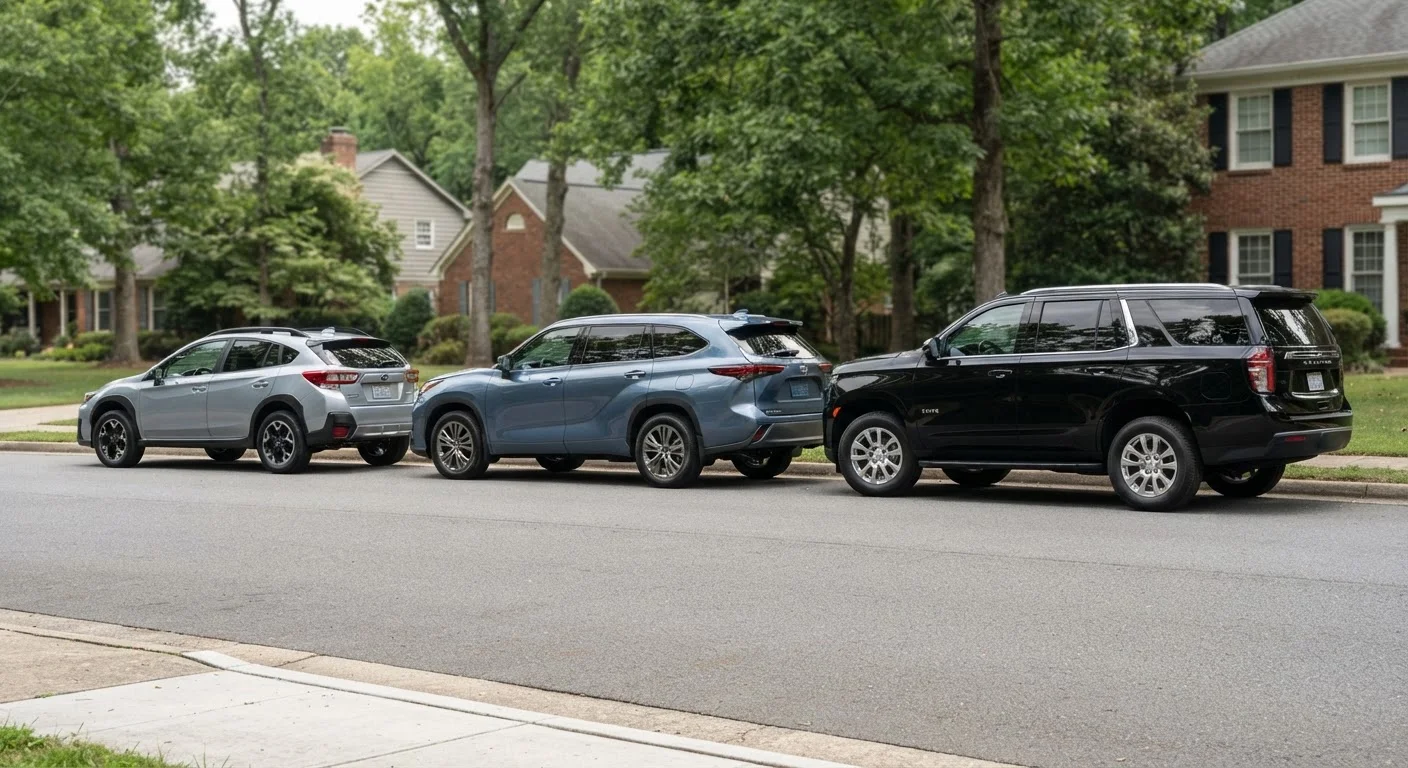
The Crossover: Car Comfort in an SUV Shape
The crossover - sometimes called a CUV - is built on a unibody platform borrowed from passenger cars rather than a truck frame. That construction choice has real consequences for daily driving. Crossovers sit lower to the ground than traditional SUVs, which makes them easier to load, simpler to park, and noticeably more settled at highway speeds.
Ride quality is typically the crossover's strongest daily-driving asset. The car-derived suspension absorbs road irregularities with less harshness than body-on-frame alternatives, and the lower center of gravity reduces the rolling sensation that larger SUVs produce in corners. Fuel economy also benefits - a compact crossover averaging 28-32 mpg combined covers meaningfully more ground per tank than a full-size rig.
The trade-off is capacity. Crossovers offer less towing ability and, in smaller configurations, tighter cargo floors. If your driving involves heavy hauling, a crossover's limitations will show up quickly. For commuting, school runs, and weekend trips, however, the crossover body style often provides the most practical balance of comfort, efficiency, and maneuverability. How unibody construction shapes the drive explains these platform differences in greater depth.
Mid-Size SUVs: Where Space and Usability Converge
Mid-size SUVs occupy the most versatile position in the segment. They offer genuine rear-seat legroom for adults, cargo areas measured in dozens of cubic feet rather than a handful, and - on body-on-frame models - tow ratings that support boats, campers, and utility trailers.
Daily drivability in a mid-size SUV depends heavily on platform. Unibody mid-sizers ride more like oversized crossovers - composed and quiet on pavement. Body-on-frame mid-size SUVs trade some ride refinement for higher payload and off-road capability, though modern independent rear suspension has narrowed that gap considerably.
Parking is where mid-size SUVs ask the most of drivers. Overall lengths often range from 188 to 200 inches, meaning urban parking requires more deliberate maneuvering than a compact crossover. That said, most drivers adapt quickly, and available surround-view camera systems on many trims reduce the adjustment period. For buyers weighing this category against a smaller vehicle, the practical differences between compact and mid-size SUVs go well beyond what specs alone reveal.
~1,000 lbs
Typical weight gap between compact and full-size SUVs
The curb weight difference between a compact crossover and a full-size body-on-frame SUV is often 1,000 lbs or more, directly impacting fuel economy and handling.
28-32 mpg
Typical combined fuel economy for compact crossovers
EPA combined estimates for popular compact crossovers frequently land in this range, versus the high-teens for full-size body-on-frame models.
8,000+ lbs
Maximum tow rating for full-size body-on-frame SUVs
Many full-size SUVs with properly equipped V8 or turbocharged engines are rated to tow 8,000-8,500 lbs, depending on trim and axle ratio.
Full-Size SUVs: Maximum Room, Real Trade-Offs
Full-size SUVs - typically body-on-frame vehicles stretching beyond 200 inches - offer the most interior volume available in the segment. A genuine third row with adult-usable legroom, cargo capacity behind the third row, and tow ratings that can exceed 8,000 lbs are the headline capabilities that distinguish this class.
In daily driving, that scale carries costs. Fuel economy typically falls into the high-teens to low-20s in combined driving. Turning circles widen, and multi-level parking structures can become impractical depending on ceiling clearance. On open roads and highways, however, full-size SUVs can feel surprisingly composed - long wheelbases absorb expansion joints and road imperfections in ways that shorter vehicles cannot replicate.
The ride experience varies considerably between trims. Base suspension tuning tends toward firm utility, while air-suspension options on upper trims can transform highway comfort substantially. Before committing to a full-size body style, evaluating ride quality on a test drive will help identify which trim level suits your actual roads.
Matching Body Style to How You Actually Drive
The most useful frame for choosing an SUV body style is your real daily route - not an idealized version of it. Urban commuters who occasionally take road trips will find the crossover's fuel efficiency and parking ease outweigh any cargo shortfall. Families managing sports equipment, multiple passengers, and occasional towing are genuinely served by a mid-size SUV's capacity. Those who need maximum people-hauling or regularly tow heavy loads have legitimate reasons to accept a full-size SUV's fuel and maneuverability costs.
Drivetrain choice intersects with body style in ways that also affect daily utility. AWD systems vary significantly across SUV classes, and the type of system fitted to a given body style affects how the vehicle performs in rain and snow - not just off-road. For buyers still deciding between an SUV and another vehicle type altogether, matching body style to your life provides a broader comparison across cargo space, running costs, and family use.
Ultimately, the right SUV body style isn't the largest one available - it's the one whose dimensions, economy, and capability align with the driving you actually do five days a week.