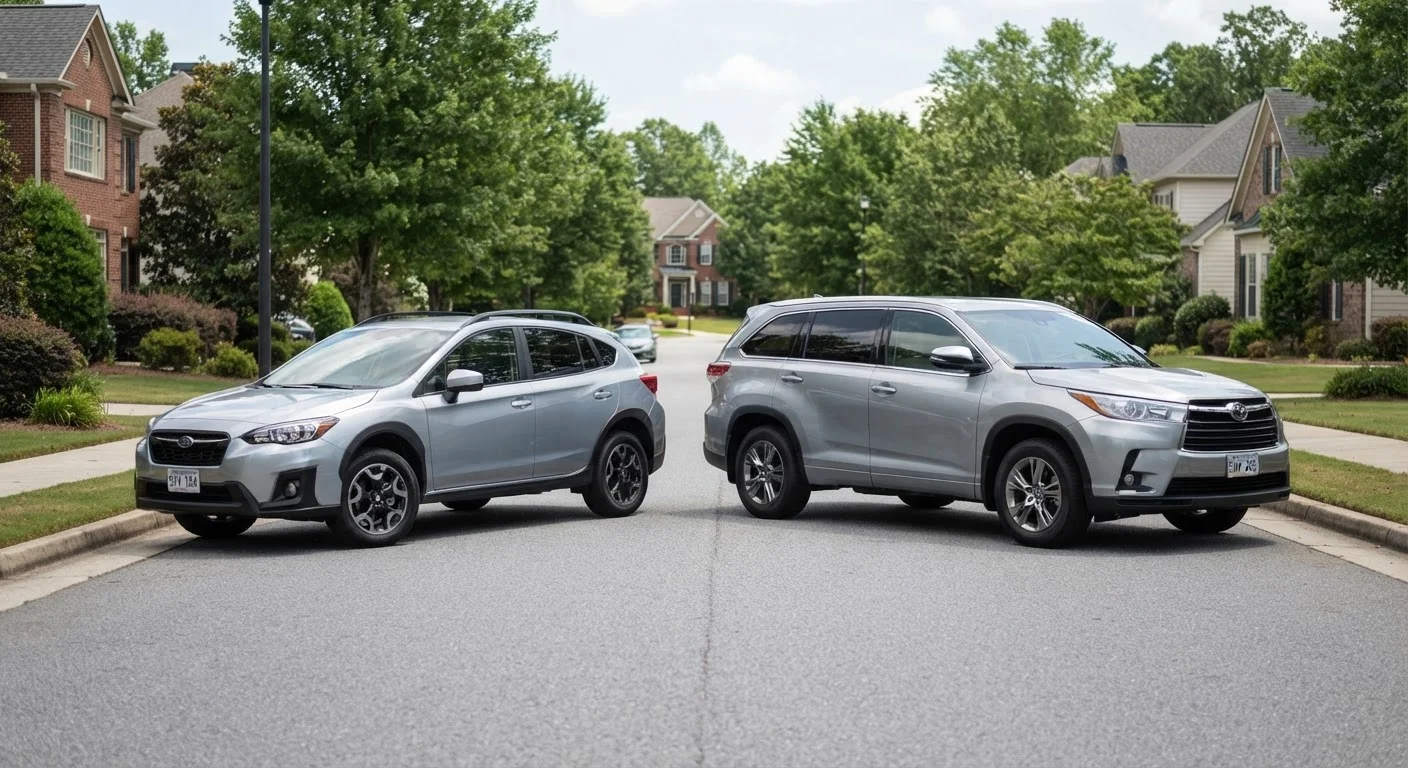
Why the Segment Label Doesn't Tell the Whole Story
Most buyers approach the compact-versus-mid-size decision by glancing at cargo volume figures on a spec sheet. That approach misses the practical nuances that surface after the first month of ownership. Both segments are built on car-based platforms (commonly called crossovers), share similar feature sets at equivalent trim levels, and often look nearly identical from the outside. The differences that actually shape daily life - passenger space, driving dynamics, parking footprint, and running costs - require a closer look.
For broader context on how SUV body styles relate to real-world use, see what SUV body styles mean for daily driving.
| Compact SUV | Mid-Size SUV | |
|---|---|---|
| Typical Wheelbase | 103-108 inches | 112-116 inches |
| Second-Row Legroom | 36-38 inches | 39-41 inches |
| Cargo (behind 2nd row) | 26-32 cu ft | 36-40 cu ft |
| Combined Fuel Economy | 27-32 mpg | 22-27 mpg |
| Typical Tow Rating | 1,500-2,000 lbs | 3,500-5,000 lbs |
| Overall Length | 174-183 inches | 188-198 inches |
| Base Price Range | $28,000-$36,000 | $33,000-$45,000 |
Interior Space: Where the Gap Is Real and Where It Isn't
The most meaningful space difference lives behind the front seats. Mid-size SUVs typically carry wheelbases in the 112-116 inch range; compact models generally fall between 103-108 inches. Those extra inches feed directly into second-row legroom, where mid-size models commonly offer 39-41 inches compared to 36-38 inches in compact SUVs. For adult rear passengers on trips longer than 30 minutes, that spread is noticeable.
Cargo volume tells a more nuanced story. Behind the second row - the measurement that reflects everyday loading - mid-size models average around 36-40 cubic feet versus 26-32 cubic feet for compact SUVs. Maximum cargo (with rear seats folded) narrows the gap considerably, since compact SUVs trade wheelbase length for a shallower load floor that folds flatter. If you routinely haul flat, bulky items, total folded capacity is the figure to watch. The same caution about reading dimension figures applies here: as explored in our guide to reading interior and cargo dimensions accurately, manufacturer figures can reflect optimistic measurement methods.
Fuel Economy, Towing, and Running Costs
Compact SUVs typically return 27-32 mpg combined with a four-cylinder engine, while mid-size models with larger displacement engines land closer to 22-27 mpg combined. Over 15,000 miles annually, that difference can represent $400-$700 in fuel costs depending on local prices - a figure worth projecting over a five-year ownership period.
Towing capacity separates the segments meaningfully. Compact SUVs are commonly rated for 1,500-2,000 lbs, sufficient for small utility trailers or light recreational equipment. Mid-size SUVs, depending on powertrain, can be rated from 3,500 to 5,000 lbs - enough for a mid-size boat or a loaded cargo trailer. If towing is a regular need rather than an occasional one, this disparity matters far more than any interior measurement.
Insurance premiums, registration fees in states that use vehicle value as a basis, and tire replacement costs all scale with vehicle size and price. These cumulative ownership costs rarely appear in comparison articles but can add thousands of dollars over a typical ownership cycle.
Test the Second Row, Not Just the Driver's Seat
When test-driving either segment, have your tallest adult passenger sit in the rear seat directly behind their own preferred driving position. This reveals actual usable legroom rather than the best-case figure listed in manufacturer materials. Bring any car seats or cargo items you use regularly and load them during the test drive - how a vehicle fits your specific gear matters more than how it fits the average household.
Maneuverability and Parking: The Urban Tax
A compact SUV's shorter overall length - typically 174-183 inches versus 188-198 inches for mid-size models - translates to tighter turning circles and easier parallel parking. In dense urban environments or older suburban neighborhoods with narrow streets, this is a practical advantage that erodes quickly on open highways or suburban big-box parking lots where space is ample.
Buyers who split time between city driving and highway touring may find the compact SUV's urban agility an everyday convenience, while those who live in lower-density areas rarely notice the size penalty of stepping up. If your household is also weighing a sedan alternative, the trade-off logic mirrors what's covered in the compact-to-mid-size sedan step-up analysis: more space almost always means a higher operating footprint.
For buyers considering whether three rows might be the actual requirement, the trade-offs of third-row SUV seating is worth reviewing before committing to either two-row segment.