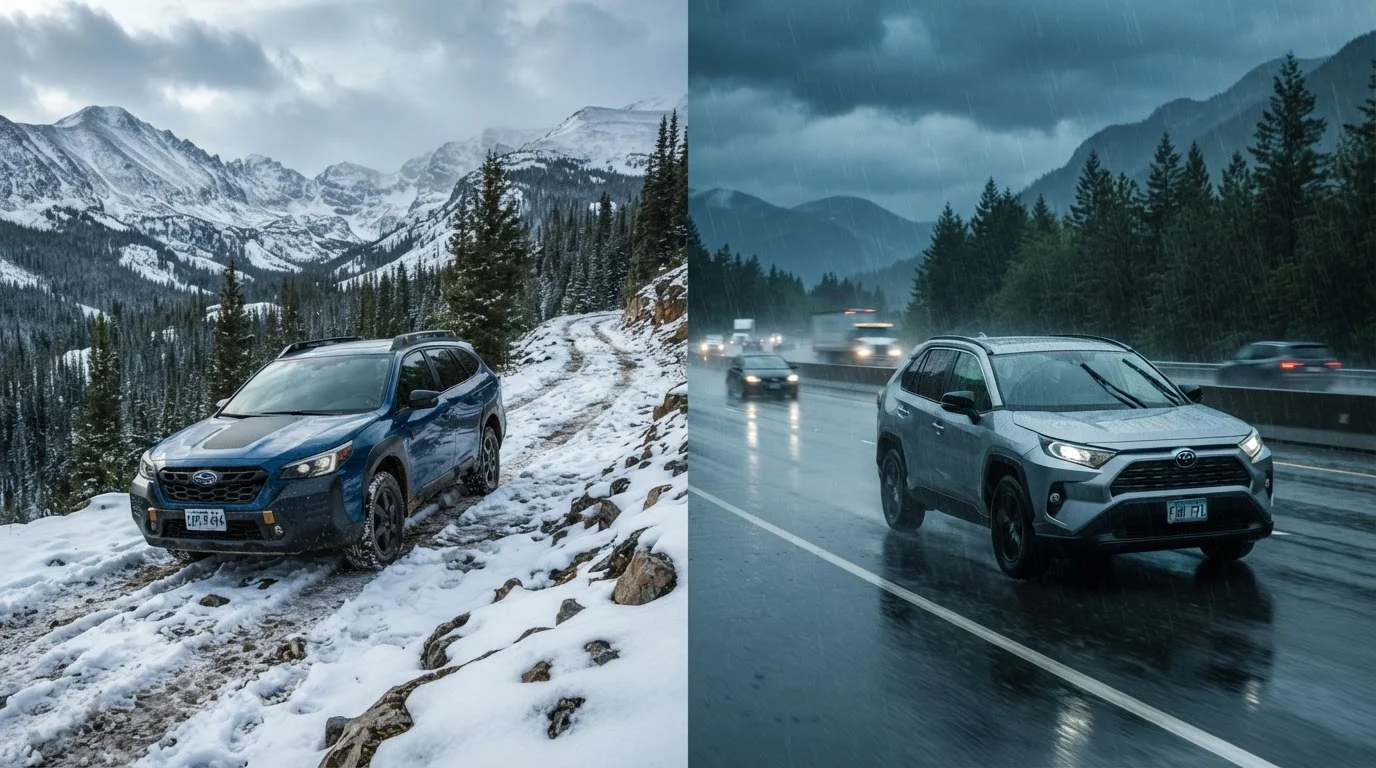
How Each System Actually Works
The confusion between AWD and 4WD is understandable - both send power to all four wheels. But when and how they do it are fundamentally different, and that distinction shapes everything from daily fuel costs to what happens when you veer off the asphalt.
AWD systems use a center differential or electronic clutch pack to continuously monitor wheel slip and redistribute torque between axles - and sometimes between individual wheels - in real time. The driver does nothing. When a rear wheel loses grip on a wet curve, the system reacts in milliseconds. Most AWD-equipped crossovers and sedans operate this way, and many are optimized primarily for on-road traction rather than off-road punishment.
4WD, by contrast, is almost always driver-selected. Turning a dial or pushing a button to engage 4WD mechanically locks the front and rear driveshafts so they rotate at the same speed. This is enormously effective in the dirt, sand, or snow - but it creates a problem on dry pavement. Because the front and rear axles can't rotate at different speeds through a turn, the drivetrain binds, causing stress on components and handling that feels unnatural. That's why 4WD should only be engaged on surfaces where wheel slip is present.
For a broader look at how drivetrain layouts affect everyday driving, see what each drivetrain actually does in everyday conditions.
| Criterion | AWD | 4WD |
|---|---|---|
| Driver engagement | Automatic - always active | Manual - driver selects when to engage |
| Best terrain | Pavement, light snow, gravel | Deep mud, rock, sand, steep grades |
| Low-range capability | Not available | Available on most 4WD systems |
| Dry pavement use | Safe at all times | 4Hi may be used with caution; 4Lo should not be used |
| Typical vehicle type | Crossovers, cars, some SUVs | Trucks, body-on-frame SUVs |
| Fuel economy impact | Moderate, continuous penalty | Smaller in 2WD mode; higher when engaged |
| System complexity | Electronic clutches, center diff | Transfer case, locking diffs |
Real-World Performance: Where Each System Earns Its Keep
On a rain-slicked highway or a snowy suburban street, AWD is genuinely valuable. It works silently, keeps all four tires contributing to forward motion, and requires no thought from the driver. That said, AWD does not improve braking - a common misconception. It only helps with acceleration and directional stability under power. Winter tires remain more important than drivetrain type for stopping distances on ice.
4WD earns its reputation in situations where AWD reaches its limits: a heavily rutted forest road, a steep gravel grade, or pulling a trailer up a soft embankment. Low-range 4WD (often labeled 4Lo) multiplies torque through a transfer case reduction, allowing the vehicle to crawl at low speeds with enormous pulling power. No AWD system replicates this. If your driving includes genuine off-road use even a few times a year, a proper 4WD system with low range is a meaningful capability, not a marketing term.
Not all AWD systems are equal either. SUV all-wheel drive systems vary considerably in how much torque they can shift and how long they can sustain it before heat becomes a limiting factor. Some crossover AWD systems will actually disengage under sustained off-road stress - a detail rarely mentioned in brochures.
100-200 lbs
Typical weight added by AWD or 4WD hardware
Engineers generally estimate all-wheel and four-wheel drive components add this range over equivalent two-wheel-drive configurations, contributing to fuel economy differences.
1-3 MPG
Typical fuel economy reduction with AWD vs. 2WD
The U.S. Department of Energy notes that AWD and 4WD vehicles generally see a reduction in fuel economy in this range compared to two-wheel-drive equivalents, though the exact figure varies by vehicle.
4Lo
Low-range gear unique to 4WD systems
Low-range 4WD multiplies torque through a transfer case reduction, allowing crawl speeds with high pulling power - a capability absent from all standard AWD systems.
Running Costs, Weight, and What You're Actually Paying For
Neither system comes free. AWD adds mechanical complexity and weight - typically 100-200 lbs depending on the design - which contributes to slightly lower fuel economy compared to an equivalent two-wheel-drive vehicle. The penalty varies by vehicle, driving style, and whether the system can partially disengage on the highway to save fuel (some modern AWD systems can).
4WD systems on truck-based vehicles are robust but add similar weight penalties. Because many part-time 4WD systems run in two-wheel drive most of the time, their day-to-day fuel economy hit is often smaller than a full-time AWD system - but the off-road hardware (transfer case, locking differentials, skid plates) adds to the vehicle's base cost and purchase price.
Maintenance is another consideration. AWD systems require periodic differential fluid changes and, on some designs, clutch pack inspections. 4WD systems need transfer case fluid maintenance and, if equipped, front differential service. Neither is prohibitively expensive when done on schedule, but both add to ownership costs compared to simpler two-wheel-drive drivetrains.
If your vehicle also has selectable drive modes like Snow or Off-Road, those settings interact directly with the AWD or 4WD system - adjusting throttle response, traction control thresholds, and torque distribution. Understanding those interactions is worth exploring; our guide to drive modes explains what each setting actually changes under the hood.
For a full library of plain-language feature breakdowns, the Car Features Explained hub is a useful starting point when evaluating any unfamiliar spec.