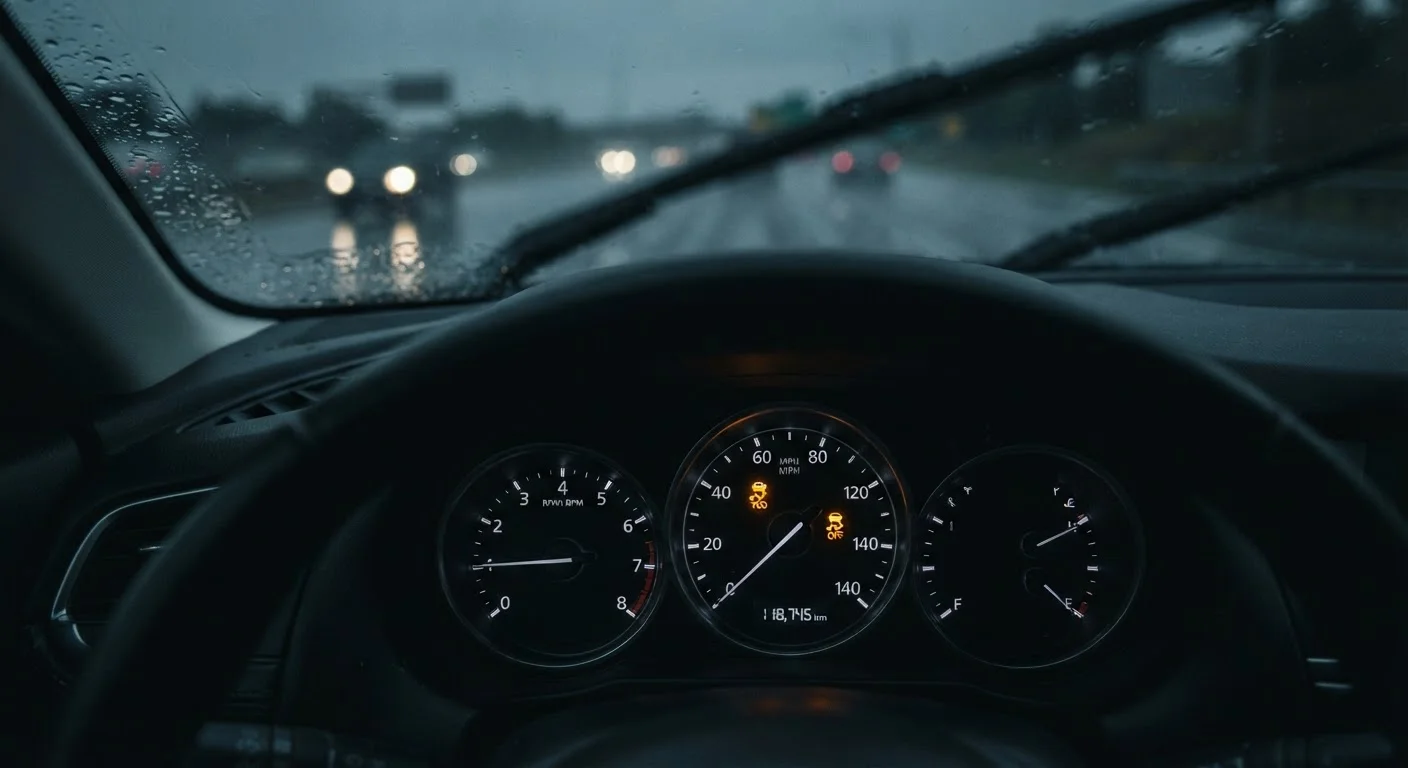
The Core Distinction: Acceleration vs. Direction
Traction control and electronic stability control are often mentioned together — and they share hardware — but they solve fundamentally different problems. Understanding the split helps you know what your car is actually doing when either system activates.
Traction Control (TC) focuses on the moment you apply power. When a driven wheel spins faster than the others — indicating it has lost grip — TC intervenes by reducing engine output, applying the brake to that wheel, or both. The goal is to transfer torque to the wheel that still has traction. This is most noticeable when accelerating from a stop on wet pavement or loose gravel.
Electronic Stability Control (ESC) — also labeled ESP (Electronic Stability Program) depending on the manufacturer — monitors whether the car is traveling in the direction the driver is steering. It compares the steering angle, individual wheel speeds, lateral acceleration, and yaw rate (rotation around the vertical axis). When those inputs diverge — for example, the car begins to slide sideways in a corner — ESC selectively brakes individual wheels to redirect the vehicle. It operates regardless of whether you're accelerating, braking, or coasting.
Think of it this way: TC handles the rear wheels spinning at a traffic light; ESC handles the car drifting off its intended path mid-corner. For context on how these systems relate to broader active safety technology, see how safety features differ from crash ratings.
| Criterion | Traction Control (TC) | Electronic Stability Control (ESC) |
|---|---|---|
| Primary purpose | Prevent wheel spin during acceleration | Prevent directional skids and slides |
| When it activates | During acceleration on low-grip surfaces | Any time the car deviates from intended path |
| Sensors used | Wheel-speed sensors | Wheel-speed, steering angle, yaw, lateral-g |
| How it intervenes | Cuts throttle and/or brakes spinning wheel | Applies brakes asymmetrically to specific wheels |
| U.S. federal mandate | Not independently mandated | Mandatory on all new U.S. cars since MY2012 |
| Can be disabled by driver | Usually yes, via dashboard button | Sometimes; not recommended on public roads |
| Relationship to ABS | Shares ABS wheel-speed hardware | Extends ABS with additional sensors |
Shared Sensors, Different Responses
Both systems are built on the same foundation as ABS (Anti-lock Braking System). All three use wheel-speed sensors to monitor each corner of the car independently. This shared architecture is why a fault in your ABS can sometimes disable TC and ESC simultaneously — something the TPMS, ABS, and ESP warning lights guide explains in detail.
Where the systems diverge is in what sensor data they act on and how they respond:
- TC primarily watches for wheel-speed differentials during acceleration and responds by cutting throttle or braking a spinning wheel.
- ESC adds a steering angle sensor and a yaw/lateral-g sensor to detect directional instability, then applies brakes asymmetrically — for instance, braking only the front-outer wheel to counter oversteer, or the rear-inner wheel to correct understeer.
The sophistication of ESC's multi-axis monitoring is why it's considered the more comprehensive system. TC is effectively a subset of what ESC hardware is capable of — which is why disabling ESC on most vehicles also disables TC, but not always vice versa.
Tyre condition interacts heavily with both systems. Neither TC nor ESC can fully compensate for severely worn or under-inflated tyres. For a clear explanation of how grip is shaped by what's under your car, see tyre pressure, tread, and grip.
When to Disable Each System (and When Not To)
Most vehicles allow TC to be temporarily switched off via a dashboard button. This can be useful in specific off-road or deep-snow situations where controlled wheel spin helps the car dig through loose material rather than stopping the wheels entirely. In those cases, re-enable TC as soon as you're back on a normal surface.
Disabling ESC is a different matter. On public roads, turning off ESC removes the system that catches a skid before it becomes a spin-out. Manufacturers generally advise against disabling ESC for everyday driving. Some performance-oriented vehicles allow partial ESC modes that permit a degree of oversteer while keeping core stability functions active — but that nuance is vehicle-specific and should be understood from the owner's manual before experimenting.
If either system's warning light stays on without apparent reason — not just flashing during an active correction — have the vehicle inspected. A stored fault code will tell a technician exactly which sensor or module requires attention. Driving with a compromised ESC in particular reduces your safety margin on any road surface.
These systems work alongside other driver-assistance technologies. If you're curious about how vehicle computers manage similar intervention logic in other contexts, park assist features and their limits is a useful parallel read. For AWD owners, understanding how your drivetrain distributes power complements how these stability systems function — see AWD system differences explained.
This article provides general educational information about vehicle safety systems and is not a substitute for guidance in your vehicle's owner's manual or advice from a qualified automotive technician.