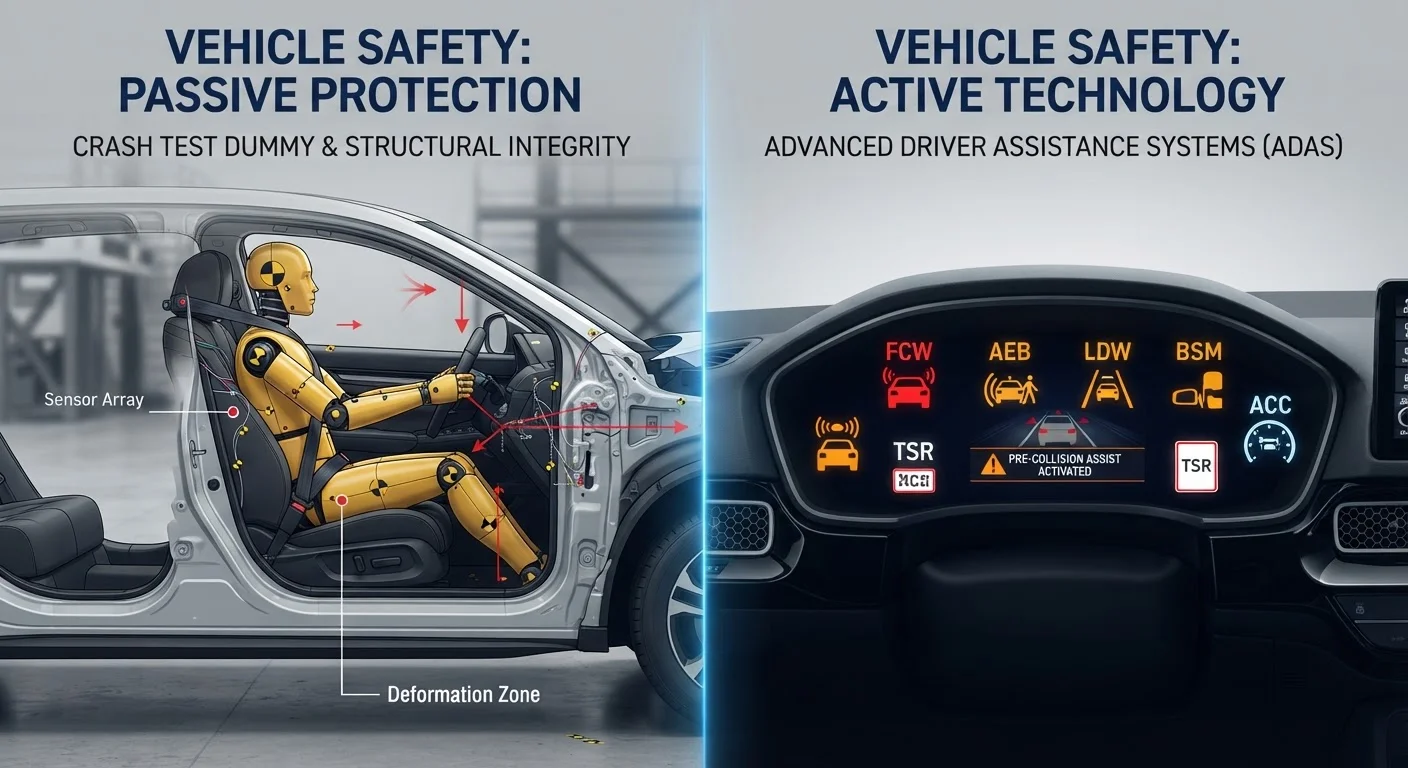
Two Separate Safety Questions
When shoppers look up a vehicle's safety credentials, they often encounter two very different types of information: a crash test score from an agency like NHTSA or IIHS, and a list of driver assistance features on the window sticker. Many buyers assume these tell the same story. They don't.
Crash ratings answer one question: If this vehicle gets into a serious collision, how well does its structure protect the people inside? Driver assistance features — collectively known as ADAS — answer a different question: What systems does this vehicle use to help the driver avoid a crash in the first place?
These are genuinely separate safety layers, and understanding active versus passive safety is the foundation for evaluating either one meaningfully. Mixing them up can lead to overlooking real gaps in either category.
Myth
A five-star safety rating means the car has all the latest safety technology.
Fact
A five-star rating reflects crash-test performance of the vehicle's structure and passive restraints — not which driver assistance features are installed.
Crash tests evaluate what happens to occupants during an impact. They measure things like chest deflection, head injury criteria, and how well the cabin holds its shape. They do not assess whether the vehicle has automatic emergency braking, blind-spot monitoring, or lane-keeping assist. A vehicle can earn top crash scores with zero ADAS features fitted, and a vehicle loaded with driver assistance technology can score poorly in structural tests.
Myth
If a car has lots of ADAS features, it must have a high crash safety rating.
Fact
ADAS features and crash test scores are evaluated separately and do not predict each other.
Advanced Driver Assistance Systems are software- and sensor-driven features designed to help avoid crashes. They have no bearing on how a vehicle's body structure absorbs impact energy, how airbags deploy, or how well seatbelts restrain occupants. An automaker can offer extensive ADAS technology across a lineup while that vehicle's crash structure earns a mediocre score — or vice versa. Checking both independently is the only reliable approach.
Myth
Safety ratings apply equally to every trim level of the same model.
Fact
Crash tests are conducted on specific configurations, and results may not apply to all trim levels, especially if structural differences or standard safety equipment varies.
IIHS and NHTSA test particular body styles and model years. If the tested vehicle included a standard front-crash-prevention system as part of the test protocol, a base trim without that feature may perform differently in real-world conditions even if it carries the same rating label. Always verify which trim and equipment level was tested, not just the model name.
Myth
ADAS features make crash test ratings less important.
Fact
Both safety layers address different scenarios; neither replaces the other.
Crash avoidance technology reduces the frequency and severity of collisions, but it cannot eliminate them. Sensor limitations, unusual road conditions, or system response times mean that crashes still occur even in vehicles with sophisticated ADAS suites. When a crash does happen, the vehicle's structural integrity, airbags, and seatbelt systems become the primary protection. Strong passive safety remains essential regardless of how capable the active systems are.
Myth
All vehicles with the same model name have identical safety features included.
Fact
ADAS features are frequently split across trim levels or bundled into optional packages, meaning two vehicles with the same model name can have very different safety equipment.
Automakers commonly make advanced features standard on upper trims while offering them only as paid options — or not at all — on base configurations. A buyer comparing two vehicles solely on their crash rating labels may overlook that one base trim lacks automatic emergency braking while a competitor includes it as standard across all trims. Always compare feature-by-feature at the specific trim you're evaluating, not just the nameplate.
What Crash Ratings Actually Measure
NHTSA's five-star program and the IIHS rating system each run standardized physical tests — controlled impacts at specific speeds and angles — then assess structural integrity, airbag performance, and occupant injury risk. The score you see reflects how the vehicle's passive safety systems performed: the steel cage, crumple zones, airbags, and seatbelt pretensioners.
Crucially, the crash rating is tied to a specific test protocol conducted at a specific point in time. Protocols get updated periodically, so a five-star rating from several years ago was earned under different criteria than today's tests. For a full explanation of how to read and compare these scores, see what safety ratings actually tell you.
What ratings typically do not tell you is which ADAS features were fitted to the tested vehicle, or whether those features are standard or optional on the trim you're considering.
Trim Level Matters More Than You Might Expect
The crash test rating you find online was earned by a specific vehicle configuration — often a mid- or upper-trim model with certain equipment included. The base trim you're pricing may differ in which safety features are standard. Before assuming a rating applies to your exact purchase, verify the tested configuration details on the NHTSA or IIHS website and compare it against your chosen trim's feature list.
How to Evaluate Both Before You Buy
A thorough safety comparison requires checking two separate sources. For crash protection, consult the NHTSA and IIHS databases using the specific model year and body style you're considering — ratings can differ between a sedan and an SUV built on the same platform, and between model years as well. The NHTSA and IIHS testing differences for SUVs and trucks article walks through how each agency's methodology affects the numbers.
For active safety features, look at the window sticker and the manufacturer's trim comparison chart for the specific configuration you're pricing. Key questions to ask: Is automatic emergency braking standard on every trim, or only available as an option or package upgrade? Does the listed feature set include pedestrian detection, or just vehicle-to-vehicle braking? The ADAS features reference card is a useful starting point for decoding what each acronym actually does.
Not every ADAS feature carries equal real-world impact, either. Independent research suggests some technologies — particularly automatic emergency braking and lane departure warning — reduce crash rates meaningfully, while others offer more modest benefits. Which safety tech features have the strongest evidence breaks down what the research shows, so you can prioritize accordingly when comparing trim levels or option packages.
The bottom line: a strong crash rating is a meaningful signal of structural quality, and a robust ADAS suite is a meaningful signal of crash-prevention capability. Neither substitutes for the other. Use both, from verified sources, for the specific vehicle configuration you're actually purchasing. For a broader framework on how to compare vehicles side by side, the Research & Compare hub covers the full evaluation process.