Who Tests Vehicles and How
In the United States, two organizations publish safety ratings that most buyers encounter: the National Highway Traffic Safety Administration (NHTSA) and the Insurance Institute for Highway Safety (IIHS). NHTSA is a federal government agency; IIHS is an independent nonprofit funded largely by auto insurers. Both crash-test vehicles, but they do so differently and report results on different scales.
NHTSA uses a five-star system across three categories - frontal crash, side crash, and rollover resistance. IIHS rates vehicles as Good, Acceptable, Marginal, or Poor across a broader set of tests that includes a small overlap frontal impact (where only part of the front corner strikes a barrier), a moderate overlap test, side impact, roof strength, and head restraint performance. IIHS also awards a separate Top Safety Pick or Top Safety Pick+ designation when a vehicle meets a combined threshold across tests and headlight performance.
Outside the U.S., programs like Euro NCAP and its affiliated ANCAP (covering Australia and New Zealand) use a five-star scale on their own protocols. For a closer look at how those programs work, see how ANCAP and Euro NCAP ratings are structured.
40+
Years NHTSA has conducted standardized crash testing
NHTSA's New Car Assessment Program (NCAP) has been evaluating vehicle crashworthiness since the early 1980s, making it one of the longest-running programs of its kind.
25%
Front overlap used in IIHS small overlap test
The IIHS small overlap frontal test - introduced in 2012 - uses only 25% of the vehicle's front end striking a rigid barrier, replicating a common real-world crash type that earlier tests did not cover.
2
Separate U.S. programs buyers should consult
NHTSA and IIHS use different test methodologies and scoring scales; consulting both provides a more complete safety profile for any given vehicle.
What the Scores Actually Measure
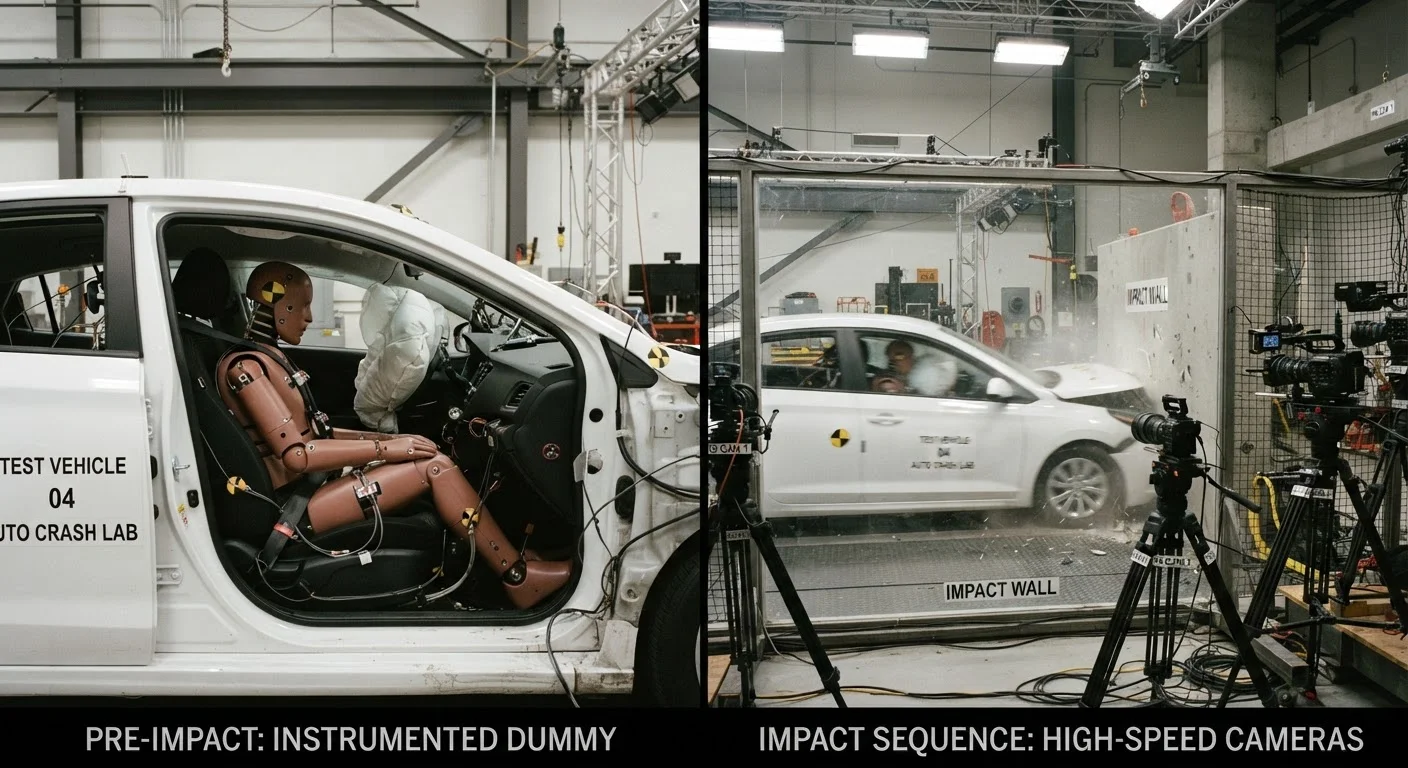
Every crash test is a controlled experiment. Vehicles are impacted at specific speeds, from specific angles, against specific barriers or objects. Sensors in crash test dummies measure forces transmitted to the head, neck, chest, and legs. The scores reflect how those forces compare to injury-risk thresholds established by biomechanical research.
This means ratings are a relative measure within a defined test scenario - not a prediction of outcomes across all real-world crashes. A vehicle rated 'Good' in a moderate overlap frontal test has demonstrated strong structural performance in that scenario. It has not been evaluated in every angle of collision, nor against vehicles of different sizes or weights.
One important nuance: ratings are earned for a specific version of a vehicle. Manufacturers can make engineering changes - updated crumple zones, different airbag calibration, new seat structures - without changing the model name. This means a 2021 and a 2024 version of the same nameplate may have earned their ratings under different conditions or different test protocols. Always verify that the rating you are reading corresponds to the exact model year you intend to purchase. For deeper guidance on how this plays out with SUVs and trucks, see how NHTSA and IIHS evaluate SUVs and trucks differently.
What Safety Ratings Don't Cover
A crash test rating tells you how well a vehicle protects occupants once a crash has already begun. It does not tell you how likely the vehicle is to avoid a crash in the first place. That distinction matters enormously, because technologies like automatic emergency braking (AEB), lane-keeping assist, and blind-spot monitoring can reduce crash frequency - something a static crash test cannot measure.
IIHS does separately evaluate front crash prevention systems and headlights, both of which influence its Top Safety Pick designations. But that evaluation is distinct from the crash test score itself. Understanding how those active systems work is an important complement to reading crash ratings. The difference between safety ratings and safety features is a distinction worth building into any vehicle comparison you conduct.
Ratings also don't account for vehicle compatibility - what happens when a small car collides with a much larger, heavier vehicle. Mass and geometry mismatches play a significant role in real-world outcomes that single-vehicle barrier tests cannot fully replicate.
Using Ratings Practically When Comparing Vehicles
The most effective approach is to treat safety ratings as one structured input among several, rather than the sole deciding factor. Here is a practical framework:
- Match the model year: Look up ratings for the specific year you plan to buy, not an adjacent model year.
- Cross-reference programs: Check both NHTSA and IIHS results. A vehicle may score well in NHTSA's rollover test but earn only Acceptable in an IIHS side impact. Reviewing both gives you a more complete profile.
- Read the subscores: Overall scores can mask variation. A vehicle with a four-star overall NHTSA rating might have earned five stars in frontal and three in side impact. If your commute involves a lot of highway driving with significant side-exposure risk, that detail matters.
- Factor in active safety: Confirm which active safety features are standard versus optional on the trim level you are considering. A vehicle with excellent crash test results but no standard AEB presents a different risk profile than one with both. Explore our Safety Tech hub for plain-language explanations of these systems.
Safety ratings are a genuinely useful tool when read carefully and compared consistently. Their value lies in the systematic, reproducible nature of the tests - which is also their limit. Used alongside active safety feature information and a clear understanding of the test conditions, they become a reliable part of an objective vehicle comparison.