What Active Safety Actually Does
Active safety refers to technologies designed to prevent a crash from happening in the first place. These systems monitor the driving environment in real time — using cameras, radar, and ultrasonic sensors — and either warn the driver or intervene directly.
Common active safety features include:
- Automatic Emergency Braking (AEB): Detects an imminent collision and applies brakes if the driver doesn't respond in time.
- Lane Departure Warning / Lane-Keeping Assist: Alerts or steers the vehicle back if it drifts from its lane unintentionally.
- Blind-Spot Monitoring: Flags vehicles in adjacent lanes that may be invisible in mirrors.
- Adaptive Cruise Control: Automatically adjusts following distance based on traffic ahead.
These fall under the broader umbrella of ADAS. For a full breakdown of what each acronym means, see the ADAS features reference card.
It's worth noting that active systems are only as effective as their calibration, road conditions, and the driver's understanding of their limits. They assist — they do not fully replace attentive driving.
| Criterion | Active Safety | Passive Safety |
|---|---|---|
| When it works | Before or during a crash attempt | During and immediately after impact |
| Primary goal | Prevent the collision | Protect occupants from injury |
| Requires driver input | Sometimes (warnings need response) | Never — fully automatic |
| Examples | AEB, lane-keeping, blind-spot monitoring | Airbags, crumple zones, seatbelt pretensioners |
| Measured by | ADAS evaluation scores (e.g. IIHS TSP) | Crash test star ratings (NHTSA, IIHS) |
| Varies by trim level | Often yes — may require upgrade | Largely consistent across trims |
What Passive Safety Actually Does
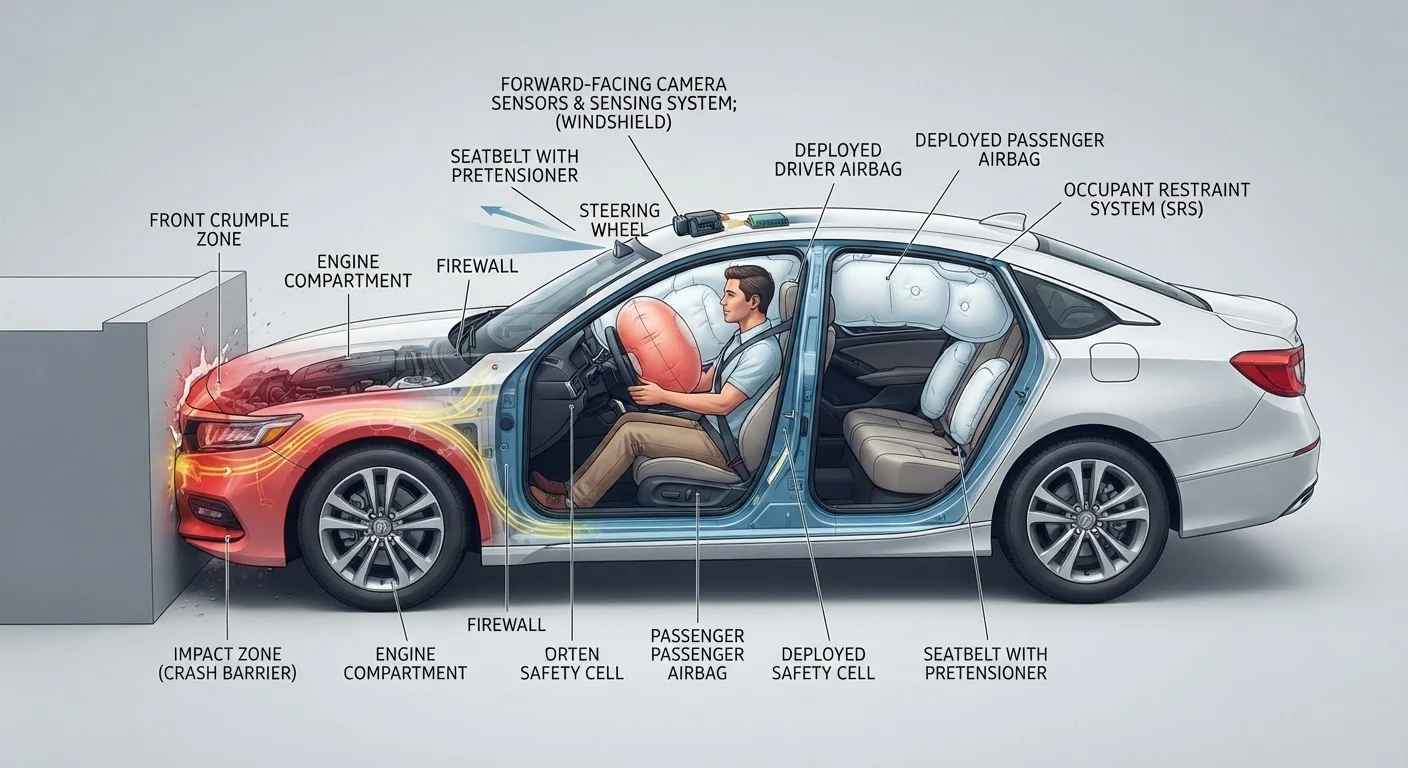
Passive safety features don't require any action — from the driver or the car's sensors — to activate. They're engineered into the vehicle's structure and interior to protect occupants the moment a collision begins.
Core passive safety elements include:
- Airbags: Deploy in milliseconds to cushion occupants from hard interior surfaces.
- Crumple Zones: Sections of the vehicle body engineered to deform and absorb crash energy, reducing force transferred to the occupant compartment.
- Seatbelts with Pretensioners: Tighten instantly on impact to restrain occupants before they lurch forward.
- Side-Impact Beams and Roof Reinforcements: Structural elements that resist intrusion into the cabin.
When agencies like the NHTSA or the Insurance Institute for Highway Safety (IIHS) publish crash ratings, they're primarily evaluating passive safety — how well the vehicle protects people during a crash. This is a distinct measurement from ADAS capability scores. The article Safety Ratings and Safety Features Are Not the Same Thing explains this distinction in detail.
How the Two Layers Work Together
Active and passive safety are not competing priorities — they address entirely different moments in a crash sequence. Think of it as two stages of a timeline:
- Before impact: Active safety features attempt to avoid the collision entirely or reduce its severity.
- During and after impact: Passive safety features absorb energy and protect occupants from injury.
A vehicle with excellent ADAS but a poorly rated crash structure offers incomplete protection. Equally, a car with top crash-test scores but no AEB still puts the driver at higher statistical risk of a collision occurring. The strongest safety profile combines both layers.
For context on which active systems have demonstrated the clearest real-world benefit, the safety tech features with the strongest evidence article summarizes what independent research has found.
As you compare trim levels or vehicles, it helps to ask two separate questions: How well does this car help me avoid a crash? And separately: How well does it protect me if one happens anyway? Answering both gives you a complete picture rather than relying on a single rating or feature list.
What This Means When You're Comparing Vehicles
When reviewing a vehicle's safety credentials, look at both dimensions deliberately:
- Check crash test scores from NHTSA and IIHS — these reflect passive safety performance across multiple impact scenarios.
- Review ADAS availability by trim — some active safety features appear only on higher trims. Confirm which features come standard and which require an upgrade package.
- Understand what each feature does before assigning value to it. Not every ADAS label represents equal protection. For example, forward collision warning and automatic emergency braking are often grouped together but behave very differently — one warns, the other acts.
For a broader orientation to modern safety systems, the plain-language field guide to modern car safety tech walks through the full landscape in accessible terms.
This article is for general informational purposes only. Vehicle safety performance varies by specific model, trim, and configuration. Always consult official crash test data and your vehicle's owner manual for accurate details on your specific car's safety features.