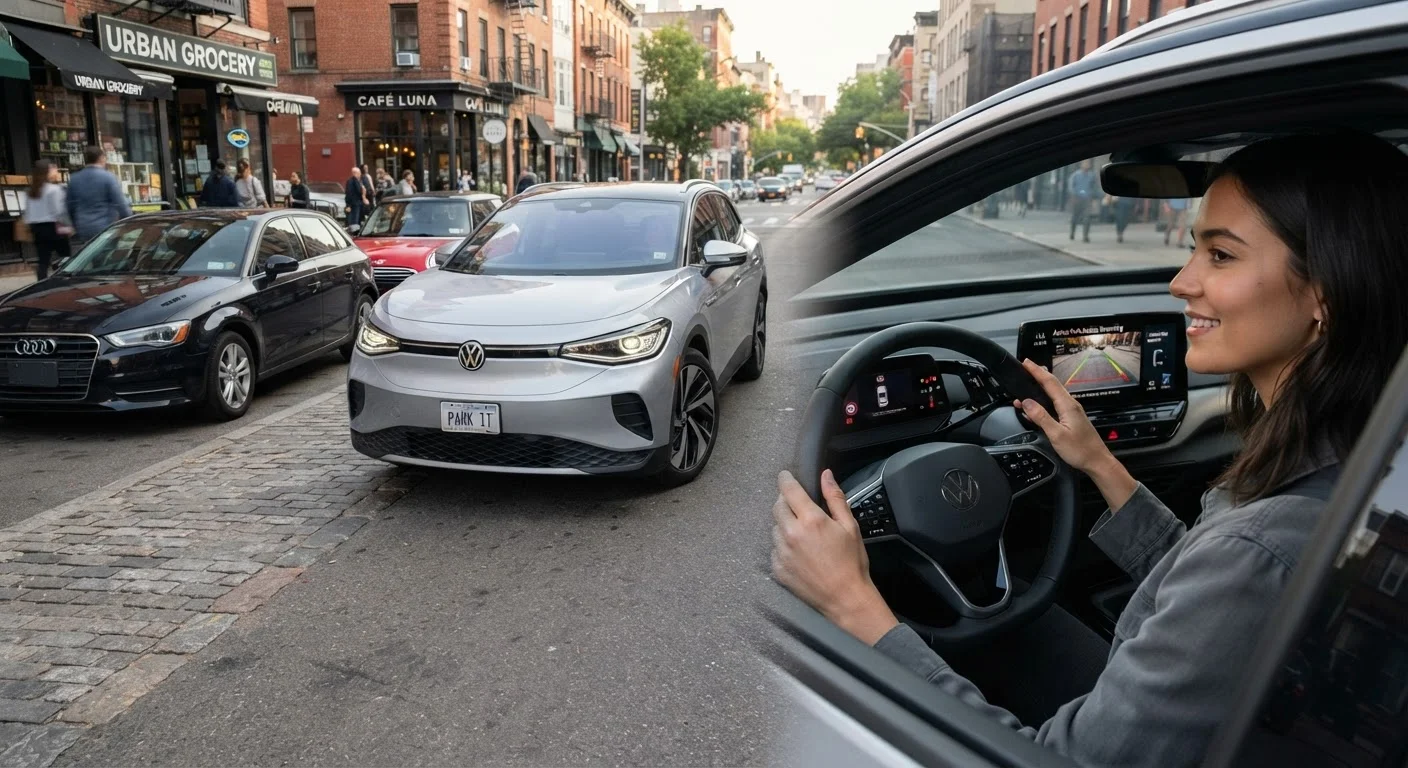
How Park Assist Actually Divides the Work
When drivers first encounter park assist, the most common misconception is that the car is doing everything. In reality, the system divides the task along a clear boundary: the car handles steering, you handle speed.
Here's the typical sequence. As you drive slowly past a row of parked cars — usually below 20 mph — the system's ultrasonic sensors scan for a gap. When it detects a space that meets the required minimum length, it signals you with a prompt on the display or an audible alert. You stop, select reverse (or follow on-screen instructions), and the system takes over the steering wheel, guiding the car through the calculated path while you apply gentle, controlled pressure to the brake to pace the movement. Once the car is positioned, you shift to drive and the system may straighten the wheels for a final pull-forward adjustment.
At every point, your foot remains on the brake. The moment you sense something wrong — a cyclist approaching, a pedestrian stepping out — you press the brake and the maneuver pauses. Grabbing the steering wheel cancels the operation entirely on most vehicles. This shared-control model is intentional: the system is a steering aid, not an autonomous agent.
For a broader comparison of how different parking technologies compare to one another, see our guide to parking assistance tech.
What the System Cannot See or Decide
Ultrasonic sensors are reliable at detecting static objects at close range, but they have meaningful limitations. Low objects — a parking curb stone, a child's bicycle left on the ground, a depression in the pavement — may not register clearly. Sensors also have fixed angles, which means narrow columns or objects immediately adjacent to the sensor housing can be underdetected.
More importantly, the system measures the space, not the full environment around the space. It does not assess whether a fire hydrant is at the kerb, whether a driveway entrance would be blocked, or whether local parking rules permit stopping there. Those judgments remain entirely yours.
Keep Your Eyes Moving, Not Just Forward
During a park assist maneuver, resist the instinct to watch only the display screen. Actively check your mirrors and glance over your shoulder throughout the sequence. Sensors cover defined zones, but your eyes cover the full picture — especially for moving objects like pedestrians and cyclists that can enter the scene quickly.
The system also does not predict moving objects. If a car pulls out of a space ahead while you are mid-maneuver, or a pedestrian walks behind the vehicle, the onus is on you to react. Some vehicles integrate rear cross-traffic alert warnings into the parking sequence, but this varies by model and should be verified in your owner's manual rather than assumed.
This is why the driver is considered legally responsible for any collision that occurs during a park assist maneuver, even if the system was active. Understanding this is not a reason to avoid the feature — it is a reason to use it with the same attentiveness you would apply to any parking attempt.
Parallel vs. Perpendicular: Which Modes Does Your Car Support?
Park assist originally focused on parallel parking — the most geometrically demanding maneuver for most drivers. Many current systems have expanded to include perpendicular bay parking (reversing straight into a marked bay) and some also handle angled bays. Each mode uses a slightly different sensor scan and steering path calculation.
To know which modes your vehicle supports, the owner's manual is the definitive reference. The system typically makes the mode clear through its display prompts, and some vehicles allow you to select the parking type before the space-scan begins. If you are familiarising yourself with a new vehicle's tech features before driving, our pre-drive tech walkthrough covers how to approach this systematically.
~15–20 mph
Typical maximum speed for space scanning
Most manufacturers specify this scan speed limit in owner's manuals; exceeding it can cause the system to miss or mis-measure a parking space.
1–1.5x
Extra car lengths required beyond vehicle size
Park assist systems generally require a space at least one to one-and-a-half vehicle lengths larger than the car to initiate a maneuver successfully.
One practical note: the scan speed matters. Driving past potential spaces too quickly can cause the system to miss or mis-measure a gap. Most manufacturers specify a scan speed — commonly under 15–20 mph — so observe this to give the sensors adequate time to map the space accurately.
Building Confidence Without Becoming Dependent
Park assist is most useful when you understand it as a precision steering tool, not a substitute for spatial awareness. Drivers who treat it as a teaching aid — watching the steering inputs, observing how the car positions itself, and comparing that to their own parking instincts — often find their unassisted parking improves as well.
If you are new to a vehicle with this feature, consider using it in a quiet, low-traffic environment initially, so you can focus on understanding the prompts and your role in the process before attempting it in a busy street or tight multi-storey car park.
Similar principles apply to other driver assistance features. Just as lane keeping assist and lane departure warning differ in how actively they intervene, parking technologies span a range from simple sensor warnings to semi-automatic steering — each with its own specific driver responsibilities. Knowing exactly what your system does, and what it leaves to you, is what turns a confusing feature into a genuinely useful one.
This article provides general educational information about park assist technology. Always consult your vehicle's owner's manual for model-specific instructions and limitations. If you are uncertain about any feature's operation, speak with a qualified technician or your vehicle manufacturer's support line.