How Parking Sensors Work — and What They Miss
Parking sensors — typically ultrasonic — are embedded in the front and rear bumpers and emit sound waves that bounce off nearby objects. The system calculates distance based on how quickly the echo returns, then translates that into a beeping alert: slow beeps for moderate distance, rapid or continuous beeps when you're very close.
The main advantage is immediacy. You hear feedback without looking away from your mirrors. Most systems activate automatically when reverse gear is engaged, and front sensors often activate below a speed threshold in traffic.
What sensors cannot do is tell you what is behind you or how large it is. A low curb, a bollard, and a child on a bicycle all register as obstacles at the same pitch. Camera integration is the solution to that limitation — which is why the two technologies are increasingly paired rather than sold as alternatives. For a broader overview of how these systems fit into the wider safety-tech landscape, see our plain-language safety tech field guide.
Backup Cameras vs. 360-Degree Surround-View Systems
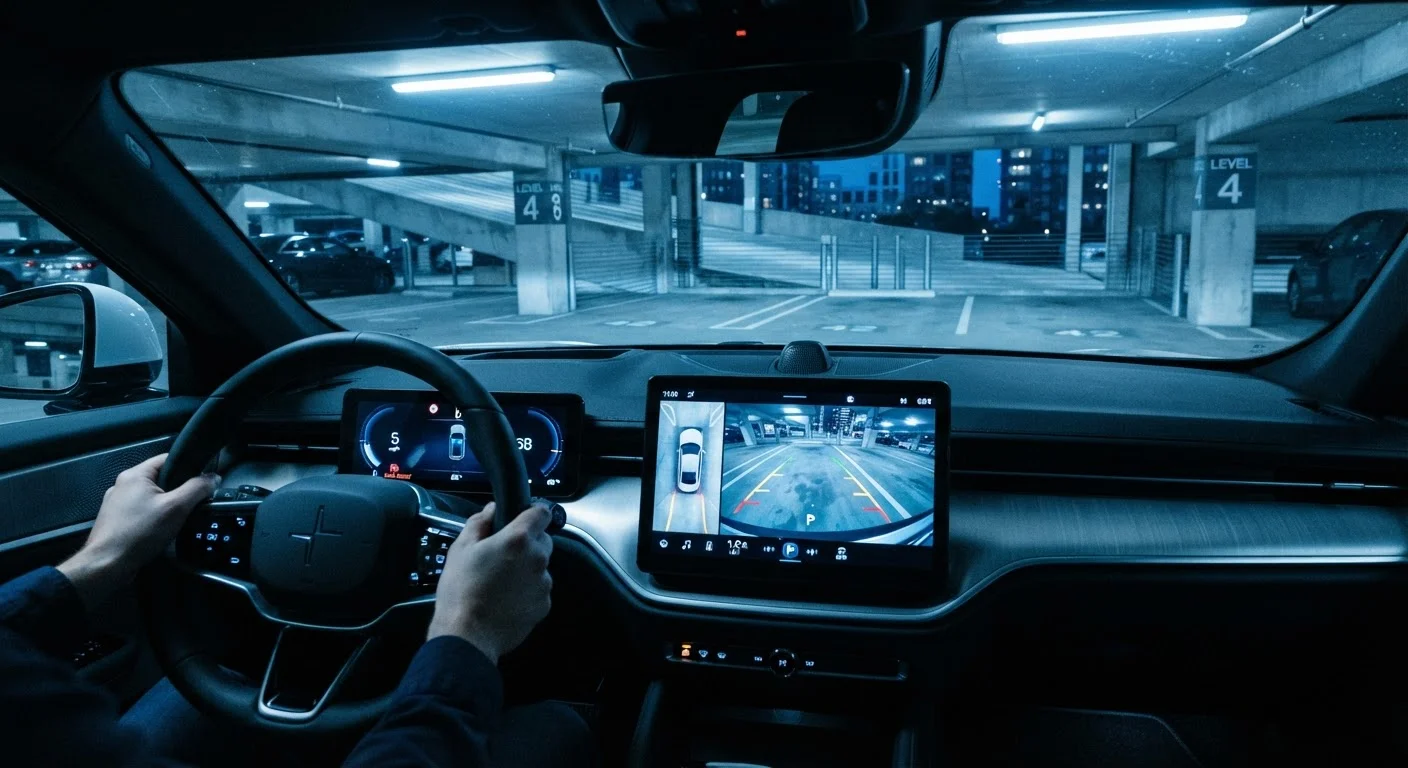
Since 2018, federal regulations in the US have required all new passenger vehicles to include a rear-view camera. That baseline camera shows a live feed of the area directly behind the vehicle on the center screen, typically with colored distance guidelines overlaid on the image.
A 360-degree surround-view system (also called a bird's-eye or top-down view) uses four or more cameras mounted around the vehicle — front, rear, and the door mirrors — and stitches the feeds into a composite overhead image. This gives drivers a virtual view of the car's entire footprint and the space immediately surrounding it.
The practical difference matters most in close-quarters situations: a standard backup camera shows depth behind the car but gives no visibility alongside it, which is where a door mirror can clip a pillar or a narrow garage frame. A surround-view system closes that gap. The trade-off is cost; surround-view is usually a mid-to-upper trim feature, or part of a technology package that adds several hundred to over a thousand dollars to the vehicle price.
| Parking Sensors | Backup Camera | 360° Surround-View | Automated Parking | |
|---|---|---|---|---|
| Primary output | Audible distance alerts | Rear video feed | Stitched overhead video | Automated steering input |
| Availability on new vehicles | Very common | Standard (federally required) | Mid-to-upper trims | Upper trims / packages |
| Typical added cost | Low | Included / minimal | Moderate to high | High |
| Best parking scenario | Any tight space | Backing into any space | Tight garages & curbs | Parallel parking on street |
| Driver still responsible for? | Steering, speed | Steering, speed | Steering, speed | Speed and overall supervision |
| Works without driver looking at screen? | Yes — audio only | No — visual | No — visual | Partial — audio/visual cues |
For guidance on evaluating which trim levels include these systems, the Research & Compare hub is a useful starting point.
Automated Parking Systems: What They Actually Do
Automated or semi-automatic parking systems — sometimes marketed under names like Park Assist or Active Park Assist — use a combination of sensors and cameras to identify a suitable parking space, then take over the steering to guide the car into it. The driver continues to operate the accelerator and brake, and must remain engaged throughout.
More advanced implementations on some current vehicles can also manage acceleration, braking, and gear changes, reducing driver input further. A small number of vehicles now offer a remote parking function, allowing the driver to initiate and monitor parking from outside the car via a smartphone app.
These systems are genuinely useful in a specific scenario: parallel parking on a busy urban street where space is tight and traffic is moving. They are less transformative for suburban drivers who park in larger lots or garages. It's also worth understanding that the driver retains legal and practical responsibility for the maneuver — the system handles the wheel geometry, not the judgment calls. Our article on what park assist handles and what you still control explains those boundaries in detail.
Test the System Before You Rely on It
When evaluating a vehicle with automated parking, ask to see it operate in a real or simulated space during a test drive. Systems vary considerably in how smoothly they execute the maneuver and how accurately they judge available space. Experiencing the system firsthand is the most reliable way to assess whether it fits how you actually park.
Deciding What's Worth Paying For
The right combination depends on your typical driving environment and the parking challenges you actually face. A few practical questions help frame the decision:
- Do you primarily park in a driveway or large lot? Standard rear sensors and a backup camera — already standard on most new vehicles — are likely sufficient.
- Do you regularly parallel park on narrow city streets? Surround-view or an automated system adds meaningful value, not just novelty.
- Do you drive a larger vehicle (SUV, truck, van)? The longer rear overhang and reduced rear visibility make both 360-degree cameras and sensors especially worthwhile.
Keep in mind that parking assistance features sit at the less critical end of the safety-tech spectrum compared with collision avoidance systems. Research on which safety technologies reduce crash risk most can help you weigh feature spending against overall safety value. If budget forces a choice, prioritize the features with the strongest evidence for preventing serious crashes before adding convenience-oriented parking tech.
When shopping across trim levels, confirm whether parking features are included or part of an optional package — and whether the package bundles features you don't need. That context matters when choosing between new and used vehicles, since used cars may already include these features from a higher trim without the new-car price.