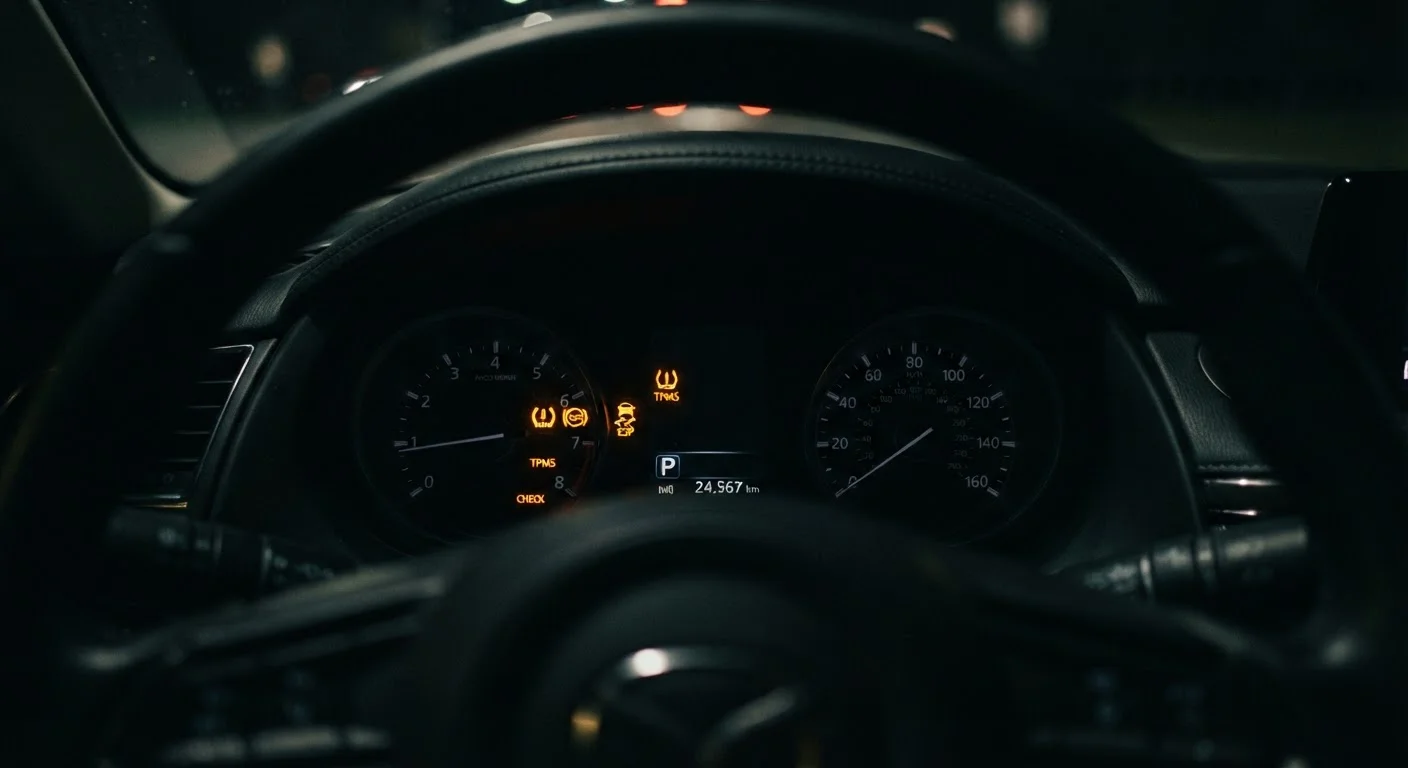
Why These Three Lights Confuse Drivers
Most drivers know the check-engine light means something needs attention. But TPMS, ABS, and ESP — three of the most important safety-system indicators on a modern vehicle — are routinely misread, dismissed, or misunderstood entirely. Part of the problem is that each system can illuminate its warning light for reasons ranging from completely harmless to genuinely urgent, and the lights themselves don't explain which situation you're in.
Understanding what these systems actually do — and what their warning lights are really communicating — puts you in a far better position to respond correctly. For a broader overview of dashboard symbols, our Driver's Quick-Reference Guide to warning lights covers the full range. Below, we break down the three safety-system lights that generate the most confusion.
TPMS — Tire Pressure Monitoring System
The TPMS light looks like a cross-section of a tire with an exclamation point inside. When it illuminates, most drivers assume they have a flat or a slow leak. That's sometimes true — but temperature is just as common a culprit. Tire pressure drops roughly 1 PSI for every 10°F decrease in ambient temperature, which means a cold morning can trigger the light even on tires that were perfectly inflated the night before.
Here's the practical distinction: if the light comes on after a cold night and goes off once the tires warm up after a few miles of driving, the pressure was simply low due to temperature. If the light stays on, check all four tires with a manual gauge — don't rely on visual inspection, since a tire can be significantly underinflated without appearing flat.
A flashing TPMS light (as opposed to a steady glow) typically indicates a sensor malfunction rather than a pressure issue. In that case, the system itself needs attention. TPMS sensors are battery-powered and have a finite lifespan — usually 7–10 years — after which they may need replacement. For a deeper look at how tire pressure affects safety and handling, see our piece on tire pressure, tread, and grip.
A cold morning alone can trigger the TPMS light — temperature drops reduce tire pressure noticeably overnight.
ABS — Anti-lock Braking System
ABS prevents your wheels from locking up during hard braking, allowing you to steer while stopping. When it activates — typically in a panic-braking situation or on a slippery surface — you'll feel a rapid pulsing or vibration through the brake pedal. This is completely normal and means the system is doing exactly what it's designed to do. Many drivers ease off the brakes at this point, which is counterproductive: keep firm, steady pressure applied and let the system work.
The ABS warning light, however, is a different matter. It indicates a fault within the system rather than the system activating. When this light is on, ABS is typically disabled, meaning your brakes will still function — but without the anti-lock feature. In a hard-stop situation, your wheels could lock and you'd lose steering control. That's a meaningful reduction in your vehicle's emergency stopping capability.
Common causes of an ABS warning include a faulty wheel-speed sensor (the most frequent culprit), a failing ABS module, or a low brake fluid level. A diagnostic scan will identify the specific fault code. Do not ignore a persistent ABS light, especially heading into wet or winter driving conditions.
Brake pedal pulsing during a panic stop is ABS working correctly — a dashboard ABS light at rest is a fault.
ESP — Electronic Stability Program
ESP goes by several names depending on the manufacturer: Electronic Stability Control (ESC), StabiliTrak, Vehicle Stability Control (VSC), and Dynamic Stability Control (DSC) are all versions of the same concept. The system monitors steering input versus actual vehicle direction, and intervenes — by selectively applying individual brakes or reducing engine power — when it detects a skid or loss of control developing.
Like ABS, you may feel and hear ESP activate: a brief judder, a momentary power reduction, or a flickering ESP indicator light while the system is working. A light that flickers briefly during spirited driving or slippery conditions is normal. A light that stays on solidly indicates a stored fault.
Some vehicles allow you to disable ESP with a button, which can be useful in specific low-speed situations (like rocking out of snow). But if the light is on and you haven't pressed that button, or it stays on after restarting the car, the system needs diagnosis. Because ESP relies on many of the same sensors as ABS, faults in one system can cascade into the other. Our Driving & Safety Tips hub covers broader strategies for handling vehicle control in adverse conditions.
ESP flickering briefly on a slippery road is normal — a steady ESP warning light at rest signals a system fault.
What to Do When These Lights Come On
The first step with any safety-system warning is to distinguish between a system activating (doing its job) and a system reporting a fault (needing attention). Feeling your ABS pulse under your foot during a panic stop is the former — expected and correct. Seeing the ABS warning light glowing on a dry, straight road is the latter.
Check Your Owner's Manual First
Warning light behavior varies by make and model — the exact color, symbol, and behavior of TPMS, ABS, and ESP indicators can differ significantly. Your owner's manual includes a dedicated warning light section specific to your vehicle. Keeping it in the glove compartment means you can reference it the moment an unfamiliar light appears, rather than guessing.
For ESP and ABS faults in particular, a diagnostic scan at a qualified shop can pinpoint the exact sensor or module involved — saving time and guesswork. Because these systems share wheel-speed sensors, a single faulty sensor can trigger multiple warning lights simultaneously. If you're seeing two or more safety warnings at once, that's worth addressing promptly rather than monitoring.
For more on how modern safety technology sometimes behaves in unexpected ways, see our article on why safety tech can behave unexpectedly. And if you want to understand the full picture of what your dashboard is telling you, Your Car's Dashboard Warning Lights, Decoded is a useful companion reference.
This article is for general informational purposes only. Always consult a qualified mechanic for diagnosis and repair of vehicle safety systems.