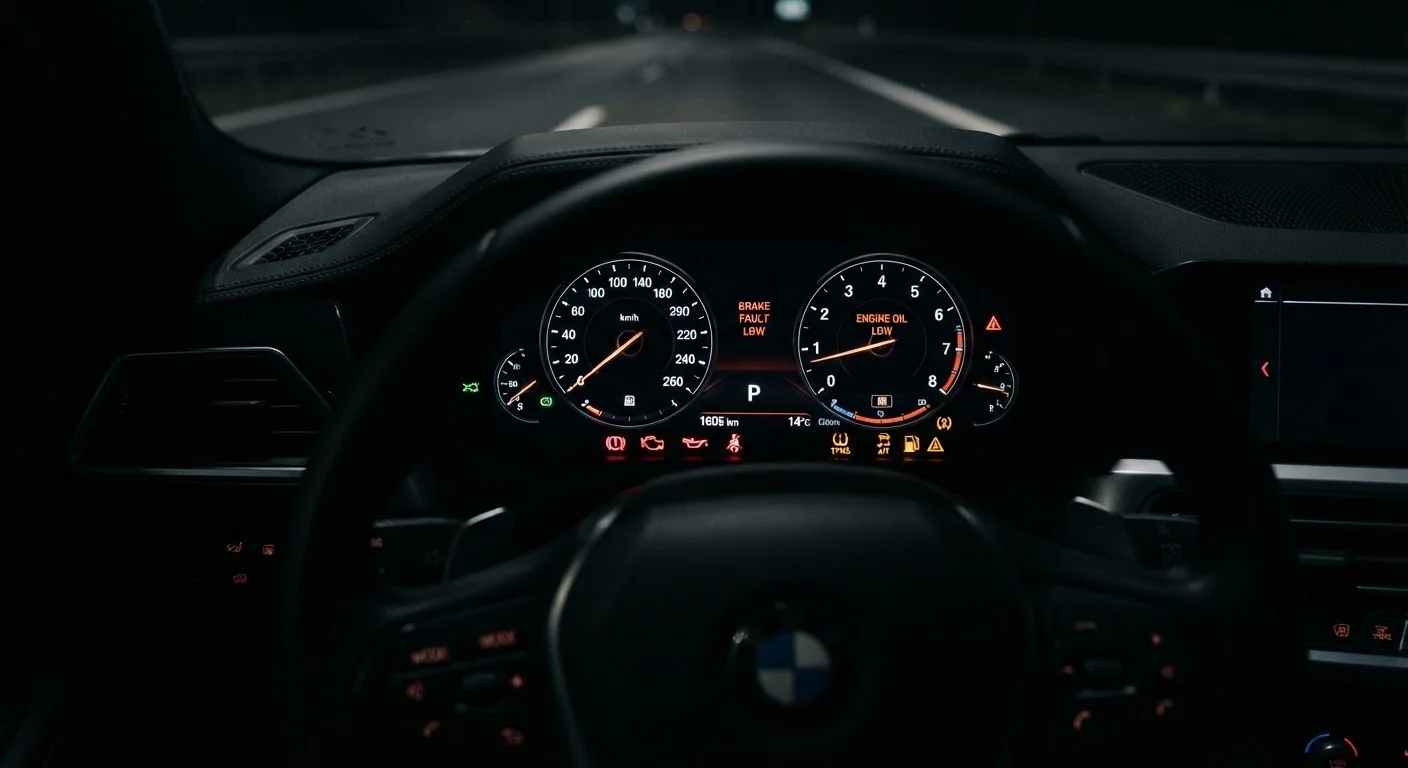
How the Color System Works
Modern dashboards use a traffic-light color logic to communicate urgency at a glance. Understanding this system is the fastest way to decide whether to pull over immediately or book a service appointment.
- Red: A critical fault requiring immediate attention. Do not continue driving if oil pressure, engine temperature, or brake system lights appear in red. Pull over safely, switch off the engine, and contact a mechanic.
- Amber / Yellow: A caution alert. The vehicle can usually be driven, but a problem needs investigation soon. TPMS and traction control lights typically appear in amber.
- Green / Blue: Informational indicators, not warnings. These confirm that a feature is active — for example, high-beam headlights (blue) or cruise control (green).
Keep in mind that a flashing or blinking light is always more serious than a steady one of the same color. A flashing check engine light, for instance, signals an active engine misfire that can rapidly damage the catalytic converter.
For a deeper look at which lights signal an immediate stop versus a scheduled visit, see warning lights that should never be ignored.
| Number of possible OBD-II fault codes | Over 5,000 standardized codes (SAE International OBD-II standard) |
| TPMS mandate (U.S.) | Required on all new passenger vehicles since 2008 (NHTSA TREAD Act implementation) |
| Red light response | Stop safely as soon as possible (General industry guidance) |
| Amber light response | Schedule service; monitor closely (General industry guidance) |
| Owner's manual location | Glove compartment or manufacturer app (Standard vehicle documentation practice) |
Light-by-Light Reference
The following covers the most commonly encountered dashboard warning lights across U.S.-market vehicles. Because icon design can vary slightly by manufacturer, cross-reference with your owner's manual if you are unsure.
Engine / Check Engine (MIL)
Looks like: An engine block outline.
Color: Amber (steady) or Amber (flashing).
What it means: The OBD-II system has detected a fault — anything from a loose fuel cap to an emissions sensor failure. A steady light allows continued driving with a prompt service visit. A flashing light means stop driving as soon as it is safe and have the vehicle towed or inspected immediately.
Oil Pressure
Looks like: An old-fashioned oil can.
Color: Red.
What it means: Engine oil pressure has dropped dangerously low. Stop the engine immediately to prevent severe internal damage. Check oil level after the engine cools — but low oil level alone does not always explain this light. Have the system inspected before restarting.
Battery / Charging System
Looks like: A rectangular battery with positive and negative terminals.
Color: Red.
What it means: The charging system is not maintaining battery voltage. This could be a failing alternator, a damaged serpentine belt, or a poor battery connection. Drive directly to a service location, as the vehicle may lose electrical power without warning.
Engine Temperature
Looks like: A thermometer submerged in liquid.
Color: Red.
What it means: The engine is overheating. Turn off the air conditioning, pull over safely, and shut off the engine. Do not open the hood immediately — let the engine cool before checking coolant. Continuing to drive risks warped cylinder heads or a seized engine.
Tyre Pressure (TPMS)
Looks like: A tyre cross-section with an exclamation mark.
Color: Amber.
What it means: One or more tyres is significantly underinflated. Check all four tyre pressures with a gauge and inflate to the specification on the driver's door jamb sticker — not the number on the tyre sidewall. Note that TPMS does not replace manual pressure checks; it activates only after pressure drops around 25% below recommended levels.
Brake System
Looks like: An exclamation mark inside a circle, sometimes with the word BRAKE.
Color: Red.
What it means: This light has two triggers. If the parking brake is engaged, releasing it will extinguish the light. If the parking brake is off and the light remains on, brake fluid may be low or there is a hydraulic fault. Do not drive until inspected.
ABS (Anti-lock Braking System)
Looks like: The letters ABS inside a circle.
Color: Amber.
What it means: The ABS module has detected a fault. Standard braking still works, but the anti-lock function may not activate in a panic stop. Schedule service promptly.
Airbag / SRS (Supplemental Restraint System)
Looks like: A seated figure with a circle (airbag) in front.
Color: Red or Amber.
What it means: A fault in the airbag or seatbelt pretensioner system. The airbags may not deploy correctly in a collision. This requires professional diagnosis — do not attempt DIY repairs on SRS components.
Power Steering
Looks like: A steering wheel with an exclamation mark.
Color: Amber or Red.
What it means: On electric power steering systems, a fault has been detected. Steering may become noticeably heavier. Drive carefully to a service facility.
Traction Control / Stability Control
Looks like: A car with wavy lines beneath it.
Color: Amber.
What it means: When flashing briefly, the system is actively working to prevent wheelspin — this is normal. When the light stays on continuously, the system has been manually disabled or has a fault that needs attention.
For context on how these systems tie into modern driver assistance technology, see ADAS features at a glance.
Your Owner's Manual Is the Definitive Source
Warning light icons and their meanings can vary between manufacturers and even between model years of the same vehicle. The descriptions in this guide reflect the most common industry-standard interpretations, but your vehicle's owner's manual — available in the glove compartment or through your manufacturer's app — is always the authoritative reference. When in doubt, consult a qualified mechanic rather than continuing to drive with an unidentified warning light active.
What to Do When a Light Comes On
Seeing a new warning light can be unsettling, but a methodical response prevents both unnecessary panic and accidental vehicle damage.
- Identify the color first. Red means stop; amber means schedule service soon; green or blue is informational.
- Check whether it is steady or flashing. A flashing light escalates urgency significantly.
- Consult this guide and your owner's manual. Confirm what the symbol means for your specific vehicle.
- Check the obvious first. For TPMS, check tyre pressures. For the battery light after a cold start, let the car warm up briefly and see if it extinguishes. For the engine light, verify the fuel cap is fully tightened.
- Do not ignore amber lights for extended periods. What begins as a minor sensor fault can compound into a more expensive repair.
- Book a diagnostic scan. An OBD-II scan tool reads the stored fault codes and points a technician directly to the affected system, saving time and guesswork.
When you are ready to talk to a shop about what you have seen, communicating clearly with your mechanic can make the diagnostic process faster and more accurate.
MIL (Malfunction Indicator Lamp)
The technical name for the check engine light. It illuminates when the vehicle's onboard diagnostic system (OBD-II) detects a fault in the emissions, engine, or drivetrain systems. A solid MIL usually allows continued driving; a flashing MIL signals an active misfire and requires immediate attention.
TPMS (Tyre Pressure Monitoring System)
A sensor-based system that alerts the driver when one or more tyres fall significantly below the recommended inflation pressure. TPMS has been federally mandated on new U.S. passenger vehicles since 2008.
OBD-II (On-Board Diagnostics II)
A standardized vehicle self-diagnostic system used in all cars sold in the U.S. since 1996. It stores fault codes that a scan tool can read, helping technicians identify the source of a warning light.
Amber / Yellow Warning
A caution-level alert indicating a system needs attention soon but does not necessarily require stopping immediately. Examples include TPMS and traction control warnings.
Red Warning
A high-priority alert that generally means a critical system has failed or is at risk of imminent damage. Red lights — such as oil pressure or engine temperature — typically require stopping the vehicle safely as soon as possible.
Fault Code (DTC)
A Diagnostic Trouble Code stored by the vehicle's computer when a sensor reading falls outside expected parameters. Codes are retrieved with an OBD-II scan tool and help pinpoint which system triggered the warning light.