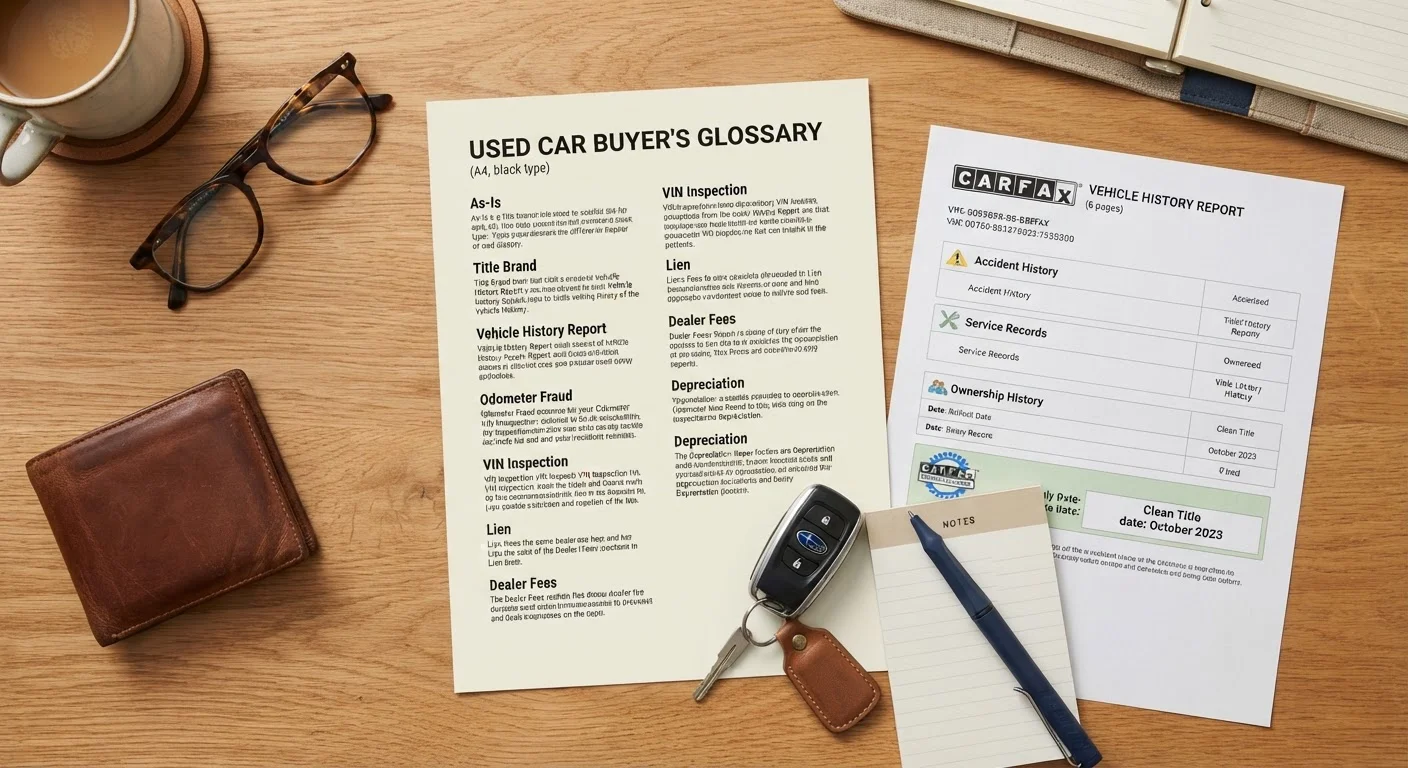
Why Terminology Matters Before You Shop
Walking into a used car search without knowing the language puts you at an immediate disadvantage. Sellers — whether dealers or private parties — use specific terms that carry real financial and legal weight. Misunderstanding a single phrase, like confusing a salvage title with a rebuilt title, can affect your insurance eligibility, resale prospects, and the actual value of what you're buying.
This glossary covers the core terms you'll encounter across listings, vehicle history reports, dealership lots, and private sales. For a deeper look at how these terms apply in an actual transaction, see our end-to-end used car deal guide.
Salvage Title
A title designation issued by a state DMV when an insurer declares a vehicle a total loss. Vehicles with this designation typically cannot be legally driven until repaired and re-inspected.
Rebuilt Title
Assigned to a former salvage vehicle that has been repaired and passed a state safety inspection. Insurer coverage and resale value are generally reduced compared to a clean-title vehicle.
Certified Pre-Owned (CPO)
A used vehicle that has met a manufacturer or dealer inspection standard and carries an extended limited warranty. Terms and coverage vary significantly — always read the warranty document before purchase.
Out-the-Door Price
The total cost of a vehicle purchase including the sale price, taxes, registration, and all dealer fees. This is the only figure that allows accurate comparison across different sellers.
Lien
A lender's legal claim against a vehicle used as collateral for a loan. A lien must be paid off before a clean title can transfer to a new buyer.
Trade-In Value
The credit a dealer applies toward your next purchase in exchange for your current vehicle. It is typically lower than what you would receive selling privately.
Dealer Demo
A vehicle previously used by a dealership for test drives or as a loaner, then offered for sale as used. These vehicles are often lightly used and may retain portions of original factory warranty coverage.
As-Is Sale
A transaction in which the seller makes no warranty about the vehicle's condition. The buyer accepts full responsibility for any defects or issues discovered after purchase.
Fleet Vehicle
A car previously operated as part of a business, rental, or government pool. Fleet vehicles are often maintained on a schedule but may have higher mileage relative to their model year.
Vehicle History Report
A compiled record of a vehicle's title events, reported accidents, odometer readings, and ownership history, drawn from DMV, insurer, and auction data sources.
Doc Fee
A dealership administrative charge for processing sales paperwork. The amount varies by dealership and is subject to state-level regulation in some jurisdictions.
Private-Party Value
The estimated market price for a vehicle sold directly between individuals, without dealer involvement. Generally higher than trade-in value, reflecting the seller's direct margin.
Title and Ownership Terms
A vehicle's title is its legal proof of ownership and tells you a great deal about its history. These are the terms most critical to understand before any purchase.
- Clean Title
- A title with no recorded damage designations, liens, or legal encumbrances. It does not guarantee the vehicle is defect-free — it means no title-level event has been flagged by a state DMV.
- Salvage Title
- Issued when an insurer declares a vehicle a total loss — typically because repair costs exceed a threshold percentage of the car's value. Salvage-titled vehicles generally cannot be driven legally until inspected and rebranded.
- Rebuilt or Reconstructed Title
- Assigned to a salvage-titled vehicle that has been repaired and passed a state safety inspection. Coverage options from insurers are often limited, and resale value is lower than a clean-title equivalent.
- Lien
- A legal claim on the vehicle by a lender, typically because the current owner financed it. The lien must be satisfied (paid off) before a clean title can transfer to you. Always verify lien status before purchase.
- Bill of Sale
- A written record of the transaction between buyer and seller, documenting price, vehicle identification, date, and both parties. Required in most states for title transfer in private-party sales.
For contract-level language used once you're at the dealership, common dealership contract terms defined is a useful companion reference.
Condition and History Terms
Listings and vehicle history reports use a set of standardized terms to describe a car's background. Understanding these prevents costly misreads.
- Vehicle History Report
- A compiled record — sourced from state DMVs, insurers, auctions, and repair facilities — showing a vehicle's title history, reported accidents, odometer readings, and ownership count. Common report providers pull from different data sets, so reports can vary.
- One-Owner Vehicle
- A car with a single registered owner throughout its life. It is a positive signal but not a guarantee of careful maintenance. Verify with service records.
- Fleet Vehicle
- A car previously owned by a business, rental agency, or government body. Fleet vehicles are often well-maintained by schedule but may carry higher mileage relative to age.
- Dealer Demo
- A vehicle used by a dealership — typically for test drives or as a loaner — and then sold as used. Demo vehicles are often lightly used and may still carry portions of the original factory warranty.
- As-Is Sale
- The seller makes no warranty, expressed or implied, about the vehicle's condition. Any defects discovered after purchase become the buyer's responsibility. Common in private-party transactions and some dealer auctions.
Pricing terms tied to condition — like book value adjustments for mileage and wear — are covered separately in used car pricing terms every buyer should know.
Transaction and Value Terms
These terms come up during negotiation, at the finance desk, and in listings. Being fluent with them helps you evaluate what you're actually paying versus what the vehicle is worth.
- Trade-In Value
- The amount a dealer offers to credit toward your next purchase in exchange for your current vehicle. Trade-in values are typically lower than private-party sale prices because dealers factor in resale margin and reconditioning costs.
- Private-Party Value
- The estimated price a vehicle would fetch in a direct sale between two individuals, without a dealer intermediary. Generally higher than trade-in value but requires the seller to manage the transaction independently.
- Certified Pre-Owned (CPO)
- A used vehicle that has passed a manufacturer- or dealer-defined inspection checklist and carries an extended limited warranty. CPO standards and warranty terms vary significantly by manufacturer — always read the specific coverage document.
- Out-the-Door Price
- The total amount you'll actually pay, including vehicle price, taxes, registration fees, and any dealer fees. Always negotiate and compare using out-the-door figures, not just the listed vehicle price.
- Dealer Fee (Doc Fee)
- An administrative charge for processing paperwork. The amount varies by state regulation and dealership. Some states cap doc fees; others do not.
For the financing side of a used car transaction — APR, loan-to-value ratio, and amortization — see the auto loan glossary.
This glossary is for general informational purposes only and does not constitute legal or financial advice. Consult a qualified professional for guidance specific to your situation.