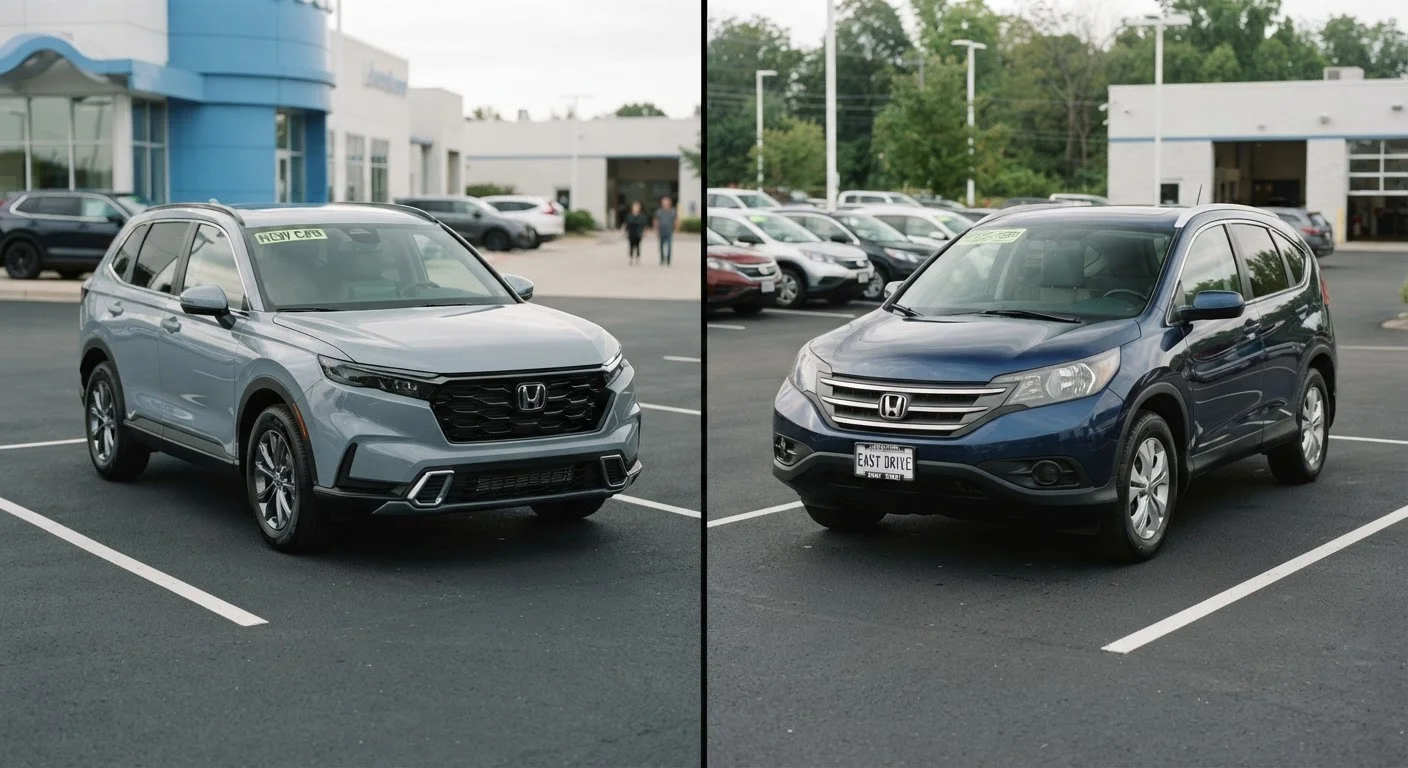
Why Price Alone Is an Incomplete Lens
Most buyers open the conversation with a single question: which one costs less? That instinct is understandable, but it consistently leads to incomplete decisions. A vehicle's purchase price is only the entry point. The variables that shape total ownership cost - depreciation rate, warranty scope, financing rate, insurance premium, and maintenance exposure - can swing the real-world gap between new and used by thousands of dollars in either direction.
For a fuller picture of what each path actually costs, see our guide on understanding the real cost difference between new and used cars. The framework below builds on that foundation by examining the non-price variables that most buyers underweight.
| Criterion | New Vehicle | Used Vehicle |
|---|---|---|
| Purchase Price | Higher sticker price | Lower upfront cost |
| Depreciation Exposure | Buyer absorbs initial drop | First owner absorbed the drop |
| Factory Warranty | Full, untouched coverage | Partial, expired, or CPO only |
| Financing Rates | Typically lower APR | Typically higher APR |
| Safety Technology | Latest standard features | Varies by model year |
| Maintenance Uncertainty | Low - known history | Higher - unknown history risk |
| Insurance Cost | Often higher premium | Often lower premium |
| Negotiation Flexibility | MSRP and incentive driven | Market comps and condition driven |
Depreciation and Equity: The Stealth Variable
New vehicles typically lose a significant portion of their value within the first few years. This depreciation is not a defect - it is a structural feature of how vehicle markets price novelty and warranty coverage. The practical implication: a buyer who purchases new absorbs that initial loss, while a buyer who purchases a two- to four-year-old vehicle steps in after the curve has flattened.
However, depreciation also works in reverse when you sell or trade. A vehicle purchased used at a lower basis may retain a higher percentage of its purchase price. The net effect depends on how long you plan to own the car. There are specific scenarios where buying new makes stronger financial sense - particularly for buyers who plan to hold the vehicle for eight or more years and want the depreciation curve to work in their favor over time.
~20%
Typical first-year depreciation on a new vehicle
Industry estimates commonly cite a 15-25% value loss in the first year for many vehicle categories, though actual rates vary by make and market conditions.
2-4 yrs
Age range where depreciation curve typically flattens
Vehicles in the two-to-four-year range have generally passed the steepest part of the depreciation curve, offering a more stable value retention profile for used buyers.
1-3%
Common APR gap between new and used auto loans
Federal Reserve consumer credit data and lender rate surveys consistently show used vehicle loans carrying higher interest rates than new vehicle loans on average.
Warranty, Technology, and Hidden Costs
A new vehicle comes with a full factory warranty - typically bumper-to-bumper coverage for three years and powertrain coverage for five or more, though terms vary by manufacturer. That coverage means predictable repair costs during the warranty window. A used vehicle's remaining factory warranty, if any, depends entirely on its age and mileage at purchase.
Certified Pre-Owned (CPO) programs offer a structured middle ground. They require a manufacturer-defined multi-point inspection and attach a limited warranty to vehicles that pass. CPO vehicles are not risk-free, but they reduce the uncertainty that accompanies a standard used purchase. For buyers comparing used deals side by side, our article on things buyers overlook when comparing used car deals outlines the factors most commonly missed.
Technology is another dimension buyers should evaluate explicitly. Active safety systems - automatic emergency braking, blind-spot monitoring, rear cross-traffic alerts - became standard on many vehicles starting around model year 2018-2019. A used vehicle from before that window may lack features that are now considered baseline. Insurance premiums can also differ between new and used vehicles based on replacement cost, theft rates, and available safety features. See our breakdown of insurance cost factors for new vs. used cars for a structured look at what drives those differences.
Financing, Negotiation, and Market Timing
Interest rates on auto loans are not uniform across new and used vehicles. Lenders - including manufacturer captive finance arms - generally offer lower rates on new vehicles because the collateral is more predictable and standardized. On a multi-year loan, even a two-percentage-point difference in rate can translate to a meaningful cost gap that partially offsets the higher purchase price of a new car.
Negotiation dynamics also differ. New-vehicle pricing is anchored to MSRP and dealer invoice, with manufacturer incentives applied on top. Used-vehicle pricing is anchored to market comparables, condition, and how long a vehicle has sat on the lot. The negotiation levers available on a used car differ fundamentally from those on a new car - understanding which tools apply in each context is part of an effective buying strategy.
Market conditions and timing can shift the calculus further. Inventory levels, interest rate environments, and seasonal patterns affect pricing for both segments. Our article on how timing affects the new vs. used decision explores how external market factors interact with your choice. For a broader structural framework on comparing any two vehicles, see the car comparison framework every buyer should know.
This article provides general educational information about vehicle purchasing considerations. It is not personalized financial, legal, or investment advice. Consult a qualified financial professional before making significant purchase or financing decisions.