Why a Framework Beats Gut Feeling
Most buyers begin car shopping with a mental image - a color, a silhouette, a brand they grew up with. That instinct is a reasonable starting point, but it is a poor decision-making engine. Dealership environments are designed to amplify excitement and compress deliberation. Without a repeatable structure, it is easy to overweight surface appeal and underweight the factors that actually determine long-term satisfaction.
A comparison framework does two things. First, it forces you to articulate what genuinely matters to you before a salesperson, a test drive, or a persuasive price tag enters the picture. Second, it creates a consistent scoring surface so that any two vehicles are evaluated on the same terms. Buyers who use structured methods report feeling more confident in their final choice and less susceptible to post-purchase regret. The framework below is built around four evidence-backed pillars and a simple scoring process you can complete with a spreadsheet or a sheet of paper.
Step 1 - Define Your Must-Haves Before You Shop
Before you open a single vehicle listing, write down your non-negotiables in three categories:
- Functional requirements: How many passengers do you regularly carry? Do you need cargo space for sports equipment, a stroller, or work tools? Will you tow anything?
- Usage patterns: Mostly highway, city, or mixed? Long commutes favor fuel efficiency and ride comfort; urban use favors tight turning radius and parking ease.
- Budget boundaries: Establish a ceiling for monthly payment and a realistic estimate of what you can put down. Use a general affordability framework - the 20/4/10 rule is a useful starting reference, with some limitations worth understanding.
Any vehicle that cannot meet all three categories of must-haves is eliminated before the comparison even begins. This protects your shortlist from wishful thinking.
Total Cost of Ownership (TCO)
The full expense of owning a vehicle over a set period, including purchase price, fuel, insurance, maintenance, registration, and depreciation - not just the sticker price.
Weighted Scoring Grid
A comparison tool where each evaluation criterion is assigned a priority weight, and vehicles are scored against each criterion so results reflect what matters most to the buyer.
NHTSA
The National Highway Traffic Safety Administration - the U.S. federal agency that conducts standardized crash tests and publishes safety ratings for vehicles sold in the U.S.
IIHS
The Insurance Institute for Highway Safety - an independent, nonprofit U.S. organization that conducts its own vehicle crash tests and publishes safety ratings separate from the NHTSA.
Non-Negotiables
The baseline requirements a vehicle must meet before it can be considered - features or capabilities you are unwilling to compromise on regardless of price or appeal.
Depreciation
The reduction in a vehicle's market value over time. New cars typically depreciate fastest in the first two to three years of ownership, which affects resale value and total cost calculations.
Step 2 - Compare the Four Core Pillars
Once you have a shortlist of two or three vehicles, evaluate each one across four structured pillars:
1. Total Cost of Ownership
Sticker price is the least useful number in a comparison. Add estimated insurance premiums, average fuel costs based on your annual mileage, routine maintenance schedules, registration fees, and projected depreciation. For new versus used considerations, the decision framework beyond price covers these variables in depth.
2. Safety
Look up crash-test results from the NHTSA (National Highway Traffic Safety Administration) and the IIHS (Insurance Institute for Highway Safety) for the specific model year you are considering. Ratings are not directly comparable across model years or testing bodies - a vehicle tested under an older protocol may score higher than one tested more rigorously. Read the subcategory scores, not just the overall star rating.
3. Reliability
Owner surveys and long-term reliability data give you a probabilistic picture of how a model line tends to perform over time. Published annual reliability studies segment vehicles by category, which makes comparisons more meaningful. No data set predicts the performance of one specific vehicle, but patterns across thousands of owners are a legitimate input.
4. Everyday Usability
This pillar covers how the vehicle functions in your daily life: cargo access, infotainment intuitiveness, rear-seat legroom, visibility from the driver's seat, and how controls fall to hand. These details rarely appear in spec sheets but drive daily satisfaction. Online research tools and owner forums are valuable here - real owners describe the friction points manufacturers omit from brochures.
Step 3 - Score and Rank Your Shortlist
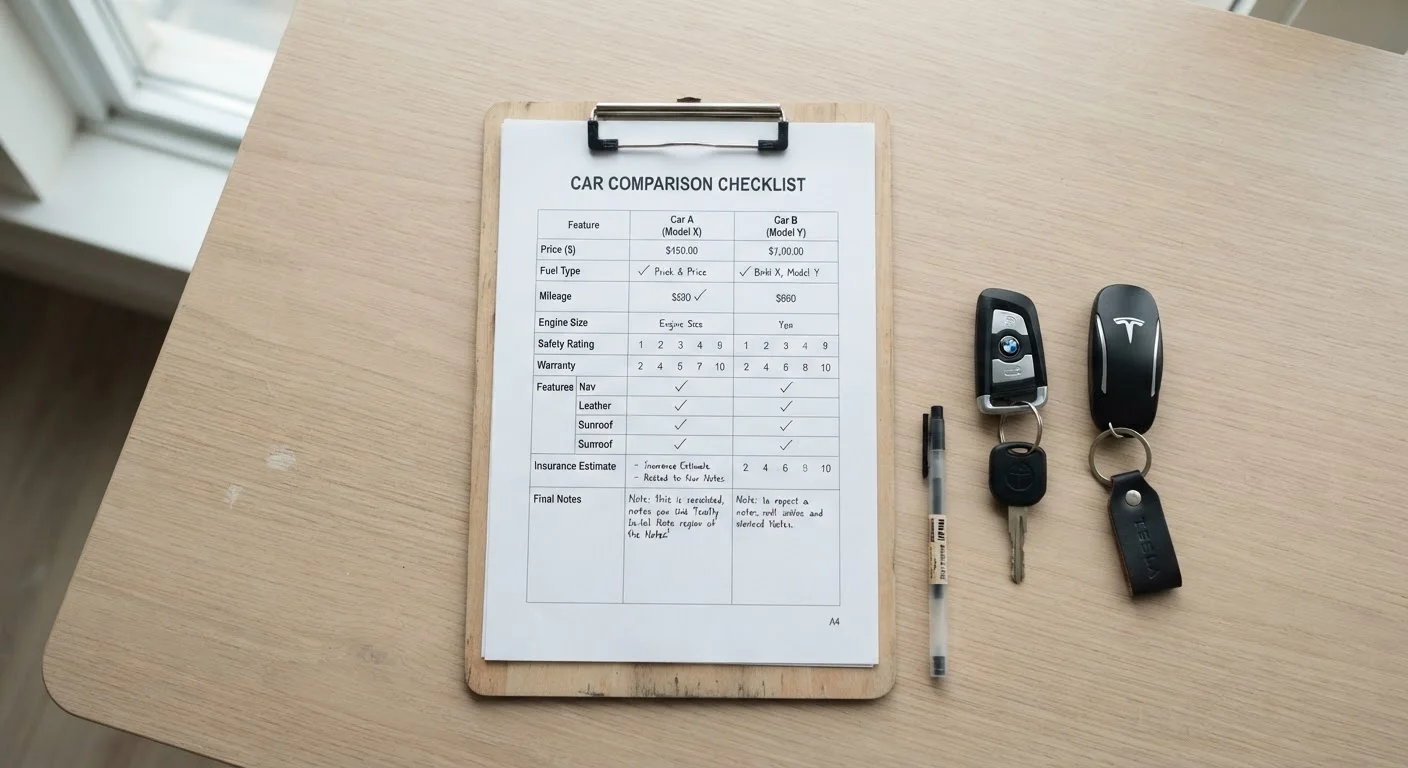
Build a simple weighted scoring grid. List your four pillars (and any sub-factors that matter to you) down the left column. Assign each pillar a weight that reflects its priority in your life - a buyer with a long highway commute might weight fuel economy heavily; a family buyer might weight safety highest.
Score each vehicle on a consistent scale (1-5 works well) for every criterion, then multiply each score by its weight. Sum the columns. The vehicle with the highest weighted total is your data-driven leader.
Weight Your Criteria Before You Score
Assign weights before you look at any vehicle's scores - not after. If you set weights once you can already see which vehicle will win, you are reverse-engineering a justification rather than running an objective comparison. Write your weights down first, then fill in the scores.
If the grid result surprises you - if your emotional favorite scores lower - treat that as valuable information rather than a reason to discard the exercise. It often reveals a hidden trade-off worth naming explicitly before you commit.
For used vehicles specifically, this scoring process has additional variables. The factors buyers commonly overlook in used car comparisons - like service history gaps and remaining warranty transfer eligibility - belong in your grid.
Step 4 - Validate with a Structured Test Drive
The scoring grid narrows your field. The test drive is where you confirm or challenge what the data suggested. To keep your evaluations comparable across vehicles, use a consistent route that includes highway merging, low-speed maneuvering, and a parking exercise. Evaluate the same attributes on each drive - do not let an exciting first impression on one vehicle set a standard the others are unfairly measured against.
Our side-by-side test drive checklist gives you a structured set of criteria to assess on every vehicle, covering comfort, controls, visibility, and driving feel. Bring it with you. Completing it immediately after each drive, while impressions are fresh, keeps your notes actionable rather than vague.
After the test drive, revisit your weighted score. If the experience meaningfully changed how you value a criterion - perhaps ride quality mattered far more than you expected - adjust your weights and recalculate. The framework is a tool, not a contract.
This article provides general educational guidance on car comparison methods and is not a substitute for personalized financial or legal advice. Consult qualified professionals for decisions specific to your circumstances.