What Depreciation Actually Means for Your Wallet
When car buyers compare a new and a used vehicle, they often focus on the sticker price or the monthly payment. Depreciation - the ongoing loss in market value - rarely gets the same attention, yet it typically represents the single largest cost of owning a vehicle over time, often exceeding fuel, insurance, or maintenance expenses combined.
Depreciation is not a fee you pay directly. Instead, it shows up as the difference between what you paid for the car and what you can sell it for later. If you buy a vehicle for $35,000 and sell it three years later for $22,000, you've absorbed $13,000 in depreciation - roughly $4,300 per year, regardless of how little you drove it.
For buyers weighing new versus used options, this math matters a great deal. Seeing the full financial picture means looking beyond the purchase price to understand how much value each option is likely to shed during the time you own it.
~20%
Average first-year new car value loss
Industry estimates commonly cite that many new vehicles lose around 15-20% of their value within the first twelve months, though the figure varies significantly by segment and model.
~50%
Typical value remaining after five years
Many passenger vehicles retain roughly 40-60% of their original value after five years of ownership, depending on make, model, mileage, and condition.
Year 1-3
Period of steepest depreciation for most vehicles
Automotive valuation guides generally identify the first one to three years as when a vehicle sheds the largest share of its lifetime value in the shortest period.
The Depreciation Curve: Why Timing Is Everything
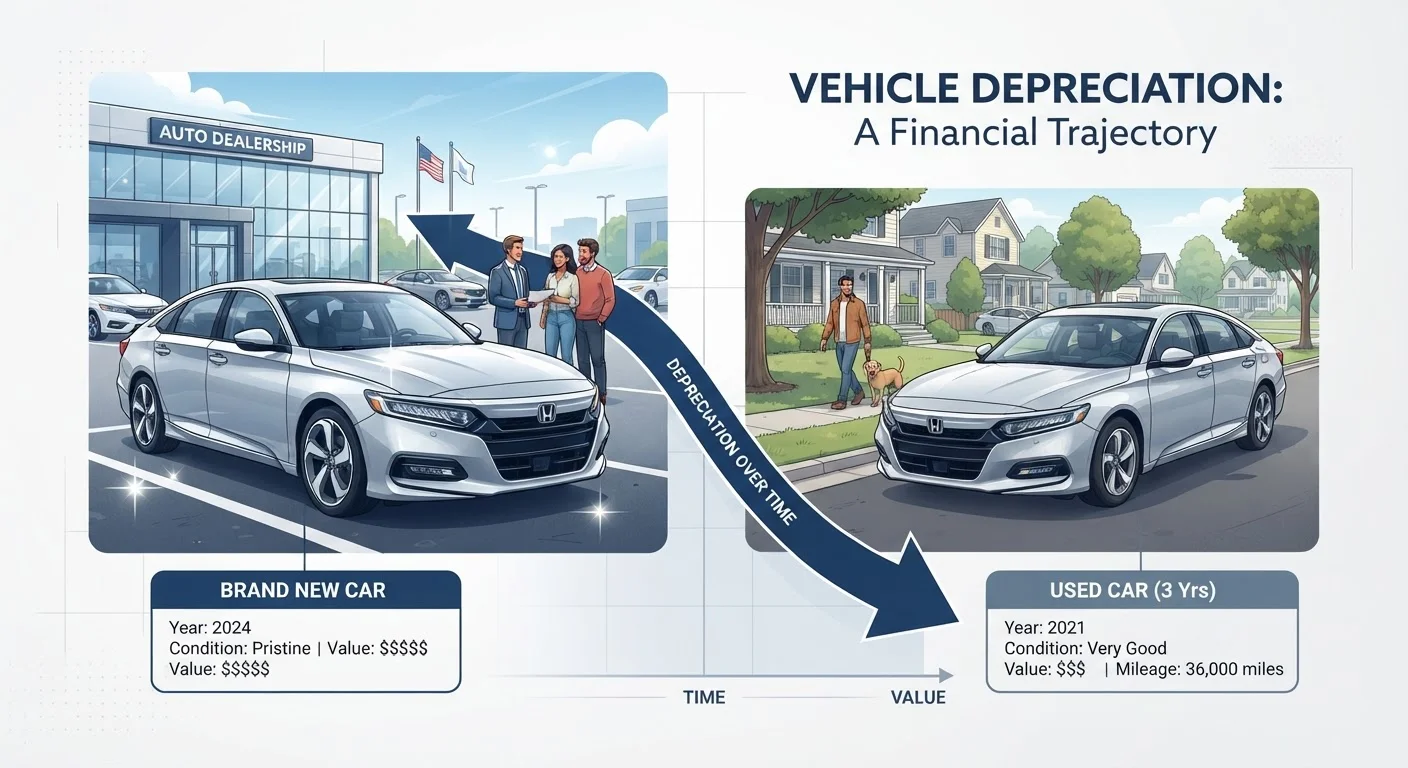
Depreciation does not happen at a steady rate across a vehicle's life. The decline is sharpest in the earliest years. When a new car leaves the dealership, it immediately sheds its 'new' premium. By the end of year one, many vehicles have lost a meaningful share of their original value. The curve then tends to flatten - a six-year-old car typically loses value more slowly, in both percentage and dollar terms, than a one-year-old car.
This curve is central to the new vs. used decision. A buyer purchasing a brand-new vehicle absorbs that steep early drop. A buyer purchasing a vehicle that is two, three, or four years old steps in after much of that initial loss has already occurred - effectively letting the first owner pay for the depreciation they never benefited from.
That said, the curve varies significantly by vehicle type. Some segments and models are known for holding value unusually well or poorly. How depreciation varies between car segments can shift the calculus considerably, especially when comparing similarly priced options across different categories.
How Depreciation Shifts the New vs. Used Comparison
A new car comes with clear advantages: full manufacturer warranty, the latest safety and technology features, no unknown ownership history, and financing incentives that can lower the effective cost. But those benefits come paired with maximum exposure to early depreciation - you are, in a sense, paying a premium for novelty that the market will quickly discount.
A used car transfers that depreciation burden to its previous owner. If the vehicle was originally purchased new and is now two to four years old, a significant portion of its lifetime value loss may already be behind it. The remaining depreciation you'll absorb tends to be shallower. A structured look at five-year ownership costs across new and pre-owned scenarios shows how these differences accumulate over time.
The tradeoff is not automatic, however. Used vehicles often carry higher interest rates on financing, may require more near-term maintenance investment, and may lack the warranty protection of a new purchase. The right choice depends on how you weigh those variables against the depreciation savings.
For buyers who want a framework that goes beyond price alone, comparing new and used across multiple dimensions - including warranty coverage, technology, and total cost - offers a more complete view.
Using Depreciation Knowledge to Spot Value in the Used Market
Understanding depreciation curves gives used car shoppers a practical edge. Vehicles that depreciate quickly when new become relative bargains when purchased used - because the market has already priced in that steep drop. A model known for fast depreciation, bought two or three years after its initial sale, may deliver significantly more vehicle per dollar than its original sticker suggested.
Conversely, vehicles with strong resale value hold their prices well throughout life, meaning used buyers pay a premium that reflects the model's demand. Neither profile is universally better - it depends on your budget, how long you plan to own the car, and whether resale value matters for your next purchase.
How depreciation shapes used car prices at different ages is a useful lens for evaluating specific vehicles you're considering. Knowing where a particular model sits on its depreciation curve at the age you're shopping helps you assess whether the asking price reflects genuine value or whether there's still significant future loss ahead.
Ultimately, depreciation is not a reason to always buy used - it's a framework for understanding the true cost of either path, so your decision is grounded in complete information rather than purchase price alone. Researching and comparing vehicles thoroughly before committing is the most reliable way to ensure the numbers work in your favor.
This article provides general educational information about vehicle depreciation and ownership costs. It is not financial advice. Individual outcomes will vary based on specific vehicle, market conditions, and personal financial circumstances. Consult a qualified financial professional for guidance tailored to your situation.