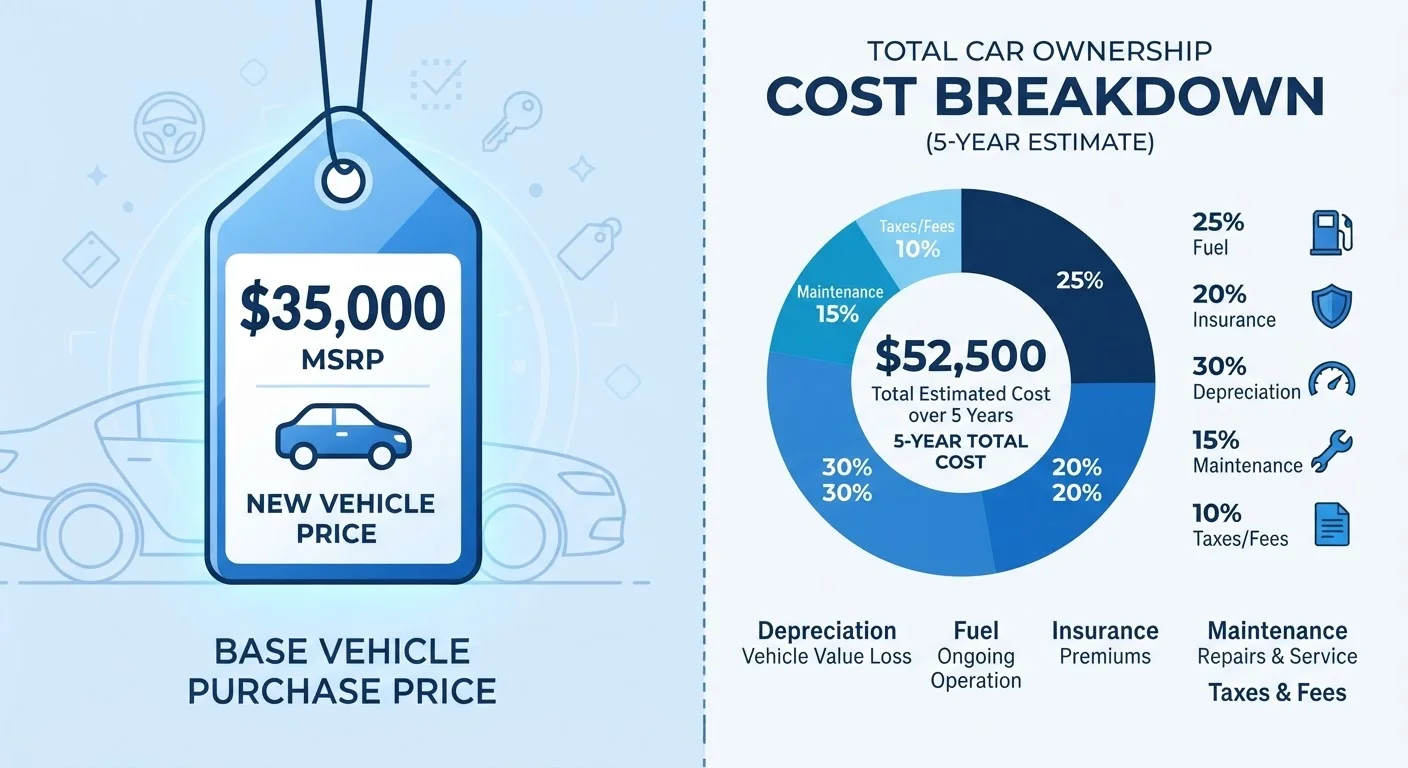
Why the Sticker Price Misleads More Than It Reveals
The Manufacturer's Suggested Retail Price (MSRP) - commonly called the sticker price - is the number displayed on a vehicle's window sticker at the dealership. It represents the base cost of the car plus any installed options and packages. While it's a useful entry point for budgeting, it reflects only a single moment: the transaction itself.
What the sticker price omits is significant. It does not account for how much the vehicle will cost to fuel over three years, what your insurer will charge annually, how often it will need brake pads or tires, or how much of its value it will shed the moment it leaves the lot. For a thorough comparison between two vehicles, relying on sticker price alone is like comparing two homes by looking only at their asking price while ignoring property taxes, HOA fees, and utility costs.
To understand what you're actually paying, you need the concept of Total Cost of Ownership (TCO). See also: what the out-the-door price includes - a related but distinct concept that captures immediate transaction costs before TCO analysis begins.
Breaking Down Total Cost of Ownership
TCO is the sum of all costs associated with owning and operating a vehicle over a defined period - typically three to five years. Its core components are:
- Depreciation: The decline in a vehicle's resale value over time. For most new vehicles, depreciation accounts for roughly 40-50% of the car's original value within the first five years. This is typically the largest single cost in TCO.
- Fuel costs: Determined by the vehicle's fuel efficiency rating (MPG or MPGe for electric) combined with average miles driven annually and local fuel prices.
- Insurance premiums: Vary significantly by vehicle make, model, driver profile, location, and coverage level. A vehicle with higher repair costs or theft rates will generally command higher premiums.
- Maintenance and repairs: Routine maintenance (oil changes, tire rotations, filters) plus projected repair frequency based on the vehicle's reliability history.
- Financing costs: Interest paid on an auto loan adds real dollars to what you spend on a vehicle. See our guide on hidden costs that inflate your auto loan for a full breakdown.
- Registration and taxes: Annual fees and state sales tax assessed at purchase.
| Criterion | Sticker Price | Total Cost of Ownership |
|---|---|---|
| What it measures | Purchase price at time of sale | All costs over defined ownership period |
| Includes depreciation | No | Yes |
| Includes fuel costs | No | Yes |
| Includes insurance | No | Yes |
| Includes maintenance & repairs | No | Yes |
| Useful for initial budget filter | Yes | Partially |
| Useful for side-by-side vehicle comparison | Limited | Highly effective |
| Complexity to calculate | Very low - one number | Moderate - multiple inputs |
When you add these categories together across five years, two vehicles priced within $2,000 of each other on the sticker can diverge by $5,000 or more in actual cost - a difference that only TCO analysis surfaces.
Applying TCO to a Real Comparison Decision
Suppose you're weighing two sedans: one priced at $27,000 with 28 MPG, and another priced at $29,500 with 38 MPG. Based on sticker price alone, the first vehicle wins. But factor in fuel savings over 60,000 miles, lower depreciation on the second vehicle's stronger resale history, and comparable insurance rates - and the higher-priced vehicle may cost less over five years of ownership.
This dynamic is especially relevant when comparing new and used vehicles. A used car's lower sticker price can be offset by higher repair frequency or a shorter useful life. Our article on the real cost difference between new and used cars walks through this tradeoff in depth. Similarly, lease vs. finance decisions hinge on TCO rather than monthly payment comparisons alone - a framework covered in our piece on leasing vs. financing costs.
A Note on TCO Estimates
TCO projections are estimates, not guarantees. Actual ownership costs depend on your driving habits, local fuel and insurance markets, and how well the vehicle is maintained. Use TCO figures as a comparative framework rather than a precise prediction. Individual results will vary based on personal circumstances.
Practical TCO tools are available through nonprofit automotive research organizations and government fuel economy databases. These resources let you enter a vehicle's make, model, and expected mileage to generate a structured cost estimate - giving you an objective basis for comparison before you negotiate.
This article is for general informational and educational purposes only. It does not constitute personalized financial advice. Consult a qualified financial professional for guidance specific to your situation.