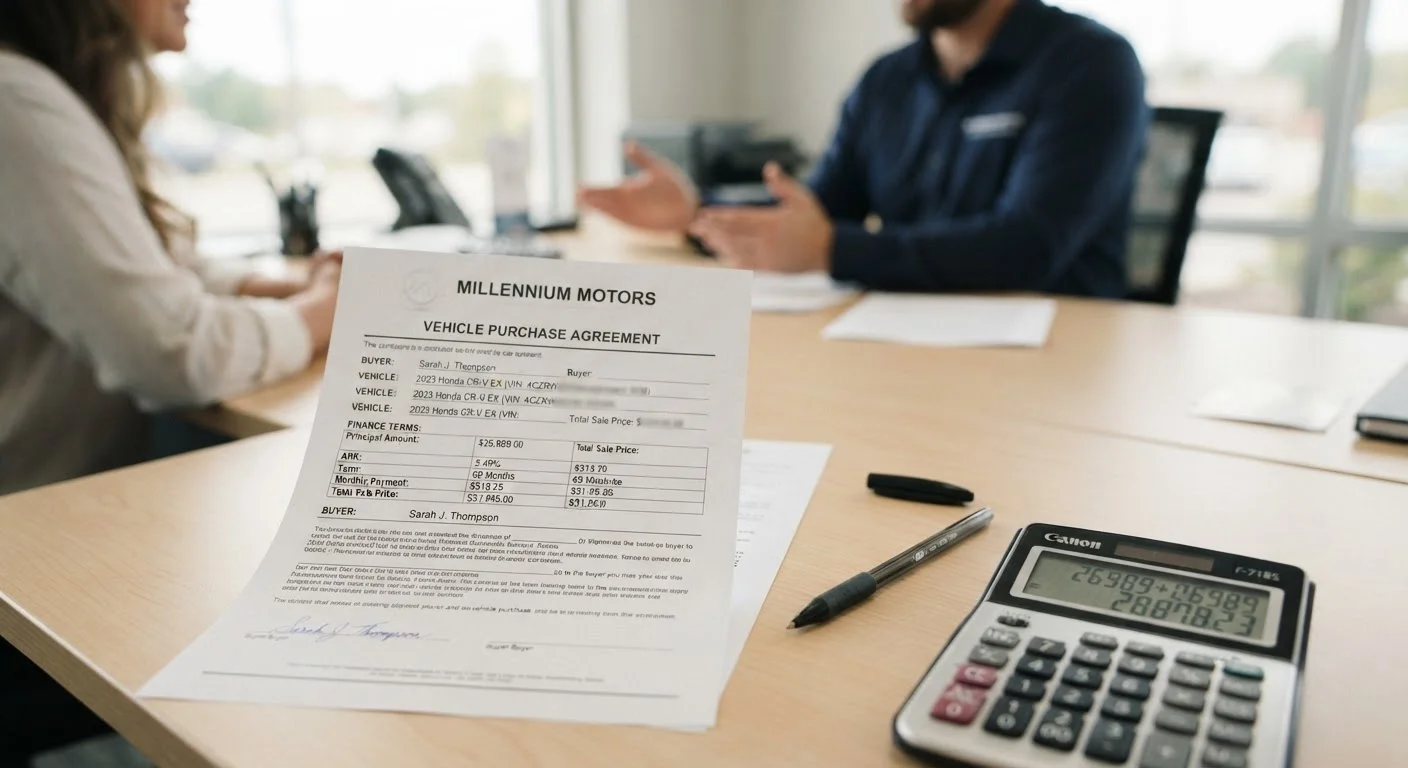
Why Three Different Prices Create Confusion
Walk into any dealership or scroll through any listing site and you'll encounter multiple figures attached to the same vehicle. The sticker price (also called the Monroney label price on new cars, or the advertised asking price on used vehicles) is what the seller wants you to focus on. It's the number in bold, the one used in ads. But it's not what you'll pay.
The asking price on a used car listing is simply the seller's opening figure — before any negotiation and before any fees are applied. It tells you roughly where the conversation starts, nothing more.
The out-the-door price is where the deal actually lands. It's the sum of every dollar changing hands: vehicle price, sales tax, title and registration fees, and dealer documentation (doc) fees. Some dealers also include fees for dealer-installed accessories or other add-ons in this figure.
Understanding the gap between these three numbers is foundational. For a deeper look at how advertised prices compare to final costs, see our piece on out-the-door price vs. sticker price.
What the Out-the-Door Price Actually Contains
An itemized OTD quote from a dealer should break down into four main categories:
- Negotiated vehicle price: The agreed sale price of the car itself, after any negotiation.
- Sales tax: Set by your state (and sometimes county or city). This is calculated as a percentage of the vehicle price and is non-negotiable — but it does vary depending on where you register the vehicle.
- Title and registration fees: State-mandated fees for transferring the title into your name and registering the vehicle. These are fixed by law and differ significantly by state.
- Dealer documentation fee: A fee dealers charge for processing paperwork. Doc fees vary widely — from under $100 to over $800 in some states — and in many states they are negotiable or capped by law.
Any legitimate dealer should provide a written OTD breakdown before you sign. If one refuses, treat that as a red flag.
$1,000–$3,000+
Typical fees and taxes added above asking price
The exact amount varies by state tax rate, local registration fees, and dealer documentation charges — making OTD comparisons essential.
$800+
Maximum doc fee charged by some dealers
Documentation fees are regulated or capped in some states but can reach several hundred dollars in others, according to state consumer protection offices.
Varies by state
Sales tax rate applied to vehicle purchases
State sales tax on vehicle purchases ranges from 0% in states with no sales tax to over 9% in some jurisdictions, directly affecting your OTD total.
How to Use OTD to Compare Deals Accurately
The practical power of the OTD price is in comparison. Two listings at $18,500 can have very different true costs depending on where the dealer is located, what fees they charge, and what add-ons they've bundled in.
Here's a reliable process for comparing used car deals on OTD terms:
- Contact each seller and request a written, itemized OTD quote for the specific vehicle you're considering.
- Confirm that the quote includes sales tax calculated at the rate for your registration address — not the dealer's location in some cases.
- Identify any dealer add-ons (paint protection, gap waivers, extended service contracts) included in the figure and ask for them to be removed if you don't want them. These are nearly always optional.
- Compare the final OTD figures side by side. The lower OTD wins on purchase cost — though you'll still want to factor in vehicle condition and history.
For the other factors buyers commonly miss when comparing deals, see things buyers overlook when comparing used car deals.
Negotiating Around the OTD Figure
Dealers often prefer to negotiate around monthly payment figures rather than OTD totals — a tactic that can obscure how much you're actually spending. Anchoring your negotiation to the OTD price keeps you in control.
When a seller claims their price is firm, that doesn't automatically mean the OTD is fixed. Doc fees, add-on packages, and accessories may still have room to move. For context on how posted prices work in practice, see what dealers mean when they say a price is non-negotiable.
Always Get the OTD Quote in Writing
Before you visit a dealership in person, call or email to request a written OTD quote for the specific vehicle. This gives you a documented baseline to compare across sellers and protects you against last-minute additions in the finance office. A reputable seller will provide this without hesitation.
Once you've reached a verbal agreement, always ask for the revised OTD figure in writing before signing any paperwork. Figures can shift between the sales conversation and the finance office, a phenomenon buyers sometimes call "payment packing." A written OTD quote is your benchmark against any last-minute additions.
This article is for general informational and educational purposes only. It does not constitute financial, legal, or tax advice. Consult a qualified professional for guidance specific to your situation.