What Each Price Actually Represents
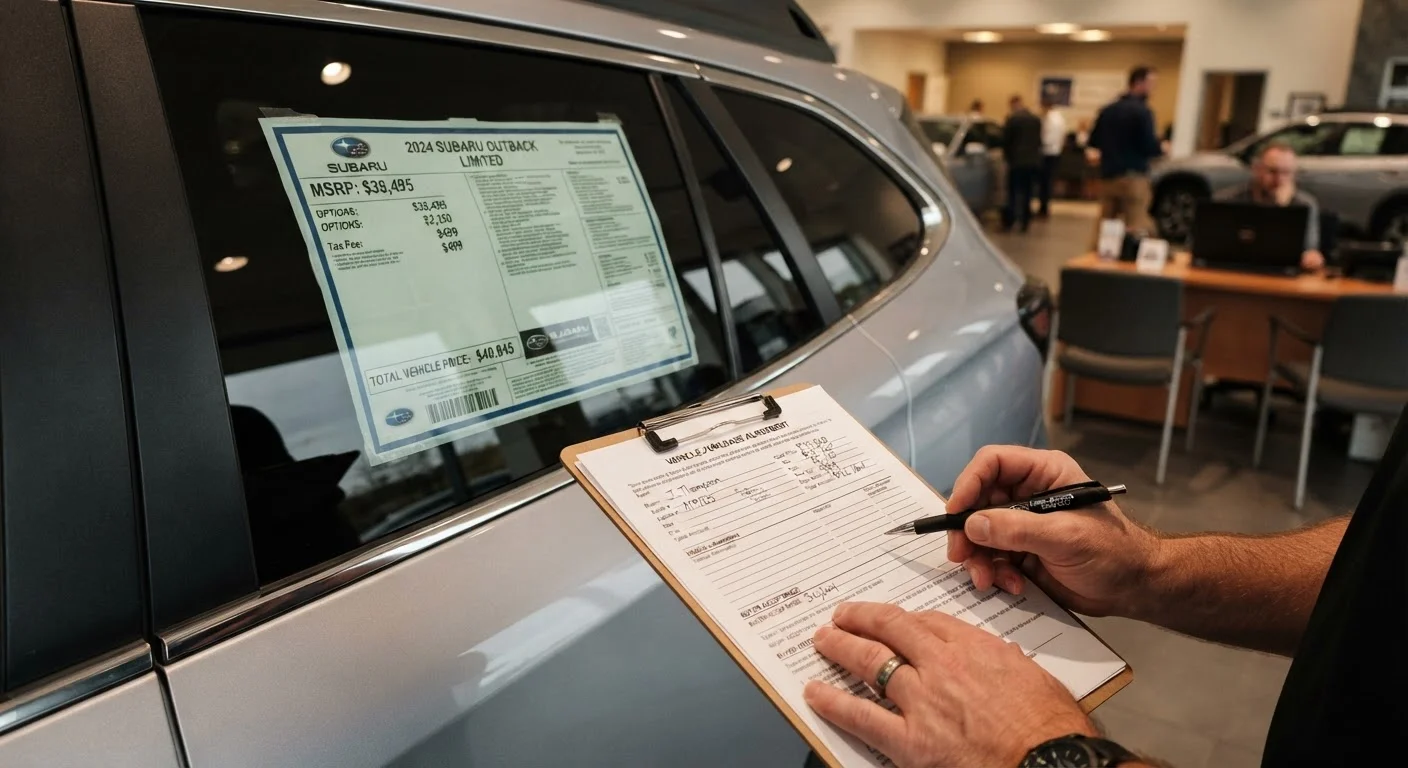
The sticker price - formally called the Manufacturer's Suggested Retail Price (MSRP) - is the figure printed on the Monroney label affixed to every new vehicle's window. It represents the manufacturer's recommended selling price for a specific trim level and its factory-installed options. Dealers are not legally required to sell at MSRP; it is a starting reference, not a binding price.
The out-the-door price is the total amount you will pay to take possession of the vehicle. It combines the negotiated vehicle price with every additional cost the dealership and government require before you can legally drive away. These include state and local sales tax, title and registration fees, documentation ("doc") fees, and any dealer-installed add-ons that weren't clearly declined.
Understanding this gap is essential. A vehicle priced at $32,000 MSRP can easily carry an out-the-door price of $35,000 or more depending on your state's tax rate, the dealer's doc fee, and any bundled products. See our breakdown of hidden costs that inflate auto loans for a detailed look at how these charges compound when rolled into financing.
What Goes Into the Out-the-Door Price
Breaking down the out-the-door price helps you identify which line items are fixed, which are negotiable, and which are optional:
- Negotiated vehicle price: What you and the dealer agree the car is worth - often below MSRP on new vehicles, though market conditions vary.
- Sales tax: Calculated as a percentage of the negotiated price; the rate is set by your state and sometimes county or city. This is non-negotiable.
- Title and registration fees: State-mandated charges to register the vehicle and transfer ownership. These are fixed by law.
- Documentation fee: A dealer administrative charge for processing paperwork. Amounts vary significantly by state; some states cap this fee while others do not.
- Dealer add-ons: Items like paint sealant, window tinting, or protection packages installed by the dealer. These are often negotiable or can be declined entirely.
| Criterion | Sticker Price (MSRP) | Out-the-Door Price |
|---|---|---|
| What it includes | Vehicle base price + factory options | Vehicle price + tax + fees + add-ons |
| Set by | Manufacturer | State law + dealer charges |
| Negotiable? | Yes - dealers can go above or below | Partially - taxes are fixed; fees vary |
| Reflects total payment? | No | Yes |
| Best used for | Early-stage model comparisons | Final budget decisions and dealer comparisons |
| Typical gap from each other | Starting reference point | Often $1,500-$4,000+ above MSRP |
For buyers comparing new and used options, keep in mind that used vehicles may also carry dealer certification fees or inspection charges. Our guide on the real cost difference between new and used cars walks through how these totals diverge across vehicle types.
How to Use These Numbers at the Dealership
When you arrive at a dealership, the conversation will often start around monthly payments or MSRP. Redirecting it to the out-the-door price is one of the most effective negotiating moves you can make. Here's how to approach it:
- Request the out-the-door price in writing early. Ask the salesperson or finance office to provide a complete itemized worksheet showing every charge before you discuss payment terms.
- Compare out-the-door prices across dealerships - not monthly payments. Two dealers offering the same vehicle can quote identical monthly payments at very different total costs depending on loan term and included fees.
- Challenge optional line items. Dealer-installed accessories and protection packages added without your prior consent are candidates for removal or price reduction.
- Confirm the out-the-door price before entering the finance office. The F&I (Finance and Insurance) office is where additional products are frequently presented. Know your agreed total so you can identify any new charges.
Buyers evaluating used car listings specifically should review what the out-the-door price actually means for used car deals and factors buyers commonly overlook when comparing used car deals side by side to avoid common comparison errors.
Finally, remember that the purchase price - sticker or otherwise - is only one dimension of the vehicle's financial impact. Total cost of ownership, which includes fuel, insurance, maintenance, and depreciation, gives you the complete picture over time.