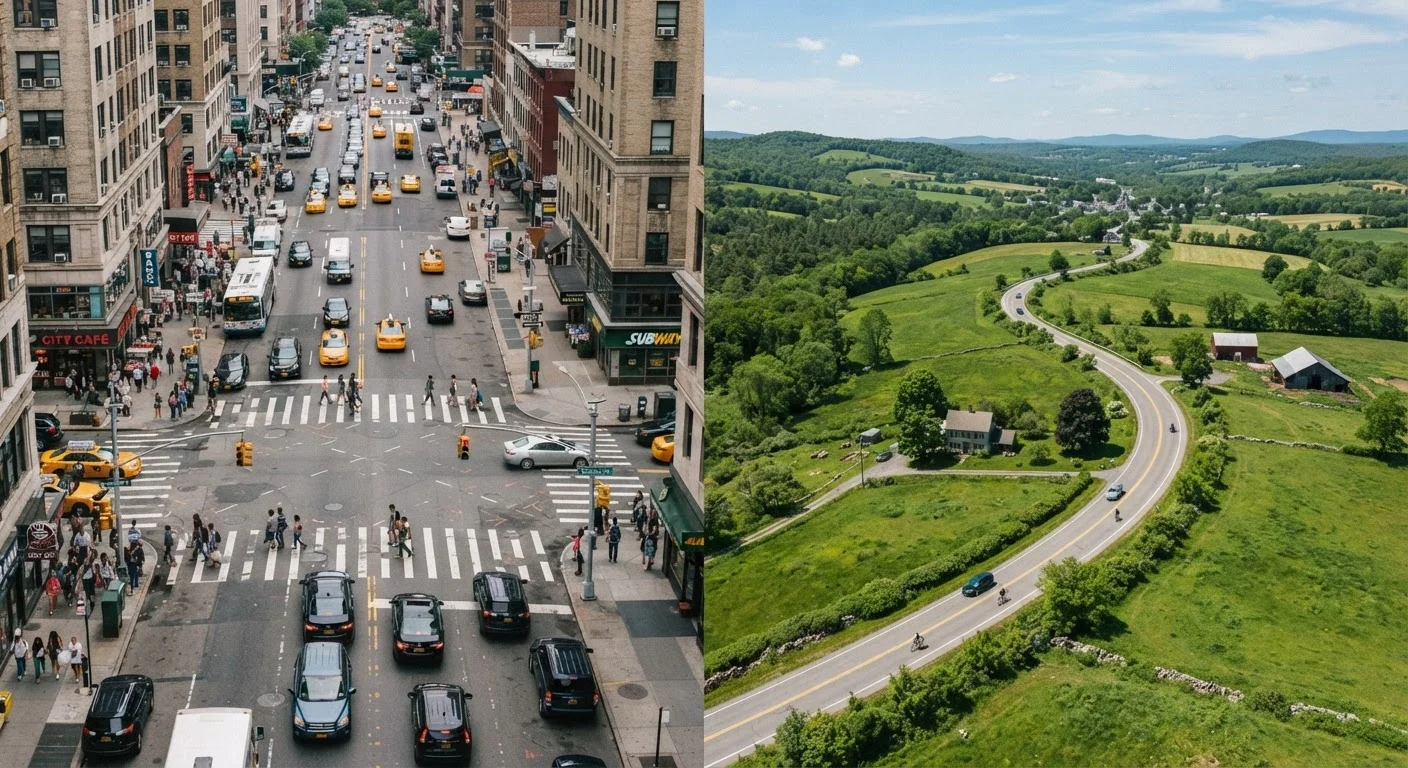
Why the Same Driving Style Doesn't Work Everywhere
Most drivers develop a default driving style shaped by the roads they use most often. That works well enough within familiar territory — but it creates measurable risk the moment the environment changes. The habits that make you efficient in stop-and-go city traffic can leave you under-prepared on a fast-moving rural road, and vice versa.
Understanding what each environment actually demands — rather than assuming road-to-road continuity — is the foundation of genuinely safer driving. See also our guide on defensive vs. reactive driving mindsets, which underpins safe navigation in both settings.
| Urban Driving | Rural Driving | |
|---|---|---|
| Primary hazard type | High-density, short-range interactions | High-speed, long-range sight distance |
| Typical speed range | 15–45 mph | 45–70+ mph |
| Scanning distance | 2–4 seconds ahead | 12–15 seconds ahead |
| Key vulnerable road users | Pedestrians, cyclists | Animals, agricultural vehicles |
| Fatigue risk | Lower — constant stimulation | Higher — monotonous environment |
| Emergency response time | Typically faster | Often significantly delayed |
| Lighting availability | Generally well-lit at night | Often unlit; relies on headlights only |
Urban Driving: Managing Complexity at Close Range
City driving is characterized by high information density at low speeds. At any given moment, an urban driver is processing traffic signals, cyclists, pedestrians stepping off curbs, double-parked vehicles, and constantly changing lane configurations. The dominant hazard is not speed — it's the volume and unpredictability of interactions compressed into a small space.
Key adjustments for urban environments
- Short-interval scanning: Shift your gaze actively between the immediate foreground, crosswalks, and adjacent lanes every few seconds. Static fixation on one point is a primary cause of urban collisions.
- Anticipate door zones: Maintain a lateral buffer from parked vehicles. A car door opening unexpectedly demands immediate reaction time you may not have at city speeds.
- Yield generously to pedestrians and cyclists: Legally and practically, assume they may enter your path. Slowing proactively costs seconds; a collision costs far more.
- Manage intersections deliberately: Even on a green light, perform a left-right-left scan before committing. Red-light violations and pedestrian crossing errors cluster at intersections. Our roundabout guide covers intersection logic in detail.
Rural Roads: Speed, Sightlines, and Isolation
Rural roads are statistically more lethal per mile traveled than urban streets. According to the National Highway Traffic Safety Administration (NHTSA), rural roads consistently account for roughly half of all U.S. traffic fatalities despite carrying a smaller share of total vehicle miles traveled. The reasons are structural: higher speeds, limited lighting, poor sight distances, and longer emergency response times.
Key adjustments for rural environments
- Extend your scanning horizon: At highway-adjacent speeds, you cover far more distance between perception and braking than in a city. Train your eyes to read 12–15 seconds ahead of your vehicle, not just two or three car lengths.
- Respect advisory curves: Yellow curve-speed signs are based on engineering data. They are not conservative suggestions — they reflect the geometry of the road. Entering a curve faster than the advised speed reduces your margin to zero.
- Account for animal and agricultural crossings: Deer, livestock, and slow-moving farm equipment appear with little warning on rural routes. Dusk and dawn are peak animal activity periods.
- Manage fatigue actively: Rural driving is monotonous, and monotony accelerates fatigue faster than complex urban navigation. Plan rest stops on long rural stretches rather than relying on willpower. Pair this with the techniques in our night driving guide, since rural nighttime driving compounds these risks significantly.
Adverse weather magnifies every rural hazard. The strategies in our rain, ice, and fog guide are especially relevant on rural routes with limited drainage and no street lighting.
Making the Transition: Recalibrating Between Environments
One of the most underappreciated risk moments is the transition between road types — particularly moving from urban to rural. After sustained city driving, your speed perception recalibrates downward: 60 mph begins to feel slow, making it easy to unconsciously exceed safe limits for the road's geometry. The reverse is also true: drivers entering a city after a long rural stretch may feel rushed and underestimate pedestrian risk.
A practical recalibration habit:
- When leaving urban roads, consciously check your speedometer against posted limits rather than relying on feel for the first five minutes.
- When entering an urban area, reset your mental hazard model — anticipate short-range, unpredictable interactions rather than the long-horizon awareness rural driving built up.
- On long trips blending both environments, treat each major road-type change as a deliberate mental gear-shift, not a passive background adjustment.
If your trips regularly include motorway segments between urban and rural legs, our motorway merging guide addresses the speed and positioning skills that connect the two.
Build a Conscious Transition Routine
When you cross from one road type to another, take 30 seconds to verbally or mentally note the change: new speed limit, new primary hazards, new scan pattern. This brief deliberate reset interrupts autopilot driving — which is when most environment-mismatch errors occur. It takes almost no time and meaningfully sharpens your situational awareness for the miles ahead.