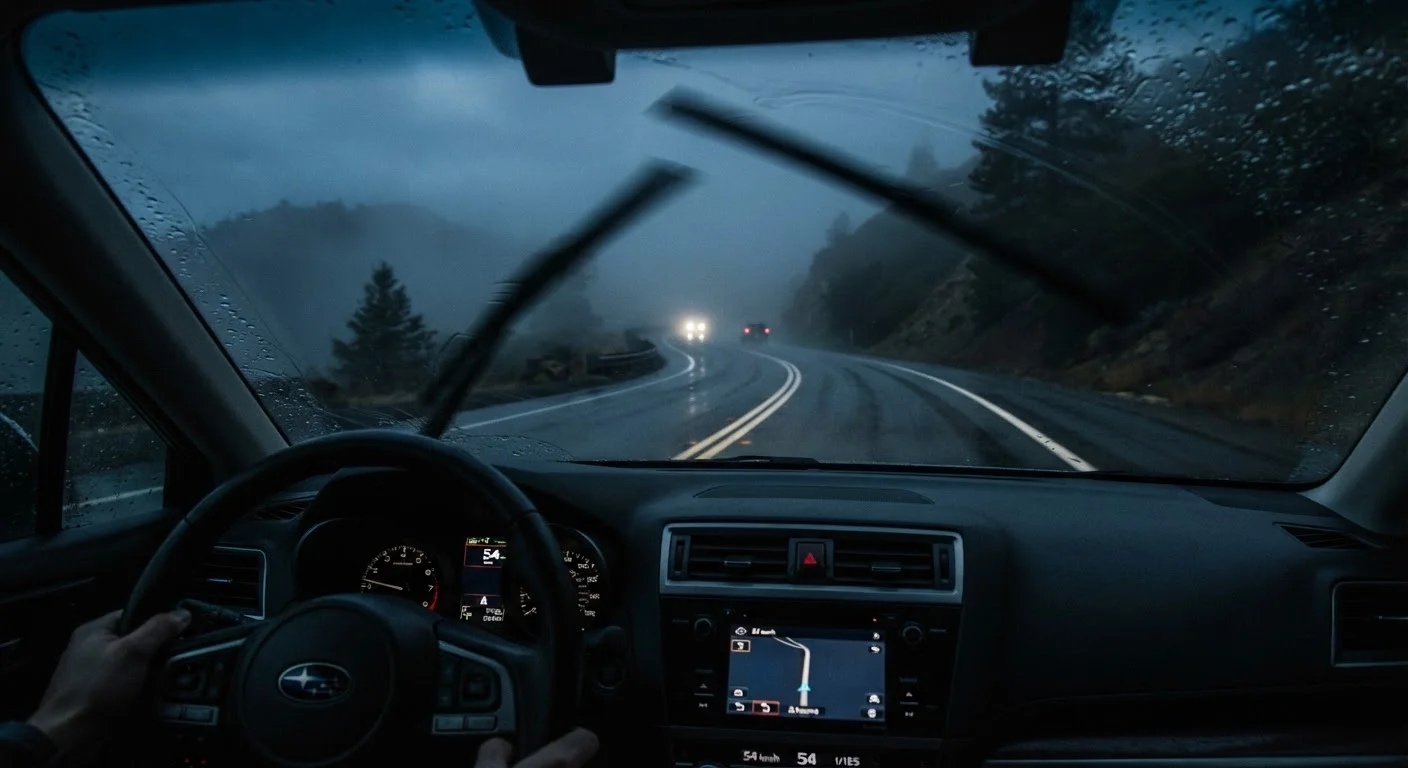
Why Conditions Matter More Than the Speed Limit
Posted speed limits are set for ideal conditions — dry pavement, good visibility, normal traffic. When rain, ice, or fog enters the picture, those numbers become a ceiling, not a target. The legal speed and the safe speed are two different things, and confusing them is one of the most common mistakes drivers make in adverse weather.
Understanding how each condition changes your vehicle's behavior is the foundation of driving safely when the weather turns. As stopping distance research shows, even modest speed increases lead to dramatically longer braking requirements — and wet or icy roads compound that effect significantly.
It's also worth noting that driver assistance systems like ABS and lane-keeping aids can be degraded by the very conditions where you need them most. The steps below give you a condition-by-condition framework for adjusting your approach.
What You'll Need Before You Start
What you will need
Tire tread depth gauge
Measures remaining tread depth to confirm tires can evacuate water or grip snow effectively.
Vehicle owner's manual
Provides manufacturer guidance on driving in specific conditions and correct use of traction systems.
Dedicated winter or all-season tires
Winter-rated tires maintain grip at low temperatures where standard all-season tires harden and lose effectiveness.
Step-by-Step: Adjusting Speed for Rain, Ice, and Fog
Assess conditions before you move
Before pulling out of a driveway or parking space, spend 60 seconds reading the environment. Check whether rain is light or heavy, whether surfaces look wet, slushy, or icy, and what the visibility range is. These observations set your initial speed target and following distance before you encounter traffic.
Look for clues beyond the obvious: ice forms first on bridges, overpasses, and shaded stretches of road — even when surrounding pavement appears clear.
Reduce speed progressively for rain
In light rain, reduce your speed by roughly 10 mph below the posted limit and increase your following distance to at least four seconds behind the vehicle ahead. In heavy rain or standing water, slow further and avoid cruise control entirely — aquaplaning (when the tire rides on a film of water rather than gripping the road surface) can occur suddenly and disables your ability to steer or brake effectively.
If you feel the steering go light or the engine revs spike without acceleration, ease off the throttle gently — do not brake sharply.
Dramatically cut speed on ice or snow
Ice reduces tire grip to a fraction of dry-road levels. A common guideline from driving safety organizations is to reduce speed by half on packed snow and to drive at a crawl on glare ice. Braking distances can increase by five to ten times compared to dry pavement at identical speeds.
Accelerate and brake in slow, smooth motions. Sudden inputs — whether steering, throttle, or braking — transfer weight abruptly and can cause a skid. If the rear of the vehicle begins to slide, steer gently in the direction of the slide without overcorrecting.
Use low beams and slow down in fog
In fog, switch to low-beam headlights — high beams reflect off water droplets and reduce your own visibility. If your vehicle has dedicated fog lights, use them. Reduce speed until your stopping distance comfortably fits within what you can actually see ahead of you. If you can only see 100 feet ahead, you should be able to stop within 100 feet.
Increase your following distance to at least six seconds in dense fog. Use the painted edge line on the right side of the road as a visual guide rather than fixating on taillights ahead, which can cause you to unconsciously close the gap.
Maintain smooth, deliberate steering and braking
Regardless of the specific condition, the universal principle is smooth control inputs. Harsh steering, abrupt braking, and sudden acceleration all transfer vehicle weight rapidly, which reduces grip precisely when you need it most. Practice the habit of looking further ahead than usual — at least 12 seconds down the road — so you can react gradually rather than sharply.
If your vehicle has ABS (Anti-lock Braking System), apply firm, steady pressure to the brake pedal and hold it — do not pump the brakes. The system modulates pressure automatically to prevent wheel lockup.
Do Not Rely Solely on Your Vehicle's Safety Systems
ABS, electronic stability control, and traction control are valuable aids, but they have defined limits in severe conditions. They cannot overcome the physics of excessive speed on ice or the absence of visibility in dense fog. These systems are designed to help you maintain control — they are not a substitute for reduced speed and increased following distance. Always treat them as a safety net, not a permission slip.
Recognizing When to Pull Over — and How
Sometimes the correct adjustment isn't a lower speed — it's stopping entirely. If visibility drops below the distance you can stop in, or if you feel the vehicle responding unpredictably despite smooth inputs, pulling over is the safest decision available to you.
Choose a parking lot, rest area, or wide shoulder away from the travel lane. Turn on your hazard lights and remain in the vehicle with your seatbelt fastened until conditions improve. Exiting onto a live roadway in low visibility or icy conditions is itself a significant hazard.
Fatigue also compounds the danger of adverse weather. Recognising the early signs of driving fatigue before your reactions slow is equally important when weather demands constant concentration. Similarly, the skills covered in night driving safety overlap significantly with fog driving — both involve managing severely reduced sight lines.
This article is for general informational and educational purposes only. Always follow local traffic laws and use your own judgment based on the specific conditions you encounter. If you are unsure whether your vehicle is roadworthy for adverse weather, consult a qualified mechanic.