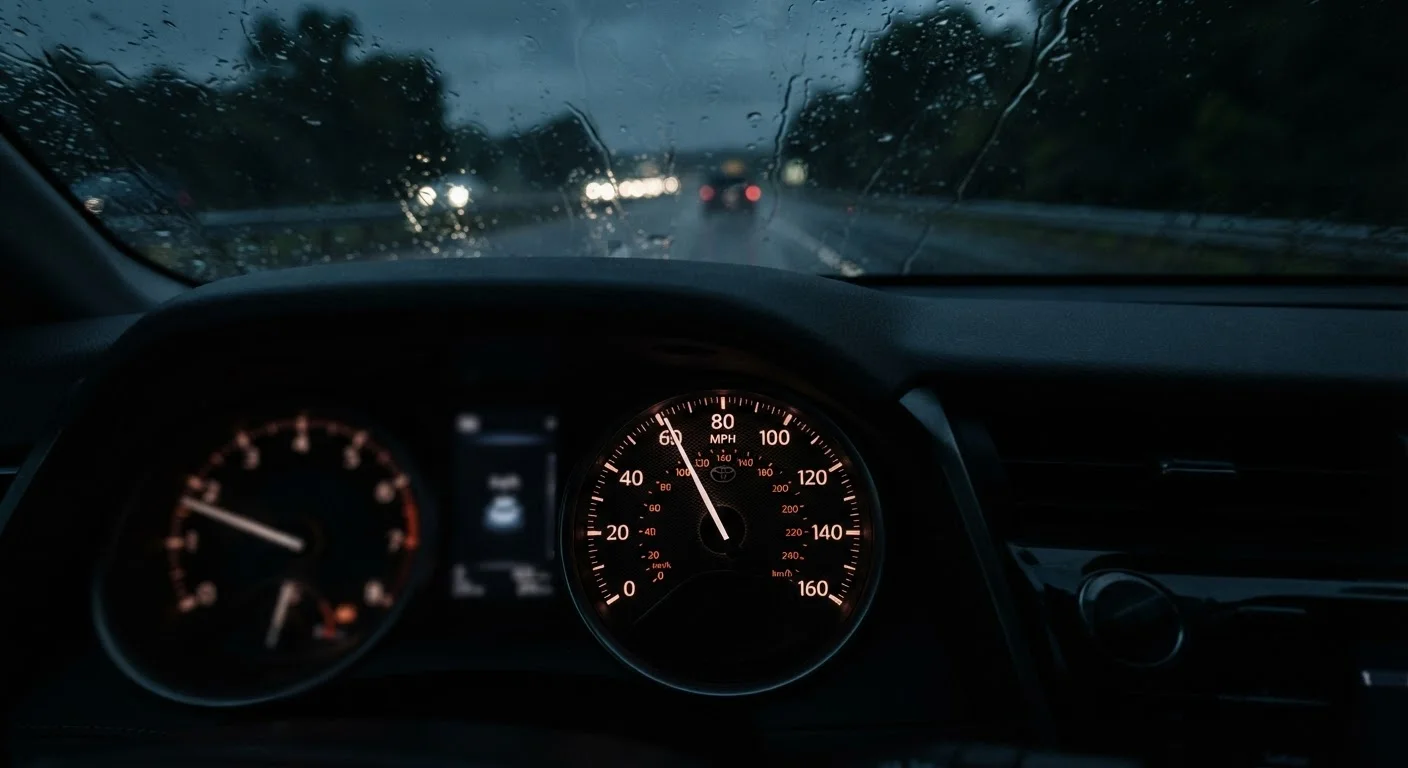
The Two Phases Every Driver Should Understand
When you see a hazard ahead and bring your vehicle to a stop, two distinct phases are happening in sequence. The first is thinking distance — from the moment your eyes detect a problem to the moment your foot contacts the brake pedal. At 30 mph, an alert driver with an average reaction time of 1.5 seconds will travel approximately 66 feet before braking even begins. The second phase is braking distance — the additional road your vehicle needs to decelerate from its current speed to zero once the brakes are applied.
These two distances add together to form your total stopping distance. Many drivers instinctively focus on braking alone, but thinking distance is equally significant. If you are fatigued or distracted, your reaction time increases, and thinking distance grows substantially. Driving fatigue is a particularly serious contributor — a tired driver's perception and response can lag by seconds, not fractions of a second.
Why Speed Doesn't Scale the Way You'd Expect
The most important — and most misunderstood — characteristic of stopping distance is that it does not scale in a straight line with speed. Braking distance follows what physicists call a square relationship: it increases with the square of your speed. In practical terms, this means:
- Going from 20 mph to 40 mph (doubling speed) roughly quadruples the braking distance.
- Going from 30 mph to 60 mph (doubling speed) increases braking distance by approximately four times.
- The jump from 60 mph to 70 mph adds a disproportionate amount of stopping distance compared to what that 10 mph increase might feel like behind the wheel.
This is why speed limits near schools and residential areas are so much lower — it isn't arbitrary. A pedestrian struck at 20 mph has a vastly higher survival rate than one struck at 40 mph, and stopping distance is a central reason why.
2x
Braking distance increase on wet vs. dry roads
General engineering guidance and driver education curricula consistently indicate wet roads can double stopping distances compared to dry pavement of equivalent quality.
4x
Braking distance increase when speed doubles
Because braking distance scales with the square of speed, doubling your speed quadruples the braking distance required — a core principle of vehicle dynamics.
~66 ft
Distance traveled during reaction time at 30 mph
Based on an average alert driver reaction time of approximately 1.5 seconds, a vehicle at 30 mph covers roughly 66 feet before braking even begins.
How Road and Weather Conditions Change Everything
The stopping distances most drivers learn are calculated for ideal conditions: dry pavement, properly inflated tires with full tread depth, and fully functional brakes. Real-world driving rarely presents all of these at once.
On wet roads, reduced tire grip means braking distances can be roughly double those on dry pavement. On ice or compacted snow, friction drops so dramatically that stopping distances can extend to ten times or more the equivalent dry-road figure. This makes the posted speed limit feel almost hypothetical — it was set for conditions significantly better than a slick winter road. Matching your speed to road conditions is a critical habit that goes beyond simply following the speed limit.
Tire condition is another major variable. Tires worn below the recommended tread depth lose grip well before a dry road would cause concern. During every vehicle inspection, confirm your tire tread depth and inflation are within manufacturer specifications — your stopping distance depends on it. Similarly, degraded brake pads extend braking distances; a qualified mechanic should inspect your braking system at intervals recommended in your owner's manual.
Translating Stopping Distance Into Daily Driving Habits
Understanding stopping distance is only useful if it changes how you drive. Here are the practical implications:
Following Distance
Your following gap must account for your vehicle's full stopping distance at the current speed. The widely used two-second rule — choosing a fixed point and ensuring the car ahead clears it at least two seconds before you do — is a minimum for dry conditions. In rain, fog, or at night, that margin should be extended to at least four seconds. Tailgating removes this buffer entirely, leaving no room for error if the vehicle ahead brakes suddenly.
Speed Selection
The posted speed limit reflects a safe maximum under normal conditions — not a target. When visibility is reduced, road surfaces are compromised, or traffic is heavy, driving below the limit is appropriate. Night driving introduces another layer: your headlights illuminate only a limited distance ahead, and you should never be driving at a speed that prevents you from stopping within that visible range.
A Note on Acceleration vs. Stopping
It's worth noting that while a vehicle's acceleration figures — like the 0–60 mph time — capture interest in car reviews, they have little bearing on safety margins. Stopping distance is the number that matters most in an emergency. Our guide on what acceleration figures actually tell you explores what those performance numbers do and don't reveal.