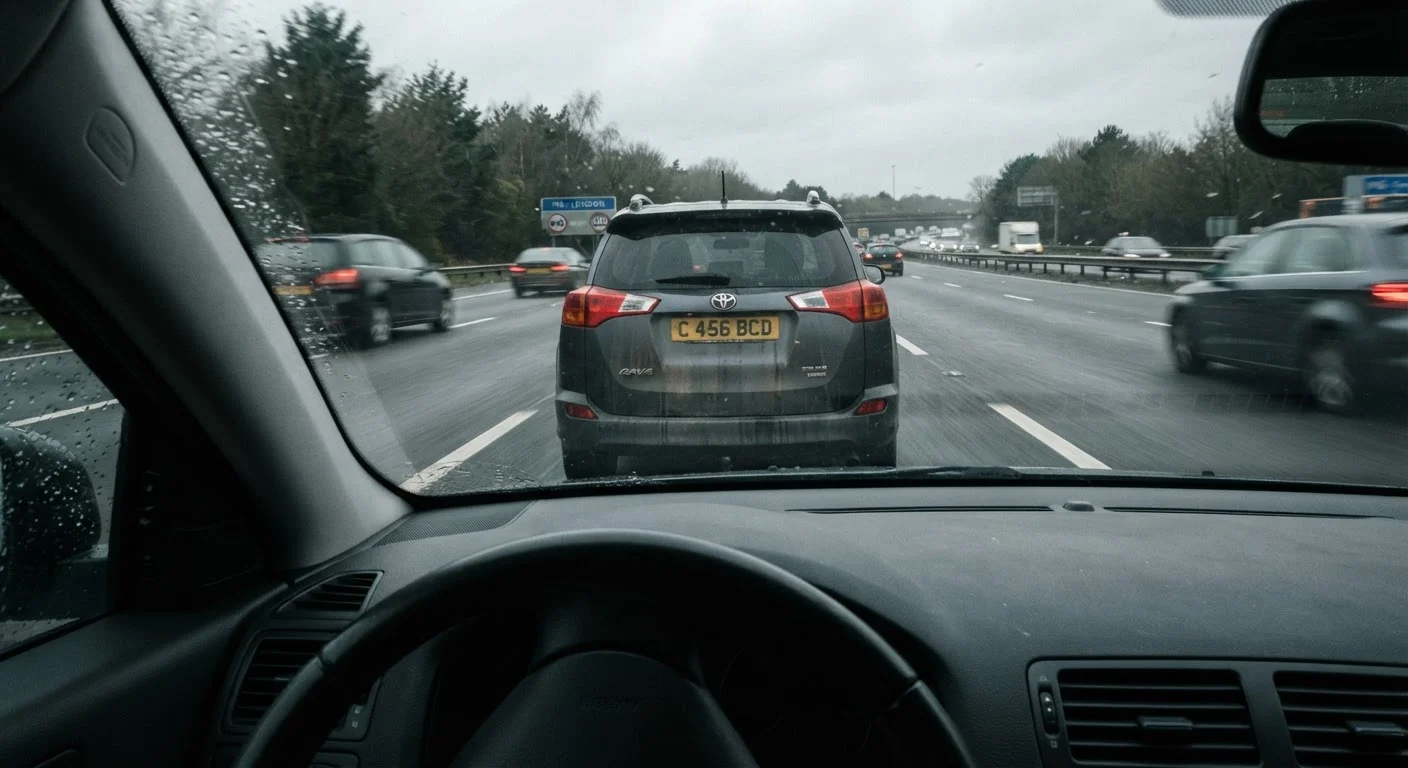
Why Stopping Distance Is Bigger Than You Think
Most drivers carry a mental image of how quickly their car can stop — and that image is almost always optimistic. Stopping a vehicle involves two separate phases: the reaction phase (the time between seeing a hazard and pressing the brake) and the braking phase (the distance the vehicle travels while the brakes slow it to a halt).
At 60 mph, your car covers approximately 88 feet every second. If your perception and reaction time totals just 1.5 seconds — a reasonable average for an alert, undistracted driver — you have already traveled more than 130 feet before the brakes engage. Add braking distance on top, and a complete stop from highway speed can consume well over 300 feet under real-world conditions.
Wet pavement, worn tires, or a loaded vehicle extend that figure further. Driving fatigue pushes reaction times out even more, sometimes to two seconds or beyond — which can add another 175 feet to the equation before braking even begins.
~29%
Of all U.S. crashes involve rear-end collisions
According to the National Highway Traffic Safety Administration (NHTSA), rear-end crashes are one of the most prevalent crash types on American roads.
1.5 sec
Average driver reaction time to a hazard
Research into driver response times consistently finds 1.5 seconds as a baseline for alert, undistracted drivers — longer when fatigued or distracted.
4–5x
Increase in stopping distance from 30 to 60 mph
Braking distance grows roughly with the square of speed, meaning highway speeds demand dramatically more space than city driving.
The Two-Second Rule — and When It Isn't Enough
The two-second rule is the most widely taught following-distance guideline in the U.S. To apply it, pick a fixed roadside marker — a sign, a bridge, or a shadow line. When the vehicle ahead passes it, count one-one-thousand, two-one-thousand. If your front bumper reaches that marker before you finish counting, you are too close.
Two seconds works as a floor in clear, dry conditions at moderate speeds. It is not enough in many common situations:
- Rain or wet roads: Stopping distances can increase by 50% or more. Extend to four seconds.
- Highway speeds (65+ mph): The absolute gap represented by two seconds is large, but traffic dynamics at high speed demand more buffer — aim for three seconds.
- Towing a trailer: Your vehicle's braking capacity is reduced and load inertia increases. Four seconds or more is appropriate.
- Following large trucks: Trucks take longer to stop. Staying further back also improves your sightlines past the vehicle.
New drivers in particular often underestimate how quickly situations develop. New license holders frequently discover that the gaps that felt comfortable during their test are inadequate in dense or fast-moving traffic.
What Modern Safety Technology Can — and Cannot — Do
Many vehicles sold today include automatic emergency braking (AEB) and forward collision warning systems. These features genuinely reduce crash severity in certain scenarios. However, they operate within physical and technological limits that drivers need to understand.
AEB systems typically require a minimum closing speed and a clear radar or camera path to the obstacle. Heavy rain, snow, or a dirty sensor can impair their effectiveness. More importantly, even the fastest AEB system cannot overcome insufficient following distance — if you are already inside your minimum stopping distance when a hazard appears, no system can prevent a collision.
Think of safety technology as a last resort, not a buffer you can borrow against. Maintaining adequate following distance means these systems never have to work that hard. For context on how vehicle cameras and sensors assist — but also where they fall short — see our guide on getting the most out of your car's reversing camera.
Practical Habits That Reduce Tailgating Risk
Safe following distance is not just a reactive measure — it is a driving posture you can build into every trip.
- Check your gap at every opportunity. Use the two-second rule as a continuous habit, not just something you apply during tests. Traffic density and speed change constantly.
- Anticipate, don't just react. Watch brake lights several vehicles ahead when possible. Seeing a hazard developing gives you extra time before the car directly ahead brakes.
- Reduce speed early in changing conditions. When rain starts or visibility drops, increase your gap before the road deteriorates further.
- Manage your own stress response. If another driver is following you too closely, resist the urge to speed up to appease them. Instead, ease off gradually to build more space ahead of you, softening any need for hard braking.
- Stay off distractions. Every second of inattention is a second of travel at full speed with no response. Even a brief glance at a screen at 60 mph means traveling the length of a typical house blind.
These habits cost nothing and require no equipment. They do, however, require conscious, consistent practice — especially because tailgating often develops gradually and unintentionally as traffic compresses around a driver.