What Your Reversing Camera Actually Shows You
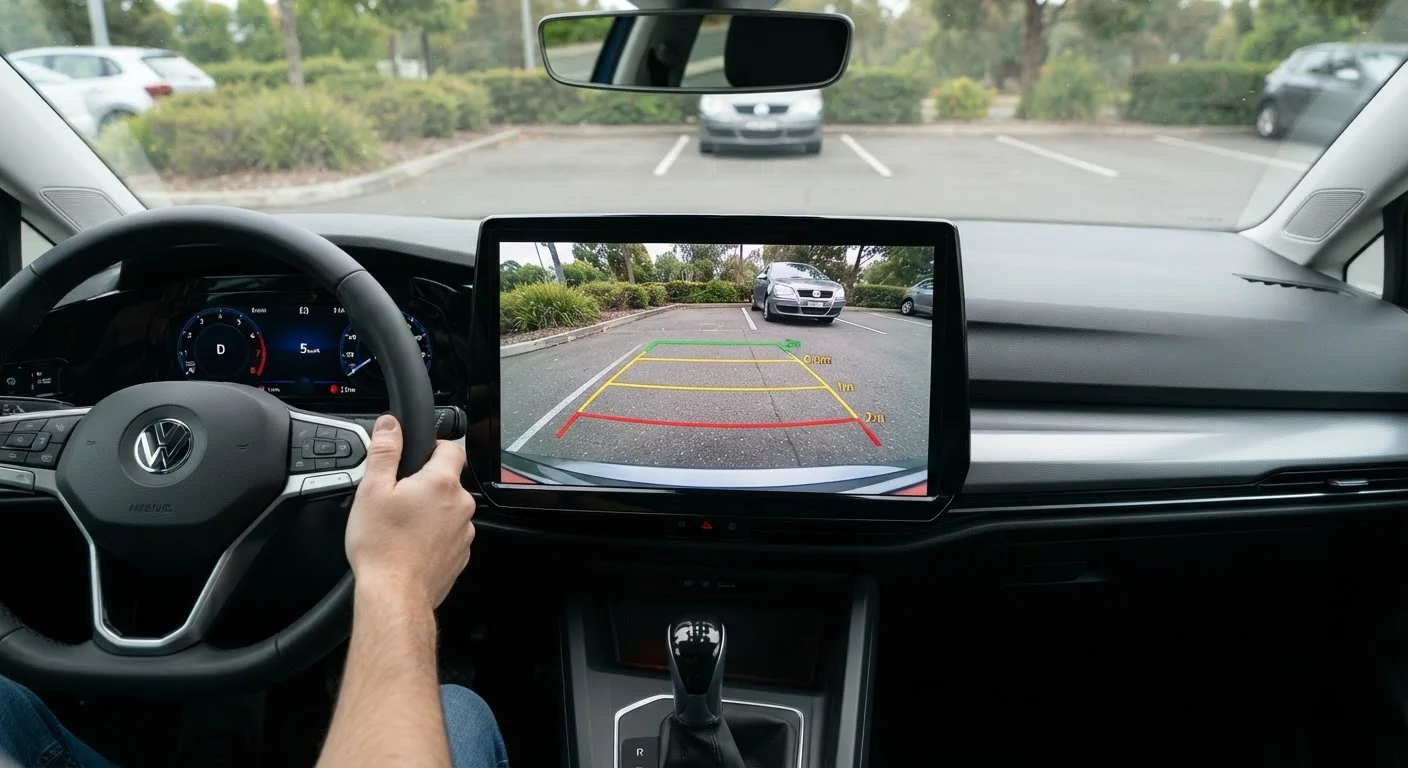
A reversing camera is a wide-angle lens mounted near the rear of your vehicle, feeding a live image to your infotainment screen the moment you select reverse gear. Most systems use a wide field of view — often between 120 and 180 degrees — which sounds comprehensive until you understand what that means in practice.
Wide-angle lenses compress distance. Objects at the edge of the frame appear farther away than they are in reality, and the centre of the image can make a nearby obstruction look reachable when it is not. The camera also sits at a fixed height, which creates a persistent blind zone directly below and close to the bumper. A child crouching behind a tyre, a wheel stop, or a low kerb can all fall entirely outside what the camera captures.
Many vehicles pair the camera with dynamic guidelines — coloured lines that shift as you turn the steering wheel to project where the vehicle's path will take it. These are useful reference tools, but they model your vehicle's geometry, not the real world. They cannot account for uneven surfaces, inclines, or objects at different heights along that projected path.
Camera Systems Cannot Replace Awareness
Reversing cameras are classified as driver assistance tools, not safety guarantees. Regulatory bodies and vehicle manufacturers consistently note that no camera system eliminates the need for a physical check of the reversing area. The camera supplements your awareness — it does not replace it. Drivers remain responsible for any collision that occurs while reversing, regardless of what assistance technology is fitted.
Building a Safe Reversing Routine
The most effective use of a reversing camera is as one layer of a multi-step routine — not as a standalone solution. Before you engage reverse, do a quick walkaround if you have any doubt about what is behind your vehicle, particularly in driveways, unfamiliar parking areas, or spaces with limited visibility. This takes seconds and catches hazards no camera can.
Once reversing, use your mirrors in combination with the camera display. Your side mirrors give you a different angle on close obstacles and kerbs that the camera's wide lens can distort or miss. Alternate your gaze between the screen and the mirrors at a steady rhythm rather than staring solely at the display — a habit that takes practice but becomes natural quickly.
Reversing speed matters enormously. The camera's image processes in near-real-time, but it takes a moment for your eye to register a new hazard on screen and for your foot to respond. At low speed — typically below 10 km/h — you have meaningful reaction time. Higher reversing speeds compress that window dangerously. See our guide on following distances and reaction time for more on how speed affects stopping distance in close-quarters situations.
Maintaining Your Camera for Consistent Performance
A reversing camera is only as useful as its current image quality. The lens sits at the rear of the vehicle — exactly where road grime, mud, rain, and condensation accumulate. A dirty lens produces a blurred, darkened, or colour-shifted image that can mislead you about what is actually there.
Wipe the camera lens regularly with a soft, damp cloth as part of your routine vehicle clean. Avoid abrasive materials that can scratch the lens coating. In winter, check that ice or snow is not partially blocking the lens before reversing — some vehicles include a heated camera surround for this reason, but many do not.
If your camera display shows persistent image distortion, colour banding, or a blank screen, have the system inspected by a qualified technician. Camera faults are not always obvious at a glance — a subtly misaligned or fogged lens can make your view look acceptable while meaningfully reducing the system's accuracy.
For a broader look at how your camera compares with parking sensors and other assistance systems, see Parking Assistance Tech Compared. And if your vehicle includes rear cross-traffic alert alongside the camera, Rear Cross-Traffic Alert: The Feature Buyers Often Overlook explains how those two systems work together most effectively.
Reversing cameras are a genuine safety aid — but they reward the drivers who understand their limitations just as much as their capabilities. Pair the camera with good habits, keep the lens clean, and treat the guidelines as a guide, not a guarantee.