What Problem Is It Actually Solving?
Backing out of a perpendicular or angled parking space is one of the most collision-prone moments in everyday driving. You're moving slowly, your view is partially or completely blocked by vehicles on either side, and cross-traffic can appear quickly from either direction. Turning your head and checking mirrors helps, but there's a significant blind arc behind most vehicles that no amount of neck-craning can fully cover.
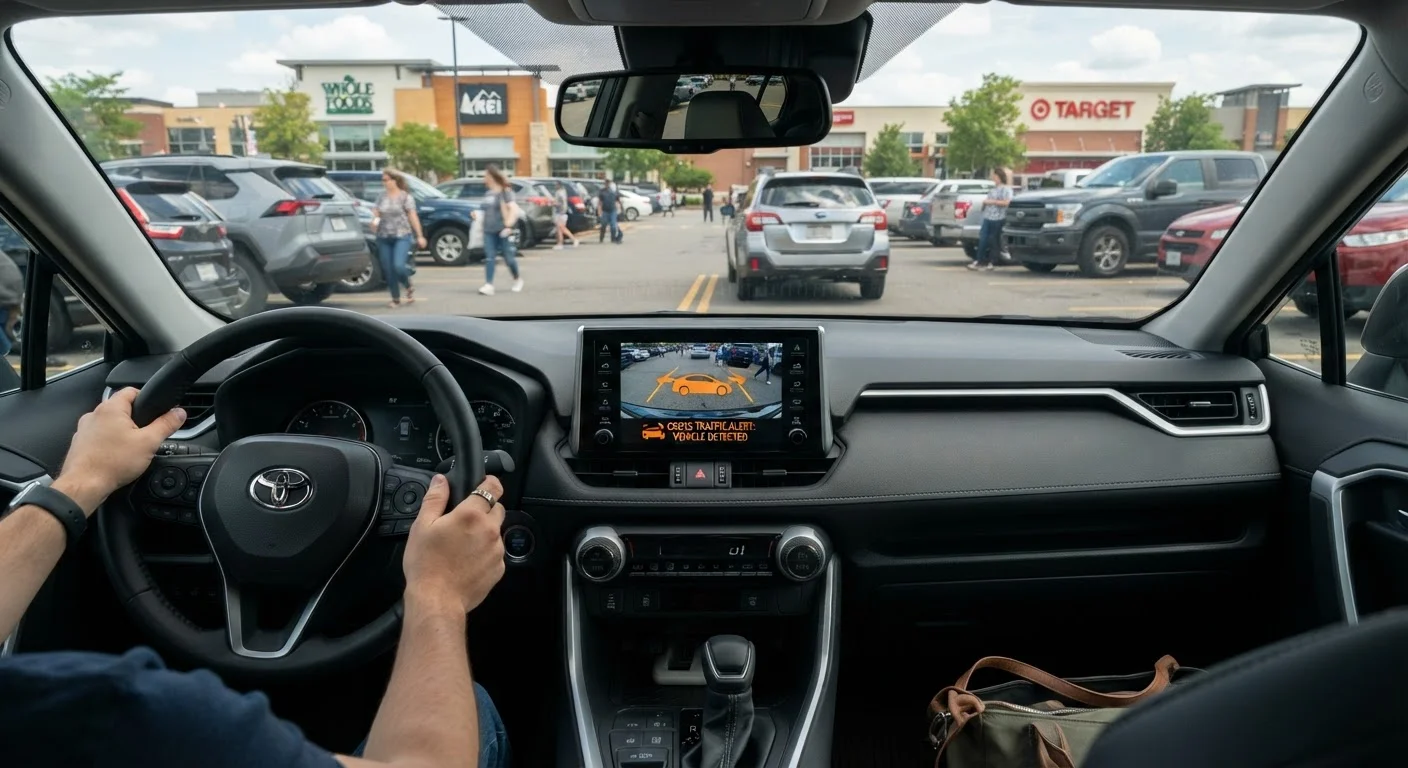
Rear cross-traffic alert exists to cover that gap. Using radar sensors embedded in the rear bumper, it continuously scans a wide angle behind the car while Reverse is engaged. If a vehicle, cyclist, or pedestrian is moving across that zone at a speed consistent with approaching cross-traffic, the system triggers a warning — typically a repeating chime and a visual alert on the infotainment screen or instrument cluster.
This is meaningfully different from what a reversing camera shows you. Your reversing camera captures what's directly behind the car, but it can't warn you about something that hasn't entered the frame yet. RCTA can detect a fast-approaching car before it's visible on the camera — giving you a fraction of a second more to stop.
How the System Works in Practice
When you shift into Reverse, RCTA activates automatically on virtually every vehicle that offers it. The radar sensors — usually two, one on each side of the rear bumper — sweep outward at oblique angles, covering the zones that extend well beyond the vehicle's corners.
The system distinguishes between stationary objects (a parked car, a wall, a shopping cart sitting still) and moving ones. It's specifically looking for objects with lateral velocity — things crossing your path. This is why a parked truck right next to you generally won't trigger the alarm; a car driving down the parking lane behind you will.
Check Which Side the Alert Comes From
Many RCTA systems indicate which direction the detected object is approaching from — left or right — through directional mirror lights or a graphic on the backup camera display. Learning to read this quickly lets you respond more precisely rather than just stopping in place.
Alert output varies by manufacturer. Some systems light up the mirror indicators (the same lights used by blind spot monitoring while driving), others display a directional graphic on the backup camera screen, and many do both simultaneously. Audio alerts also vary in urgency — some escalate in frequency as the object gets closer.
Higher-spec versions of the system add automatic emergency braking to the mix. In those cases, if you don't respond to the warning and a collision is imminent, the car can apply the brakes itself. This is a distinct capability worth checking for specifically, as basic RCTA only warns — it doesn't act. For a parallel distinction in front-facing systems, see how forward collision warning differs from automatic emergency braking.
Where It Works Well — and Where It Doesn't
RCTA performs best in the scenario it was built for: a conventional parking lot with vehicles moving at typical parking-lot speeds (5–15 mph). In that environment, it provides a meaningful second opinion when your sightlines are compromised.
The system has documented limitations that buyers should understand before relying on it:
- Low-speed or slow-moving objects: Very slowly moving pedestrians may not register the same way as a vehicle, depending on the system's speed threshold settings.
- Environmental interference: Some radar systems produce false alerts near shopping cart corrals, concrete pillars, chain-link fences, or other structures that create unusual radar returns.
- Narrow parking situations: In very tight spaces — a cramped urban garage, for example — the angles may not allow the sensors to perform optimally.
- Trailers: Attaching a trailer typically disables or degrades RCTA, as the trailer body sits directly in the sensor field.
Understanding these boundaries is important. RCTA is a genuine safety aid, but it belongs in the same mental category as blind spot monitoring — a tool that enhances awareness without replacing active, attentive driving habits.
Should This Feature Factor Into Your Purchase Decision?
For most buyers, RCTA is worth prioritizing — particularly if you regularly park in busy lots, drive a longer vehicle with limited rearward visibility, or share the vehicle with less experienced drivers. It's also a meaningful feature if you park in areas frequented by cyclists or pedestrians who may move quickly across your path.
The practical question is where it sits on the trim ladder for vehicles you're considering. RCTA is frequently bundled with blind spot monitoring into a "safety package" that may be standard on certain trims or optional on others. Comparing trims carefully — rather than assuming the feature is included — is worthwhile. Our guide to parking assistance technologies can help you evaluate the full range of reversing aids together.
One useful framing: RCTA addresses a specific, common real-world scenario where accidents genuinely occur. It's not a luxury feature — it's a targeted solution to a well-documented collision type. That makes it easier to justify than some tech features whose everyday usefulness is more situational.
This article provides general educational information about vehicle safety features. It is not a substitute for reading your vehicle's owner's manual, which contains the authoritative description of how your specific system operates and its limitations.