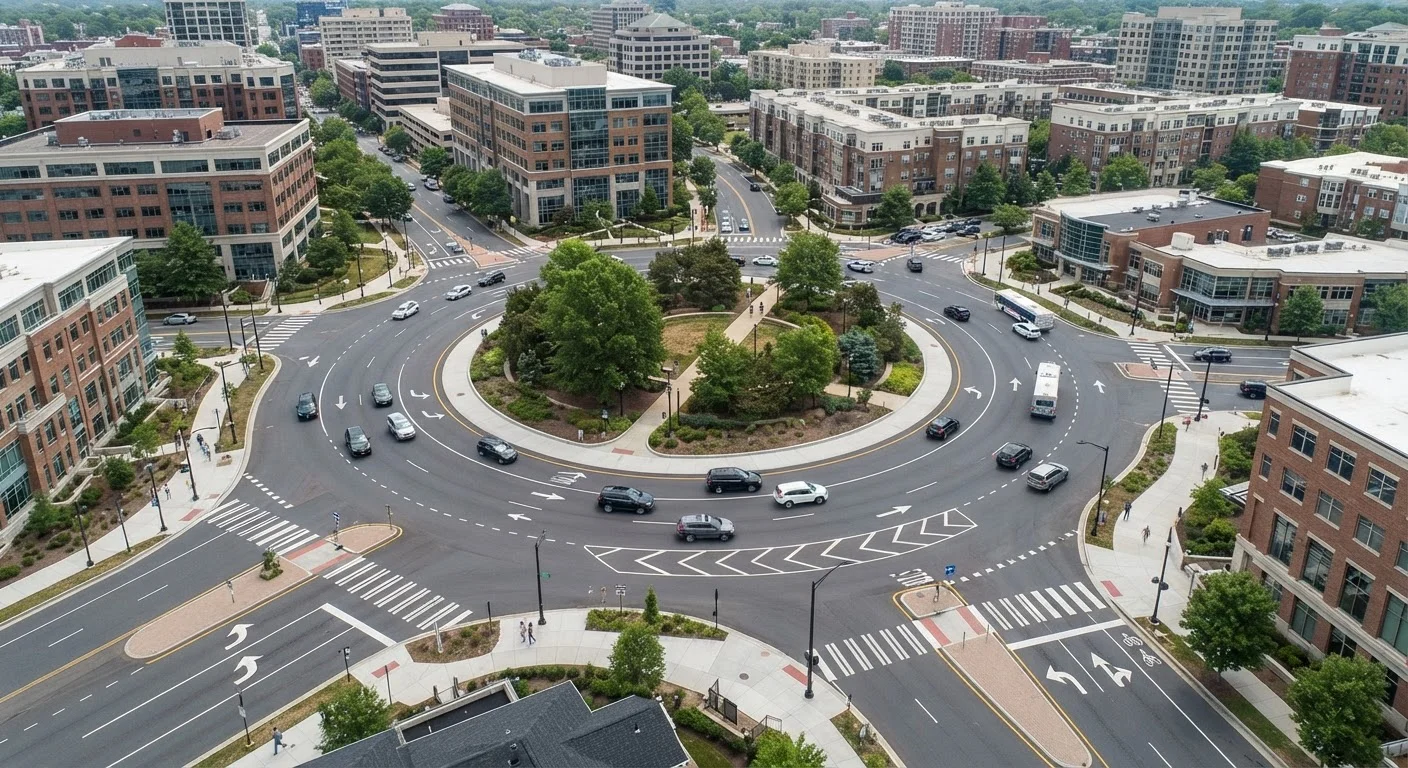
Why Roundabouts Still Catch Drivers Off Guard
Roundabouts are engineered to move traffic more safely and efficiently than traditional intersections, yet they remain a consistent source of confusion. The problem is rarely the road itself — it's the set of habits and assumptions drivers bring to them. Rules that work perfectly at a four-way stop or a signalized intersection simply don't transfer to a roundabout environment.
Multi-lane roundabouts add another layer of complexity. With two or more lanes of circulating traffic and multiple entry points, the margin for error shrinks. Understanding exactly where the rules diverge from everyday driving instincts is the first step toward navigating them without hesitation. For new drivers building broader situational awareness, our primer on reading the road offers useful complementary context.
~40%
Reduction in injury crashes at intersections
The Federal Highway Administration reports roundabouts reduce injury crashes by approximately 40% compared with traditional signalized intersections.
75%
Drop in serious injury collisions
Studies cited by the Insurance Institute for Highway Safety show serious injury crashes fall by roughly 75% when a signal is converted to a roundabout.
The Mistakes That Create the Most Risk
The following errors account for the majority of roundabout conflicts and near-misses. Each one has a clear cause and a straightforward fix — once you know what to watch for.
Assuming the entering driver has the right of way.
Why it happens: Drivers accustomed to four-way stops or yield-to-the-right conventions carry those habits into roundabouts, where they don't apply.
Choosing a lane based on where you enter rather than where you exit.
Why it happens: Instinct says to stay to the right, but in a multi-lane roundabout the correct lane depends entirely on which exit you need.
Failing to signal when exiting the roundabout.
Why it happens: Many drivers only think about signaling on entry, or assume that because they're already turning, a signal is unnecessary.
Stopping or hesitating in the middle of the roundabout.
Why it happens: Confusion about lane position or a missed exit causes drivers to brake unexpectedly while circulating, creating a rear-end hazard.
Ignoring the pedestrian crosswalk immediately outside the exit.
Why it happens: After focusing on the complex give-way rules inside the roundabout, drivers mentally relax at the exit and overlook pedestrians who may be crossing.
Entering a roundabout at too high a speed.
Why it happens: Drivers who approach confidently may misjudge how sharply the lane curves inside, or simply carry too much speed from the approach road.
Give-Way Rules Are Legally Enforced
Failing to yield to circulating traffic at a roundabout is a traffic violation in every U.S. state that has adopted roundabout give-way laws. A collision caused by improper entry can result in you being found at fault regardless of speed. Always come to a complete stop if any vehicle is already in the roundabout, even if the path looks clear at first glance.
Building Better Roundabout Habits
Correcting roundabout errors is largely a matter of slowing your decision-making before you reach the junction, not during it. A few seconds of preparation on the approach — confirming your exit, selecting your lane, adjusting speed — eliminates the need to react under pressure inside the circle.
Don't Change Lanes Inside the Roundabout
Switching lanes while circulating is one of the most dangerous moves you can make in a roundabout. Vehicles in adjacent lanes may be invisible in your blind spot due to the curve of the road. Commit to your lane before you enter and hold it all the way to your exit.
Spiral lane markings, where present, are designed to guide your vehicle naturally toward the correct exit without requiring a lane change mid-circle. Trust them. Where markings are absent, the rule of thumb remains: right lane for nearby exits, left lane for exits more than halfway around.
Roundabout confidence is closely related to the broader skill of reading and anticipating traffic flow. The same discipline that helps on a roundabout pays off in other complex driving environments — something we explore in detail in our article on adapting your approach between city and rural roads.
With each pass through a roundabout, the correct sequence becomes automatic: approach at advisory speed, yield to circulating traffic, enter in the right lane, hold that lane, signal before your exit, and yield to pedestrians on the way out. Follow that sequence consistently and the roundabout stops being a guessing game.