Why Merging Feels Difficult — and What Actually Helps
Anxiety around motorway merging typically comes from two sources: uncertainty about when to act and discomfort with the speeds involved. Both are addressable through deliberate technique rather than accumulated experience alone. The mirror-signal-manoeuvre (MSM) routine taught during licence training is specifically designed for this scenario — the challenge is applying it under real-world time pressure.
A key insight is that merging is fundamentally a speed and timing problem, not a right-of-way problem. Neither the driver on the slip road nor the driver already on the motorway has automatic priority in most road codes — both have a shared responsibility to avoid a collision. Understanding this framing removes the adversarial feeling some drivers associate with merging.
Drivers who struggle with lane changes on multi-lane roads often face similar challenges at roundabouts. If that applies to you, our article on roundabout rules that confuse even experienced drivers covers overlapping principles around positioning and right of way.
What you will need
Step-by-Step: Merging and Changing Lanes Safely
The following steps cover both motorway entry from a slip road and mid-motorway lane changes. The core technique is the same in both cases — the difference is mainly in how much time the slip road gives you to prepare compared with a lane change already in moving traffic.
Never Stop at the End of a Slip Road
Coming to a halt at the end of a motorway slip road — unless traffic ahead is completely stationary — creates a serious rear-end collision risk. Slip roads are designed for speed-matching, not waiting. If a gap does not appear immediately, adjust your speed smoothly while continuing to observe, rather than stopping.
Set your mirrors before you join the motorway
Before reaching the slip road, confirm your door mirrors and rear-view mirror are correctly positioned. Your rear-view mirror should frame the full rear window. Each door mirror should show a thin sliver of your own vehicle's flank on the inner edge, with the horizon sitting roughly in the middle of the glass. Mirrors adjusted too far inward duplicate the rear-view mirror's field and leave blind spots uncovered.
Build speed on the slip road to match live traffic
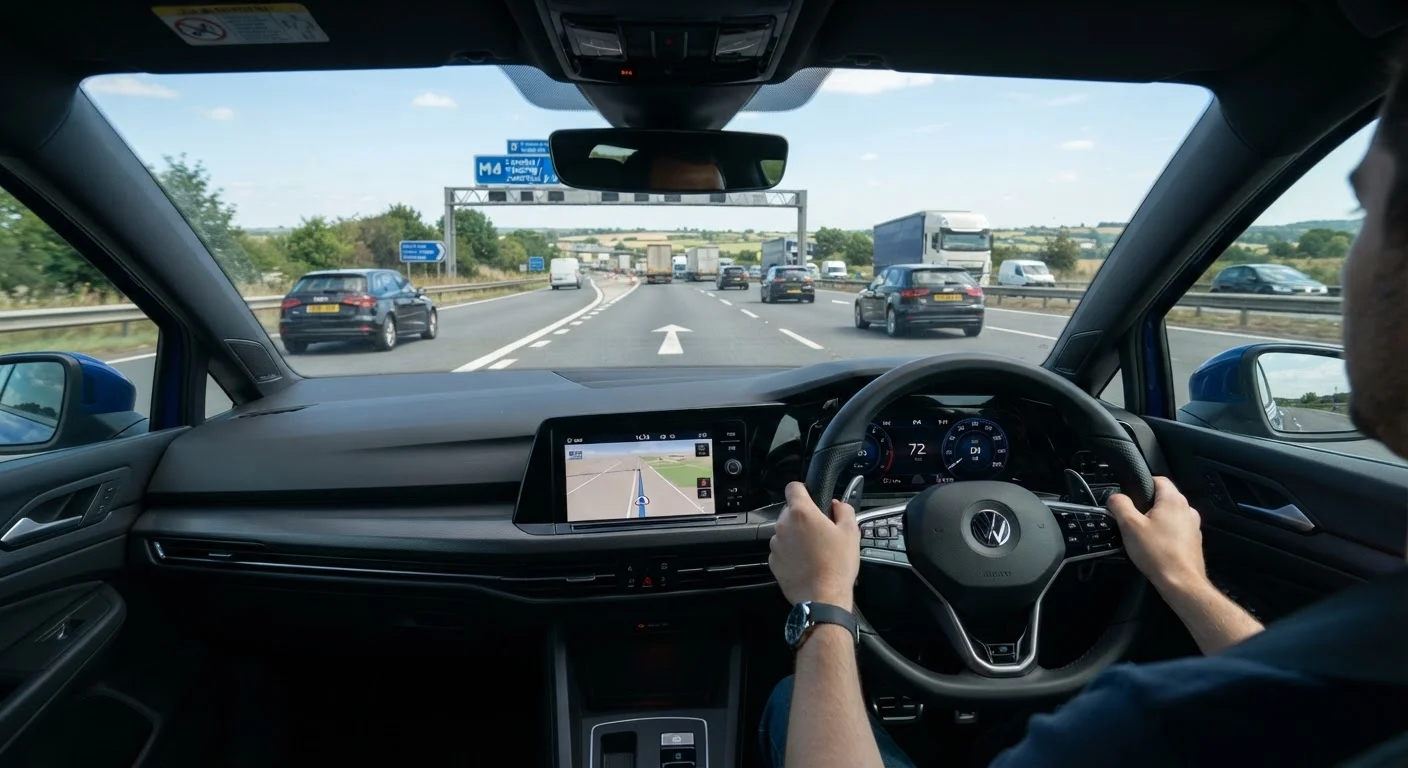
The slip road exists specifically to allow speed-matching with motorway traffic. As you travel down it, observe the speed of vehicles already in the nearside lane and accelerate progressively toward that speed. Arriving at the merge point significantly slower than surrounding traffic forces those vehicles to brake and compresses the safe gap you need.
Check mirrors and identify a suitable gap
While still on the slip road, begin your mirror sequence: rear-view mirror, then nearside door mirror. Identify a gap in the nearside motorway lane that is large enough to accommodate your vehicle at matching speed. A gap roughly equivalent to two seconds of following distance at the prevailing speed is a practical benchmark.
Signal your intention early
Activate your right-hand indicator (or left, depending on your country's traffic flow) at least three to four seconds before you begin moving into the lane. Signalling early gives drivers already on the motorway time to adjust their own position or speed to facilitate your merge — it is a communication, not a demand for right of way.
Perform a shoulder check for blind spots
Immediately before moving into the lane, take a brief glance over your shoulder toward the blind spot area. This is the zone your mirrors cannot fully cover. The shoulder check should be quick — keep the vehicle tracking straight while you do it. If a vehicle occupies the blind spot, hold your position on the slip road and allow it to pass before merging.
Merge smoothly and cancel your signal
When the gap is clear and your speed matches traffic, steer gently and progressively into the nearside lane. Avoid sudden or jerky steering inputs — smooth movements are more predictable to other road users and keep your vehicle stable. Once fully in the lane, cancel your signal and maintain at least a two-second following distance from the vehicle ahead.
Apply the same routine for mid-motorway lane changes
Changing lanes between motorway lanes — for example, to overtake — uses the identical mirror-signal-manoeuvre sequence. Check your rear-view mirror, then the door mirror on the side you intend to move toward, signal, shoulder check, and move only when the gap is confirmed clear. Return to the nearside lane once the overtake is complete; in most jurisdictions, remaining in a middle or outer lane without cause is an offence.
Use the Two-Second Rule for Gap Assessment
When assessing a gap in motorway traffic, pick a fixed point on the road and count two seconds between the vehicle ahead passing it and your front bumper reaching it. If the gap in the lane you want to join is at least that large, it is generally sufficient for a controlled merge at matching speed. In wet or low-visibility conditions, extend this to three seconds.
Common Mistakes and How to Correct Them
Even drivers with years of motorway experience can develop habits that reduce safety. The most common errors fall into a few categories:
- Merging too slowly: Joining at 50 mph when traffic is moving at 65–70 mph creates a speed differential that compresses gaps rapidly. Match the flow as closely as conditions allow.
- Over-relying on mirrors: Mirrors cover most of the picture, but not all of it. The shoulder check is not optional — it is the only way to confirm the blind spot is clear.
- Signalling too late: Indicating as you are already moving across the line gives other drivers almost no reaction time. Signal before you start moving.
- Hesitating mid-manoeuvre: Slowing or wavering partway through a lane change creates unpredictability. Commit to the move once you have confirmed it is safe to do so.
Motorway behaviour also differs meaningfully from urban and rural driving environments. The contrasting demands of urban vs rural roads are worth reviewing if you regularly switch between road types.
Blind Spots Are Invisible in Mirrors
Door mirrors and the rear-view mirror together still leave a zone alongside and slightly behind your vehicle that is not visible without turning your head. Always perform a brief shoulder check before committing to a lane change. This is especially important on multi-lane motorways where vehicles can close gaps quickly.