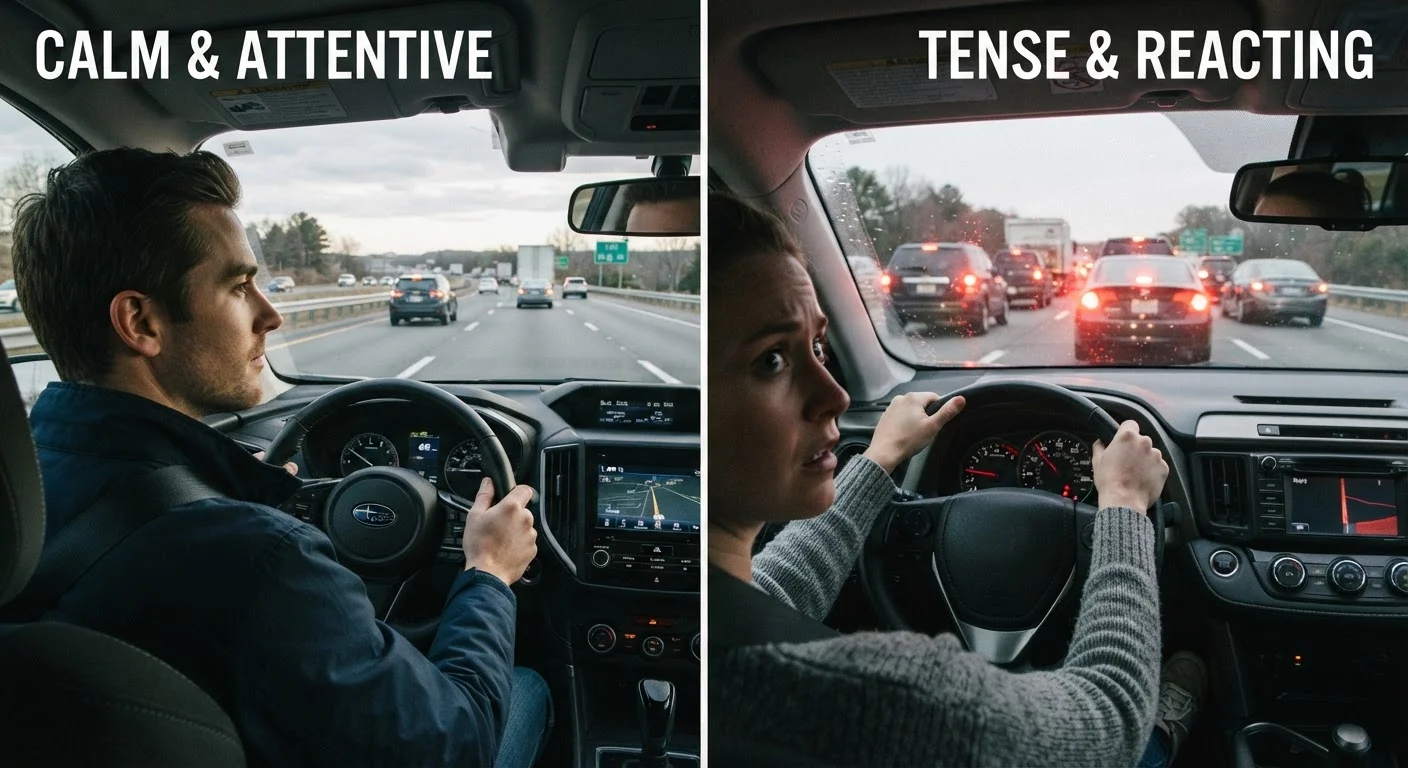
What Each Mindset Actually Means
Defensive driving is a structured approach to operating a vehicle in which the driver continuously scans for potential hazards, adjusts speed and position to create safety margins, and plans responses before a threat fully materialises. The underlying principle is simple: assume that other road users may behave unpredictably, and always leave yourself an exit.
Reactive driving, by contrast, is what most people do without deliberate training. The driver responds to events as they occur — braking when they see brake lights, swerving when an obstacle appears, accelerating into a gap that has just opened. Reaction replaces anticipation.
Neither label is a moral judgment. Reactive responses are sometimes unavoidable. The critical difference is that defensive driving reduces how often you need a last-second reaction by identifying hazards while they are still developing.
For a look at how vehicle technology mirrors this distinction, see Forward Collision Warning vs Automatic Emergency Braking — one alerts the driver, the other acts independently, much like the difference between anticipating and reacting.
The Science Behind the Gap
Human perception-reaction time — the interval from spotting a hazard to beginning a physical response — averages around 1.5 seconds under normal conditions. That figure rises sharply with distraction, fatigue, or low-visibility conditions.
1.5 sec
Average driver perception-reaction time
The U.S. Federal Highway Administration references approximately 1.5 seconds as a standard perception-reaction estimate used in road design calculations.
~132 ft
Distance traveled at 60 mph before braking begins
At 60 mph a vehicle covers approximately 88 feet per second, meaning 1.5 seconds of reaction time alone equates to roughly 132 feet before the brake is applied.
~40%
Rear-end crashes as share of all U.S. crashes
The National Highway Traffic Safety Administration (NHTSA) has consistently reported rear-end collisions as one of the most frequent crash types, often linked to inadequate following distance and late hazard recognition.
At 60 mph, 1.5 seconds equates to roughly 132 feet traveled before your foot even reaches the brake pedal. Braking distance is additional. A defensive driver who has already identified a slowing vehicle ahead and eased off the throttle has effectively compressed that gap — they enter the braking phase earlier and from a lower speed.
Reactive drivers, by definition, start their clock later. They are working with less runway every time. Over thousands of trips, that narrowed margin statistically increases exposure to collisions — particularly rear-end crashes, which are among the most common crash types on U.S. roads.
Tailgating is one of the clearest examples of how reactive habits compound risk. Following closely leaves almost no buffer for reaction time, let alone anticipation.
Core Defensive Habits vs Reactive Patterns
Defensive and reactive driving show up as specific, observable behaviours. Understanding the contrast makes it easier to audit your own habits.
| Criterion | Defensive Driving | Reactive Driving |
|---|---|---|
| Timing of awareness | Hazard identified while still developing | Hazard noticed once it has occurred |
| Following distance | 3+ second gap maintained deliberately | Gap determined by traffic flow, not intent |
| Speed management | Adjusted proactively for conditions ahead | Adjusted in response to immediate events |
| Mirror and scan habit | Regular, systematic 360° awareness | Checked when something prompts it |
| Intersection approach | Cover brake, scan cross traffic early | Proceed; brake if conflict appears |
| Safety margin | Built in deliberately before risk arises | Consumed by the response itself |
A few habits are worth highlighting individually. Scanning the horizon — looking 10–15 seconds ahead rather than at the car directly in front — is the single most impactful defensive technique. It gives you more time to process changing conditions and adjust smoothly rather than abruptly.
Covering the brake (hovering your foot near the pedal without pressing it) in high-risk zones like intersections or school zones shaves critical milliseconds from your reaction phase. Communicating intent early — signalling well before turning, braking progressively rather than sharply — also reduces the chance that another driver's reactive response becomes a hazard to you.
Because these techniques apply differently across environments, it's worth reading Urban Driving vs Rural Roads: How Your Approach Needs to Shift for context on where each habit matters most.
Building a Defensive Mindset Over Time
Defensive driving is a skill set, not a personality trait. It can be learned and reinforced through deliberate practice. Start with one habit per trip: spend a week focusing exclusively on following distance, then shift attention to mirror checks, then to intersection scanning.
Formal defensive driving courses — offered by many state motor vehicle agencies, insurers, and driving schools — provide structured feedback that self-directed practice cannot fully replicate. These programs often include hazard recognition exercises that accelerate the shift from reactive to anticipatory thinking.
New drivers in particular benefit from building these habits early, before reactive patterns become deeply ingrained. Safe Driving From Day One covers the awareness gaps that most new licence holders discover too late.
It is also worth understanding how your vehicle's own technology fits into this framework. Modern safety tech like automatic emergency braking and lane-keeping assist are designed to serve as a last line of defence — not a replacement for driver awareness. As explored in Active Safety vs Passive Safety, these systems complement a defensive mindset rather than substitute for it.
This article provides general driver education and is not a substitute for formal driver training or instruction from a qualified driving professional.