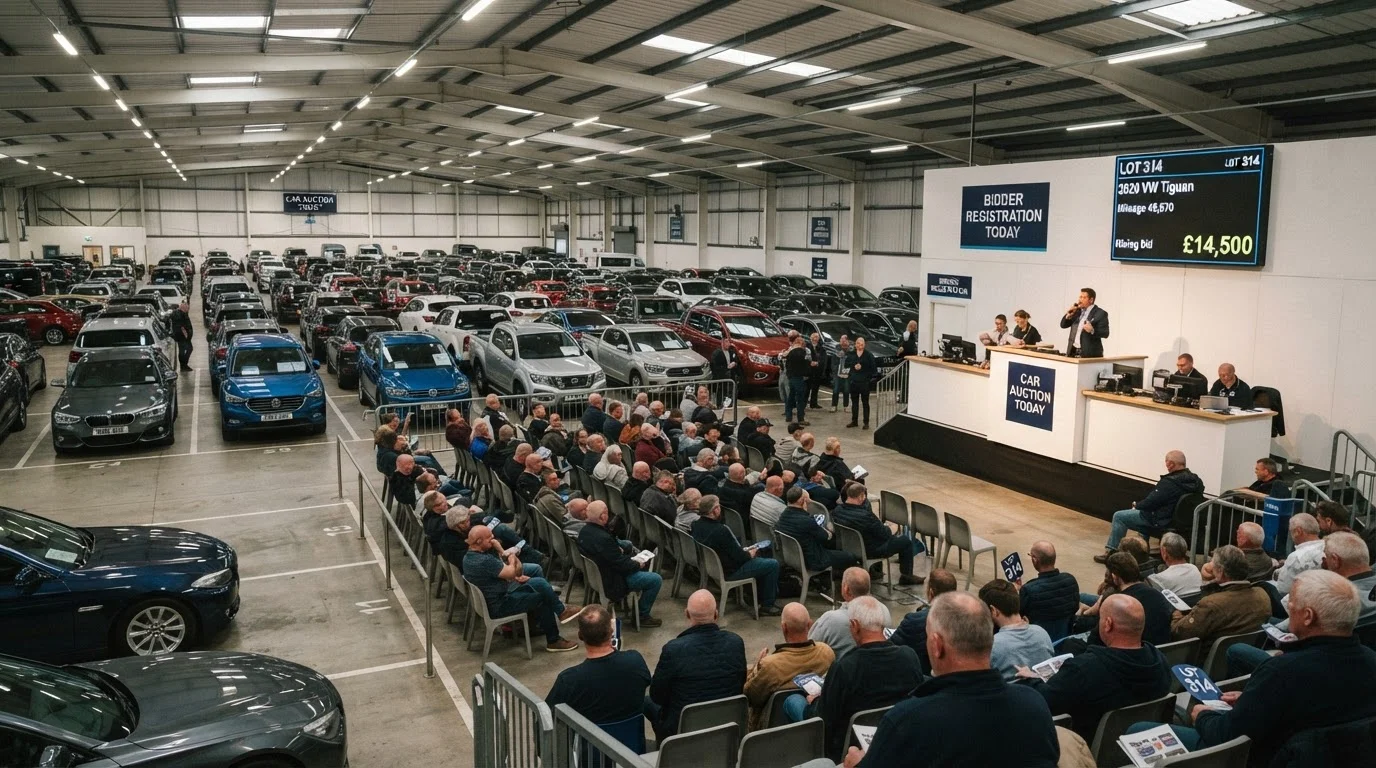
What Car Auctions Actually Are
Car auctions are sales events where vehicles are offered to the highest bidder, typically within a short bidding window. They fall into two broad categories: dealer-only auctions, which require a state-issued dealer's license to attend, and public auctions, which are open to private buyers. Government and fleet disposal auctions — run by municipalities, federal agencies, or rental companies — often fall into the public category.
The inventory at any given auction varies widely: repossessed vehicles, trade-ins wholesaled by dealers, ex-fleet units, and seized assets all commonly appear. Condition and history are equally unpredictable. For a broader look at how auctions compare to other sourcing channels, see our buyer's starting point guide.
The Case for Auctions: Genuine Advantages
Auctions attract buyers for real reasons. The pricing dynamic — competitive bidding against a floor, rather than a sticker negotiation — can result in below-market purchases, particularly for vehicles with low buyer interest on a given day.
Prices can fall below retail market value
When bidder interest is low or a vehicle has cosmetic issues that deter casual buyers, hammer prices can come in meaningfully under comparable retail listings. This gap is the primary draw for experienced auction buyers.
Wide inventory variety in a single event
Public and government auctions regularly offer dozens of vehicles across multiple segments, mileage bands, and body styles — giving prepared buyers more options than most individual dealerships.
Transparent, competitive price discovery
The bidding format shows what other buyers are willing to pay in real time, which can serve as a useful market data point independent of dealer-set sticker prices.
Access to fleet and government vehicles with maintenance records
Some government and fleet disposal auctions include maintenance logs, which is unusual for the auction channel and adds meaningful transparency for buyers who can access them.
Volume and variety are also genuine strengths. A single auction event may offer dozens or hundreds of vehicles across segments, mileage ranges, and price points — a breadth that no single dealership lot matches. For buyers who already know their target vehicle and have done their homework on fair market value, an auction can be an efficient place to act.
The Real Risks: What Buyers Often Underestimate
The as-is condition of auction vehicles is not a technicality — it is the defining characteristic of the channel. Most auctions provide no warranty, no return period, and no recourse if a mechanical problem surfaces after the gavel falls. Inspection time before bidding is typically limited to a visual walkaround; test drives are rarely permitted.
Vehicles sold strictly as-is, no warranty
Once the hammer falls, the vehicle is yours regardless of what problems emerge. There is generally no legal recourse for undisclosed mechanical issues unless outright fraud can be demonstrated.
Minimal or no pre-purchase inspection opportunity
Most auctions do not allow test drives, and visual inspection is limited to a short window before bidding. Hidden mechanical faults — engine, transmission, electrical — are difficult or impossible to detect.
Buyer's fees and ancillary costs erode savings
Auction houses typically charge a buyer's premium that adds a percentage on top of the hammer price. Combined with transport, title fees, and repair costs, the final all-in figure can match or exceed retail alternatives.
Fast-paced environment encourages overbidding
Competitive bidding creates psychological pressure that can push buyers past their planned ceiling. Without a firm, pre-set maximum, it is easy to overpay relative to the vehicle's actual market value.
Title and paperwork complications are more common
Repossessed vehicles or those with liens, salvage branding, or unclear ownership history appear more frequently at auction. Buyers must independently verify clean title before bidding.
Buyer's fees are another frequently overlooked factor. Auction houses charge a buyer's premium — often a percentage of the hammer price — which can add several hundred to over a thousand dollars to the final cost. Transport from the auction site, title transfer fees, and any immediate repairs needed must all be factored against any apparent price advantage. Compare the auction channel's protections (or lack of them) against what dealerships and private sellers offer in our guide: private seller vs. dealership comparison.
Salvage and Rebuilt Title Vehicles at Auction
Vehicles with salvage or rebuilt titles appear regularly at public auctions and are sometimes not prominently labeled. A salvage title indicates the vehicle was previously declared a total loss by an insurer. Rebuilt titles mean the vehicle was repaired and passed a state inspection — but standards vary significantly by state. Financing a salvage or rebuilt title vehicle is difficult, and resale value is substantially lower than a clean title equivalent. Always verify title status through the VIN before bidding.
How to Prepare If You Decide to Bid
Preparation determines outcomes at auction more than at any other used car channel. Before attending:
- Pull vehicle history reports on any vehicles you're considering. Auction houses frequently publish VINs in advance.
- Set a firm maximum bid and include estimated buyer's fees, transport, and a repair buffer in your ceiling — not just the hammer price.
- Attend a preview session if one is offered. Look for rust, mismatched paint, uneven panel gaps, and signs of fluid leaks.
- Understand the auction's run rules — some auctions carry condition announcements ("as-is," "no announcement," "engine runs") that carry specific meanings and limited protections.
If you're new to evaluating used vehicles generally, it's worth revisiting common assumptions about used cars before committing to a channel with this risk profile.
9–10%
Typical auction buyer's premium range
Many major wholesale and public auction platforms charge a buyer's fee in the 9–10% range on top of the hammer price, though structures vary by auction house and vehicle price tier.
~40%
Used vehicles passing through wholesale auctions annually
Industry estimates suggest a substantial share of the total used vehicle supply moves through wholesale auction channels each year before reaching retail lots or end buyers.
Auctions vs. Other Sourcing Channels
Auctions occupy a specific niche in the used car market — not better or worse than other channels, but different in ways that matter depending on your situation. Dealer lots offer warranties and financing but carry higher margins. Private sellers may price closer to market but require individual vetting. Ex-fleet and lease returns — covered in detail at fleet and lease returns — often come with service records that auctions rarely provide.
Online marketplaces and classifieds, explored in our online vs. local classifieds comparison, allow more time to research and inspect before committing — a meaningful advantage for buyers who aren't comfortable making fast decisions under auction pressure.
This article is for general informational purposes only and does not constitute financial or legal advice. Consult a qualified professional for guidance specific to your circumstances.