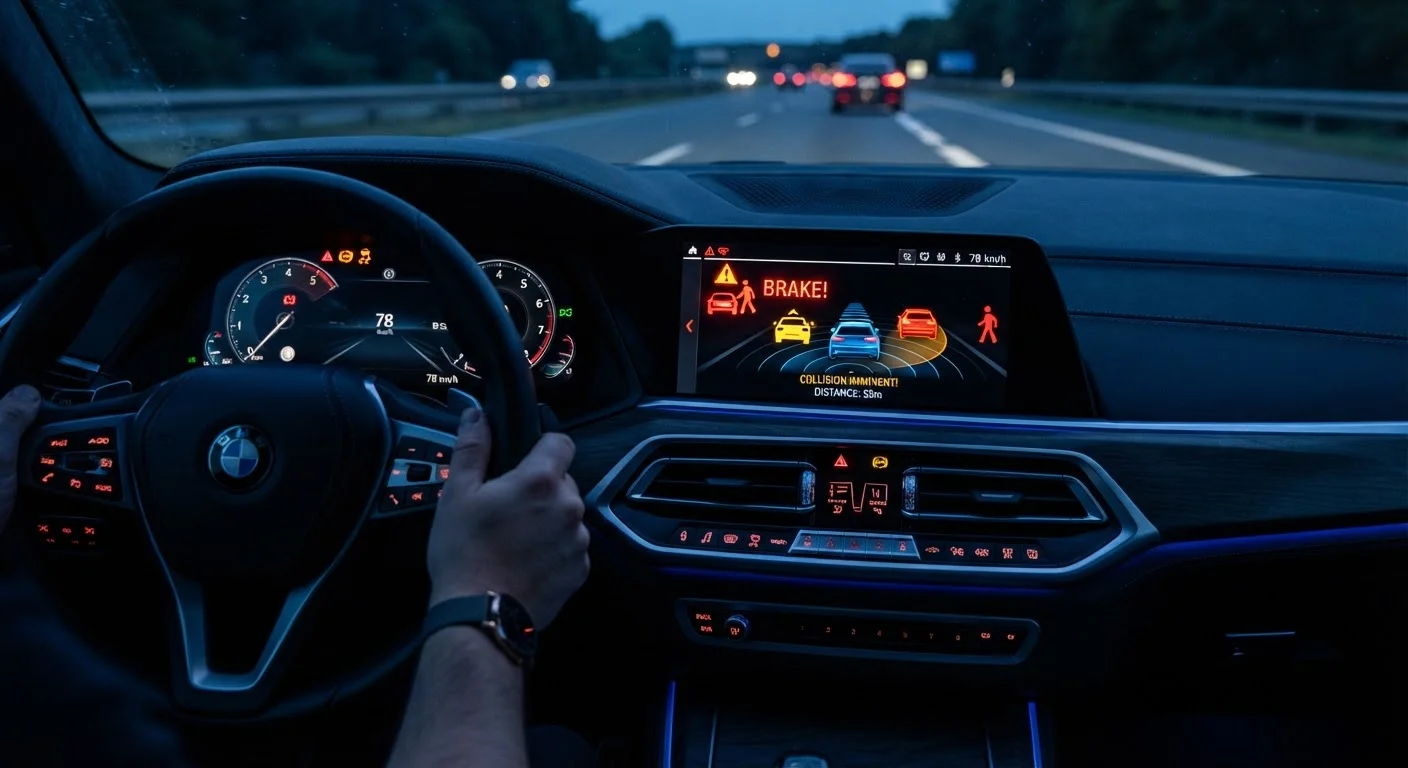
The Sensor Layer: How AEB Sees the Road
Before AEB can intervene, it must first understand what's happening in front of your vehicle. Most systems use one or more of three sensor types: radar, cameras, or lidar. Many modern vehicles combine radar and cameras to compensate for the weaknesses of each technology.
Radar excels at measuring the speed and distance of objects even in low-visibility conditions — rain, fog, and darkness — but it is less precise at identifying what an object actually is. Cameras provide detail and can distinguish a pedestrian from a traffic cone, but their performance drops in poor lighting or when lenses are dirty or obscured. By fusing both data streams, a vehicle's processor builds a clearer picture of the road environment in real time.
The sensors sample continuously — many systems update dozens of times per second — feeding data to an onboard computer that tracks relative positions and closing speeds of detected objects. For a broader look at how these sensors fit into the wider family of driver assistance features, see the ADAS features reference card.
The Decision Process: From Detection to Brake Application
Detecting a vehicle ahead is only the first step. AEB must also determine whether a collision is imminent — and that calculation involves several variables.
The system continuously computes a value called time-to-collision (TTC): an estimate of how many seconds remain before your vehicle would contact the detected object at the current rate of closure. When TTC falls below a threshold — typically somewhere between 1.5 and 3 seconds depending on the system — the AEB logic evaluates whether the driver is already braking sufficiently.
If your foot is already on the brake and generating meaningful deceleration, many systems will stand by or simply supplement your effort with additional force. If no braking input is detected and TTC continues to fall, the system escalates:
- Forward Collision Warning (FCW) — an audible beep and visual alert, giving you a final chance to react.
- Brake pre-charging — the system moves brake pads closer to rotors to eliminate lag the moment braking is needed.
- Automatic partial or full braking — the system applies brakes without driver input.
Understanding the difference between the alert stage and the intervention stage is important. Our companion explainer on Forward Collision Warning vs. Automatic Emergency Braking covers this distinction in detail.
Check Your Owner's Manual for System Specs
Every AEB implementation is different. Your owner's manual will specify the speed range your system covers, the object types it's calibrated to detect, and any conditions under which it may be automatically disabled. Spending fifteen minutes with that section is the most direct way to understand exactly what your car can and cannot do.
Conditions That Affect System Performance
AEB is designed to be robust, but no sensor-based system is immune to environmental and physical constraints. Knowing these limitations helps you set appropriate expectations.
Weather and visibility: Heavy rain, snow, and dense fog can degrade camera performance and scatter radar signals. A dirty or ice-covered sensor housing — whether a radar module behind the front grille or a camera behind the windshield — can significantly reduce detection range.
Sensor obstruction: Even a sticker placed near the rear-view mirror or a cracked windshield in the camera's field of view can impair function. Most vehicles display a dashboard warning when a sensor malfunction is detected.
Speed range: AEB systems are typically calibrated to operate within a defined speed window. Performance at very low parking-lot speeds or at highway merging speeds may differ from performance in the 15–50 mph urban range where most systems are optimized.
Object type: Systems vary in their ability to detect pedestrians, cyclists, and stationary objects. A vehicle that detected a stopped car reliably may not respond as quickly to a pedestrian stepping off a curb, depending on how the system was designed and tested.
For a detailed look at what the system cannot reliably handle, see what AEB triggers and what it can't do.
Sensor Warnings Deserve Prompt Attention
If your dashboard displays a sensor fault or AEB unavailability message, treat it as a meaningful alert — not just a nuisance light. The system may be partially or fully inactive until the fault is resolved. Consult your owner's manual or a qualified technician to diagnose the cause before relying on AEB in traffic.
AEB in Context: What It Means for How You Drive
Understanding AEB accurately — neither overestimating it nor dismissing it — makes you a more capable driver. The system is a genuine safety net: studies from the Insurance Institute for Highway Safety (IIHS) have linked AEB to meaningful reductions in rear-end crashes. But it functions best when the driver is also engaged.
Practically speaking, this means maintaining a clean sensor field (regular car washes that include the front grille and windshield area), not placing objects that block the camera's line of sight, and noting any dashboard alerts that signal a sensor fault.
It also means recognizing that AEB is one layer of a broader safety architecture. For the complete picture of how these systems work together, the Modern Car Safety Tech field guide provides a plain-language overview of the full suite. The Safety Tech hub is also a useful starting point for exploring individual systems.
If your vehicle's AEB has ever activated unexpectedly, it's worth reading about why safety tech can behave unexpectedly — most events have straightforward explanations rooted in how sensors process their environment.