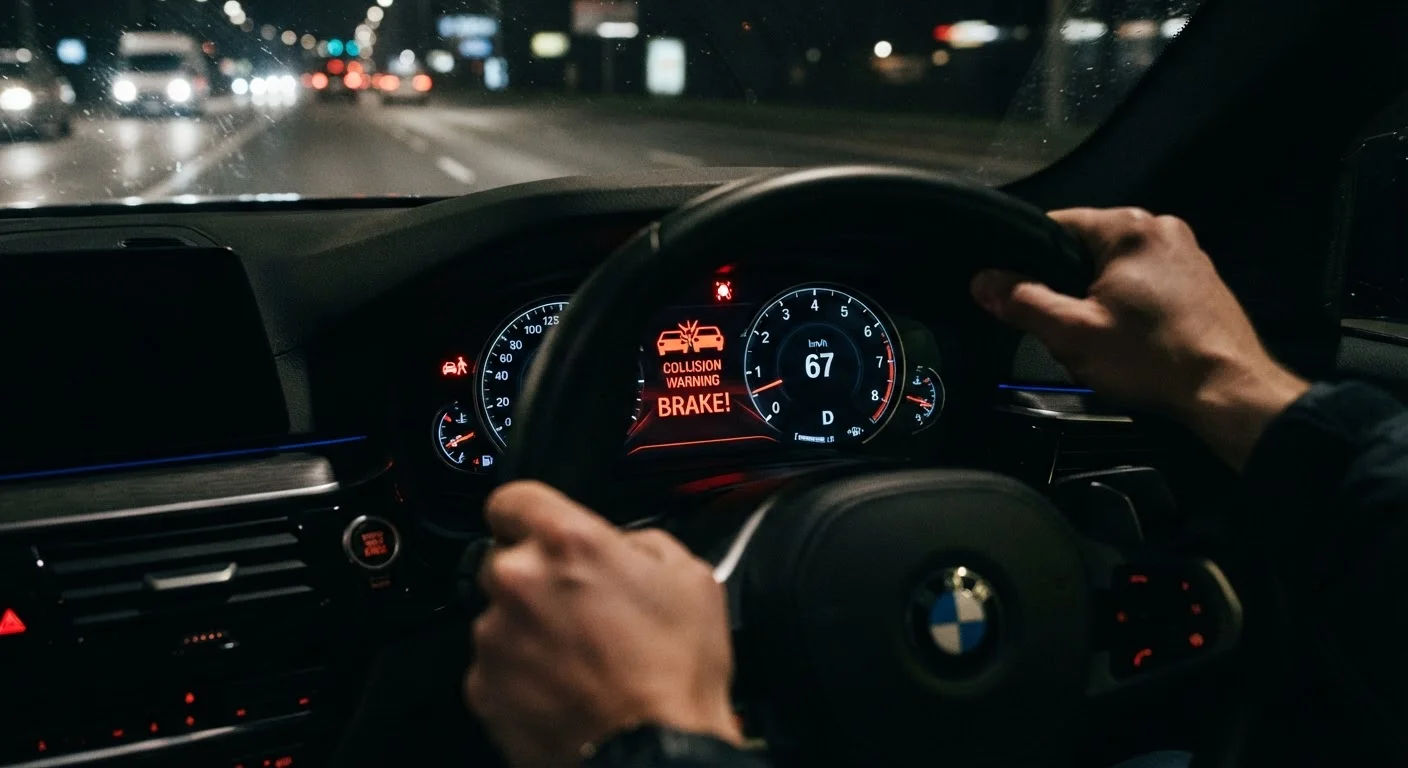
How AEB Decides to Intervene
Automatic Emergency Braking doesn't react to every obstacle — it's built around a specific decision process. Sensors mounted at the front of the vehicle (most commonly a radar unit, a forward-facing camera, or both) continuously track objects in the vehicle's path. The system calculates the time-to-collision (TTC) — essentially how many seconds remain before impact at current speeds and trajectories.
When TTC drops below a threshold and the driver hasn't responded, the system first issues a warning (a chime or visual alert), then applies brake pressure automatically. The intensity of that braking scales with urgency: a slow-developing hazard may trigger gentle braking, while a sudden obstacle triggers full emergency braking.
For a deeper look at the sensor logic involved, see how AEB systems decide to intervene.
Check the Owner's Manual for Your System's Range
AEB performance varies significantly between manufacturers and even between trim levels of the same model. Your owner's manual will specify the speed range in which AEB is active and which object types (vehicles only vs. pedestrians and cyclists) the system is calibrated to detect. Reading this section takes five minutes and gives you accurate expectations for how your system will behave.
What AEB Can Reliably Handle
AEB performs most consistently in scenarios where sensors have clear lines of sight and adequate time to process the hazard. These include:
- Rear-end collisions with stationary or slow-moving vehicles in daylight, particularly on highways and arterials
- Intersection crashes where a vehicle is crossing the path ahead at a trackable speed
- Low-speed city driving near stopped traffic or queued vehicles
Independent testing by organizations such as the Insurance Institute for Highway Safety (IIHS) has documented meaningful crash reduction in these categories, particularly for rear-end incidents. This evidence base is part of why regulators have pushed for AEB to become standard equipment. For context on which safety technologies have the strongest evidence behind them, see safety tech features with the strongest research support.
~50%
Reduction in rear-end crashes with AEB
IIHS research has found that vehicles equipped with AEB show roughly a 50% lower rate of rear-end striking crashes compared to vehicles without the system.
2029
U.S. federal AEB standard deadline
The National Highway Traffic Safety Administration (NHTSA) finalized a rule requiring AEB on virtually all new passenger vehicles sold in the U.S. by 2029.
~1 in 3
Crashes potentially addressable by AEB
NHTSA estimates that a significant share of rear-end collisions — among the most common crash types — could be mitigated or prevented by properly functioning AEB systems.
What AEB Cannot Do
AEB has meaningful, documented limitations that every buyer should understand before treating it as a safety net.
- Nighttime pedestrian detection is unreliable on many vehicles. Cameras struggle in low light, and radar may not distinguish a pedestrian's smaller radar cross-section from background clutter.
- Animals and debris crossing the road are often undetected because systems are calibrated around vehicle-shaped objects.
- Cut-in scenarios — where a vehicle merges into your lane at close range — may not allow enough TTC for the system to activate meaningfully.
- Adverse weather degrades sensor performance. Heavy snow can physically block radar units and cameras.
- High closing speeds on limited-access highways may exceed the system's ability to reduce speed sufficiently.
AEB also won't activate for hazards that appear suddenly from the side, such as a car running a red light at an intersection perpendicular to your path — that's a different sensor coverage zone. Understanding why safety tech sometimes behaves unexpectedly can help you recognize what's normal: why safety tech can behave unexpectedly.
What This Means for Car Buyers
When comparing vehicles, don't treat AEB as a binary yes/no checkbox. Ask two more specific questions: What does this system detect? and At what speeds does it operate? Some systems cover pedestrians and cyclists in addition to vehicles; others cover only other vehicles. Some activate from near-zero to highway speeds; others are calibrated primarily for city scenarios.
Trim level also matters. A base model might include basic vehicle-only AEB, while a higher trim adds pedestrian and cyclist detection. These are meaningfully different levels of protection, and the labels don't always make that clear in marketing materials.
For a broader orientation to the driver assistance landscape, our plain-language guide to modern car safety tech explains how AEB fits alongside other systems like blind-spot monitoring and lane-keeping assist.
Ultimately, AEB is a genuine safety advancement — one with a real evidence base behind it. But it works best when drivers understand its role: an intervention of last resort, not a substitute for attentive driving.