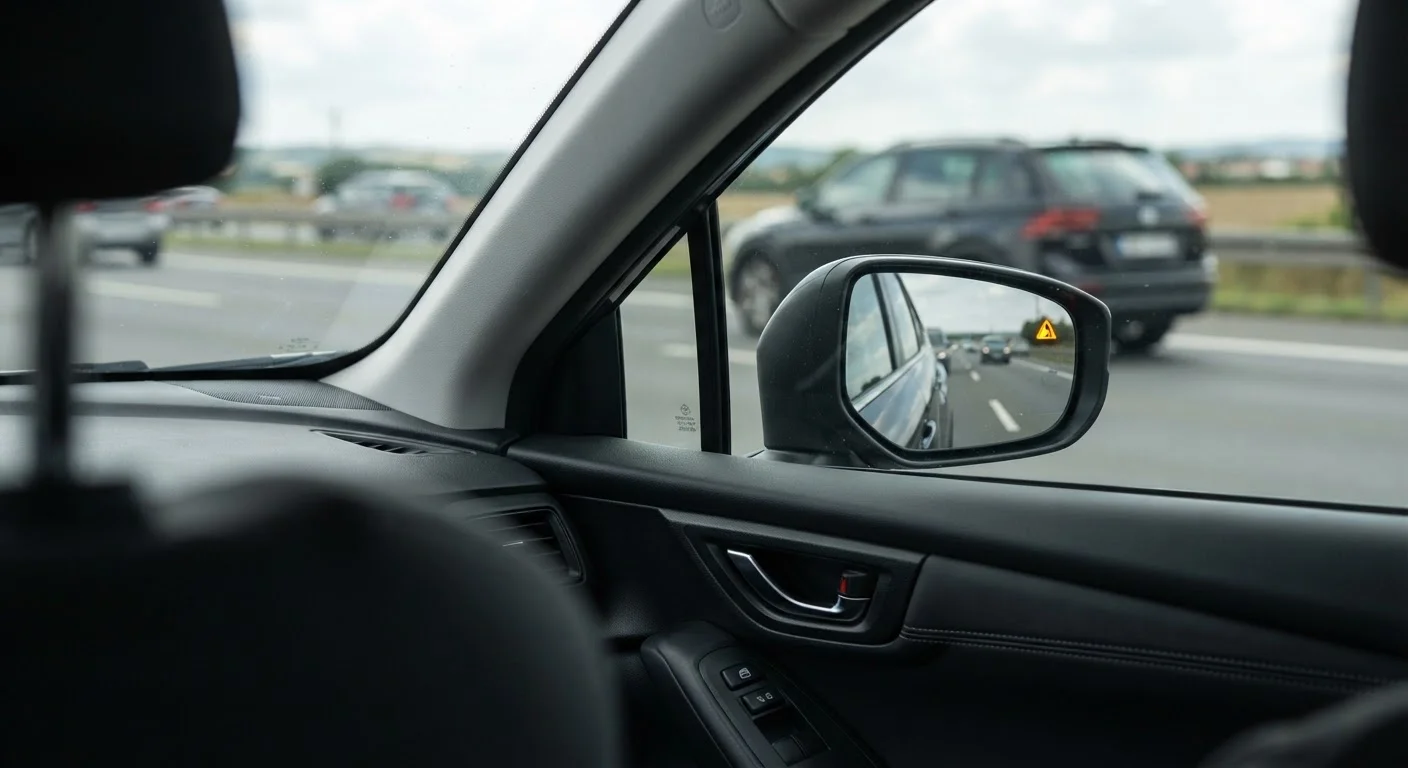
What Blind-Spot Monitoring Actually Does
Blind-spot monitoring (BSM) uses radar sensors — typically embedded in the rear bumper or rear quarter panels — to continuously scan the lanes directly beside and slightly behind your vehicle. When another vehicle enters that detection zone, the system triggers a visual alert, usually an amber light in or near the corresponding side mirror. If you then activate the turn signal toward that side, most systems escalate to an audible tone or a steering wheel vibration to reinforce the warning.
The detection zone generally covers roughly one to two car lengths behind and beside the vehicle — the area where a vehicle could sit invisibly in your mirrors yet still be on a collision course. This is a meaningful real-world gap: even properly adjusted mirrors leave a sliver of space that requires a shoulder check to fully clear. BSM watches that gap continuously so you don't have to time your checks perfectly.
It's worth noting that BSM is not a lane-keeping system — it won't steer the car or apply brakes. It only alerts. For a discussion of how attention-detection works in tandem, see driver monitoring systems.
Where Blind-Spot Monitoring Earns Its Keep
Continuously monitors lanes you physically cannot see
Radar sensors scan adjacent lanes without interruption, covering the area that even well-adjusted mirrors leave exposed. This is particularly valuable at highway speeds when gaps close rapidly.
Reduces lane-change collision risk
IIHS research indicates that vehicles equipped with BSM show measurable reductions in lane-change crashes, suggesting the feature addresses a genuinely frequent accident type.
Escalating alerts when you signal toward a detected vehicle
Most systems upgrade from a mirror light to an audible tone or haptic warning when you activate the turn signal, giving a more urgent cue at the moment it matters most.
Valuable in vehicles with poor rearward visibility
Large SUVs and trucks often have constrained sightlines through the rear glass; radar-based detection compensates meaningfully where physical visibility is most limited.
Operates passively without driver input
Unlike manually checking mirrors, BSM requires no timing or deliberate action — it's always active, serving as a consistent backstop even during brief lapses in attention.
The strongest case for BSM is highway driving. At highway speeds, vehicles can close a gap of several car lengths in under two seconds, leaving very little margin for a missed shoulder check. The radar operates continuously and doesn't blink or lose attention, which makes it a reliable backstop for the moments when driver attention briefly lapses. Studies by the Insurance Institute for Highway Safety (IIHS) have found that BSM systems are associated with meaningful reductions in lane-change crashes and related injuries — a signal that the feature addresses a real and frequent accident type.
BSM also proves useful in vehicles with inherently poor rearward visibility — large SUVs, pickup trucks, or minivans with narrow rear windows. When the physical sightlines are constrained, radar-based detection fills in more meaningfully than it would in a compact car with good glass area.
Where the System Falls Short
False alerts can erode driver trust
Highway barriers, bridge abutments, and vehicles in non-adjacent lanes can occasionally trigger warnings. Frequent false positives risk conditioning drivers to dismiss alerts — undermining the system's purpose.
Reduced reliability in heavy rain or snow
Moisture, ice, or debris accumulated on bumper-mounted sensors can degrade radar performance, causing the system to display a warning light and suspend operation in adverse conditions.
Inconsistent detection of cyclists and motorcycles
BSM is calibrated primarily for full-size vehicles. Smaller, faster-moving road users like motorcyclists may not trigger a reliable alert, leaving a meaningful gap in coverage.
Trailer towing often disables or confuses the system
A trailer attached behind the vehicle occupies the sensor's detection zone, typically causing constant false alerts or prompting the system to shut off automatically.
Does not act — only alerts
BSM provides no automatic steering input or braking. A driver who ignores or misses the alert still bears full responsibility for the lane change, limiting the system's safety ceiling.
Understanding the limitations is just as important as appreciating the strengths. One of the most commonly reported frustrations is false alerts: highway barriers, parked vehicles, and even fast-approaching cars in lanes beyond the adjacent one can occasionally trigger warnings. Over time, frequent false alerts risk training drivers to ignore the indicator — the exact opposite of the intended effect.
Adverse weather is another documented weakness. Heavy rain, snow, or ice can accumulate on bumper surfaces and interfere with radar signal accuracy, causing the system to go dark precisely when road conditions demand the most caution. As blind-spot monitoring misreads details further, the system also doesn't detect cyclists, pedestrians, or motorcycles as reliably as it detects full-size vehicles.
Detection range can also be surprisingly short at low speeds. In slow-moving traffic where lane splitting or weaving is common, the system may not register a fast-moving motorcycle quickly enough to be useful. Always treat the system as an aid, not a definitive clearance signal.
How Sensor Placement and Vehicle Size Affect Performance
Sensor Calibration After Bumper Repairs
If a vehicle with blind-spot monitoring has had rear bumper damage or repainting, the radar sensors embedded in that area may need professional recalibration to restore accurate detection. This is not always performed automatically during a body shop repair. When inspecting a used vehicle with BSM, ask for documentation confirming sensor calibration was completed if rear-end damage appears in the vehicle history.
Sensor location matters more than most buyers realize. Manufacturers typically place radar emitters in the rear bumper fascia — an area vulnerable to everyday contact, tow-hitch installation, and aftermarket modifications. A dented or repainted bumper can degrade radar performance without any visible indication on the dashboard. If a vehicle has had rear-end damage, it's worth asking whether the sensors were recalibrated after repair.
Vehicle width also influences the effective detection zone. A wide pickup truck has a longer blind-spot corridor than a compact sedan, so the same sensor hardware has more physical space to cover. Some trucks and larger SUVs compensate with trailer-detection modes — an important consideration if you plan to tow, since a trailer behind the vehicle can cause the system to produce constant alerts or shut down entirely. Rear cross-traffic alert is a closely related feature that handles a different vulnerability: vehicles approaching from the side when reversing out of a parking space.
Evaluating BSM When Comparing Vehicles
When assessing BSM across trim levels, ask a few practical questions beyond whether the feature is present. First, does the system offer both visual and audible alerts, or only one? Audible escalation when you signal is generally more effective at prompting action. Second, can alert sensitivity be adjusted through the vehicle's settings menu? Some systems allow tuning that reduces nuisance alerts without disabling protection. Third, does the manufacturer include trailer mode or a way to suspend the system when towing?
BSM pairs well with other proximity technologies. For comparison, parking assistance technology addresses low-speed maneuvering scenarios that BSM doesn't cover. And for backing out of spaces, reversing cameras complement BSM by adding a visual layer where radar has less value.
No single system covers every scenario. Buyers who understand what each technology is designed to detect — and where each one goes quiet — are far better positioned to decide which combination makes sense for their driving patterns.