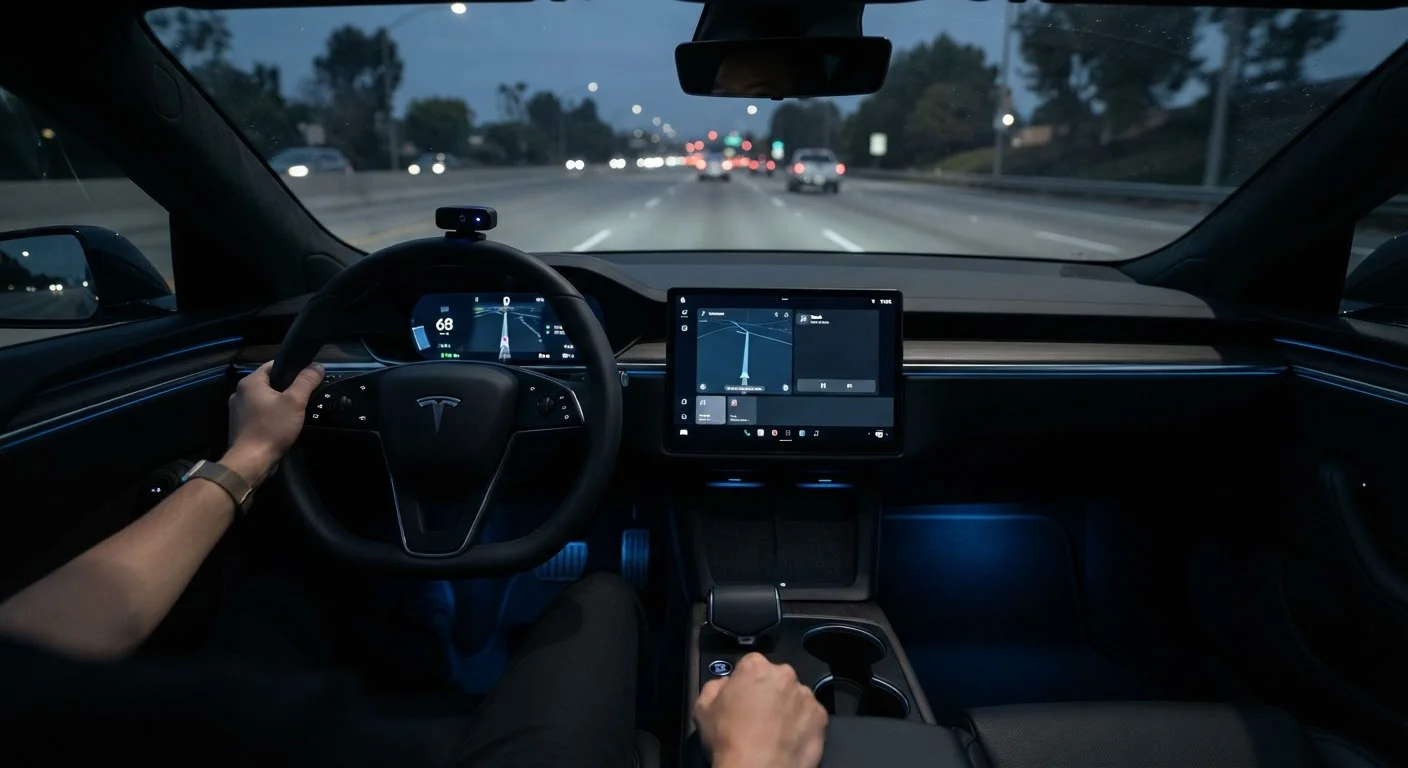
What the System Is Actually Watching
Unlike the cameras and radar pointed outward at traffic, a driver monitoring system turns the lens inward. A small camera — often mounted in the instrument cluster, steering column, or rearview mirror housing — tracks your face continuously while the vehicle is moving.
The system measures several behavioral signals at once: how often and how long your eyelids close (a metric called PERCLOS), where your gaze is directed, whether your head has drifted downward or to the side, and how long your eyes have been off the road ahead. These individual data points are fed into onboard software that builds a real-time picture of your alertness level.
It's worth noting what the system is not doing: it isn't recognizing your face for identification purposes in normal operation, and it isn't streaming video externally. The processing is largely local, designed to trigger safety responses rather than collect personal data — though privacy terms do vary by manufacturer.
Privacy Varies by Manufacturer
Most driver monitoring systems process facial data locally in real time without storing video footage. However, some connected vehicles may log event data as part of broader telematics packages. If data privacy is a concern, review the manufacturer's connected-services agreement and your vehicle's owner manual before purchasing.
How Alerts Escalate
When the system detects a warning pattern — prolonged eye closure, repeated head-bobbing, or gaze persistently aimed away from the road — it doesn't immediately slam on the brakes. Interventions are staged deliberately to avoid startling drivers unnecessarily.
A first-stage alert is typically a soft chime paired with a coffee-cup or bed icon on the instrument cluster, suggesting the driver take a rest break. If the behavior continues or worsens, the audible alert becomes louder and more urgent. Some vehicles will also flash warning lights or briefly vibrate the steering wheel.
In systems integrated with semi-autonomous driving features, a sustained alert that goes unacknowledged can trigger a more assertive response: gentle braking to slow the vehicle, seatbelt pre-tensioning, or in rare advanced implementations, a controlled stop in the lane with hazard lights activated. These escalation sequences vary significantly between vehicles and trim levels, so reading your owner's manual is worthwhile.
For a broader look at how these systems fit alongside other safety features, see our plain-language guide to modern car safety tech.
Drowsiness vs. Distraction: Two Different Problems
Driver monitoring systems address two related but distinct risk categories, and understanding the difference helps set realistic expectations.
Drowsiness detection is the older, more established application. It tracks physical signs of fatigue — slowed blinking, drooping eyelids, micro-sleep episodes — and is particularly relevant on long highway drives. Driving fatigue impairs judgment similarly to alcohol, and the system is designed to catch what tired drivers themselves often miss: that they're already impaired.
Distraction detection is broader. It catches scenarios where a driver's eyes are open but focused somewhere other than the road — a glance at a screen, a sustained look at a passenger, or repeated attention to in-car controls. Phone screens get the headlines, but many distractions are just as dangerous. DMS addresses this by monitoring gaze duration and direction rather than trying to identify the source of the distraction.
Neither mode is foolproof. A driver who appears alert by eye-movement metrics but is cognitively distracted — lost in thought or on a hands-free call — may not trigger an alert at all.
~37%
Crash fatalities linked to drowsy driving
The NHTSA estimates that drowsiness is underreported in crash data, with some research suggesting it contributes to a significant share of fatal crashes annually.
2 sec
Eyes-off-road threshold before risk rises sharply
Research from the Virginia Tech Transportation Institute found that glances away from the road lasting more than two seconds meaningfully increase crash risk.
What This Means When You're Buying a Car
Driver monitoring is becoming increasingly standard, pushed by evolving safety ratings and, in some regions, regulatory requirements. Euro NCAP now includes DMS performance in its scoring, which has accelerated adoption across vehicle segments. In the US, the National Highway Traffic Safety Administration has been evaluating related standards, making it likely that DMS will become more prevalent across price points in the coming years.
When comparing trims or vehicles, it's useful to ask a few practical questions: Does the system monitor the driver continuously, or only when a semi-autonomous mode is active? Does it work with glasses and in low light? What does the escalation sequence look like, and can alerts be adjusted? Some base trims include a simplified version of DMS while higher trims add camera-based gaze tracking — the distinction matters for real-world effectiveness.
DMS works best as one layer in a broader safety stack. It complements features like blind-spot monitoring and lane-keeping assist rather than replacing attentive driving. No system currently available fully substitutes for a rested, focused driver — and none is designed to.