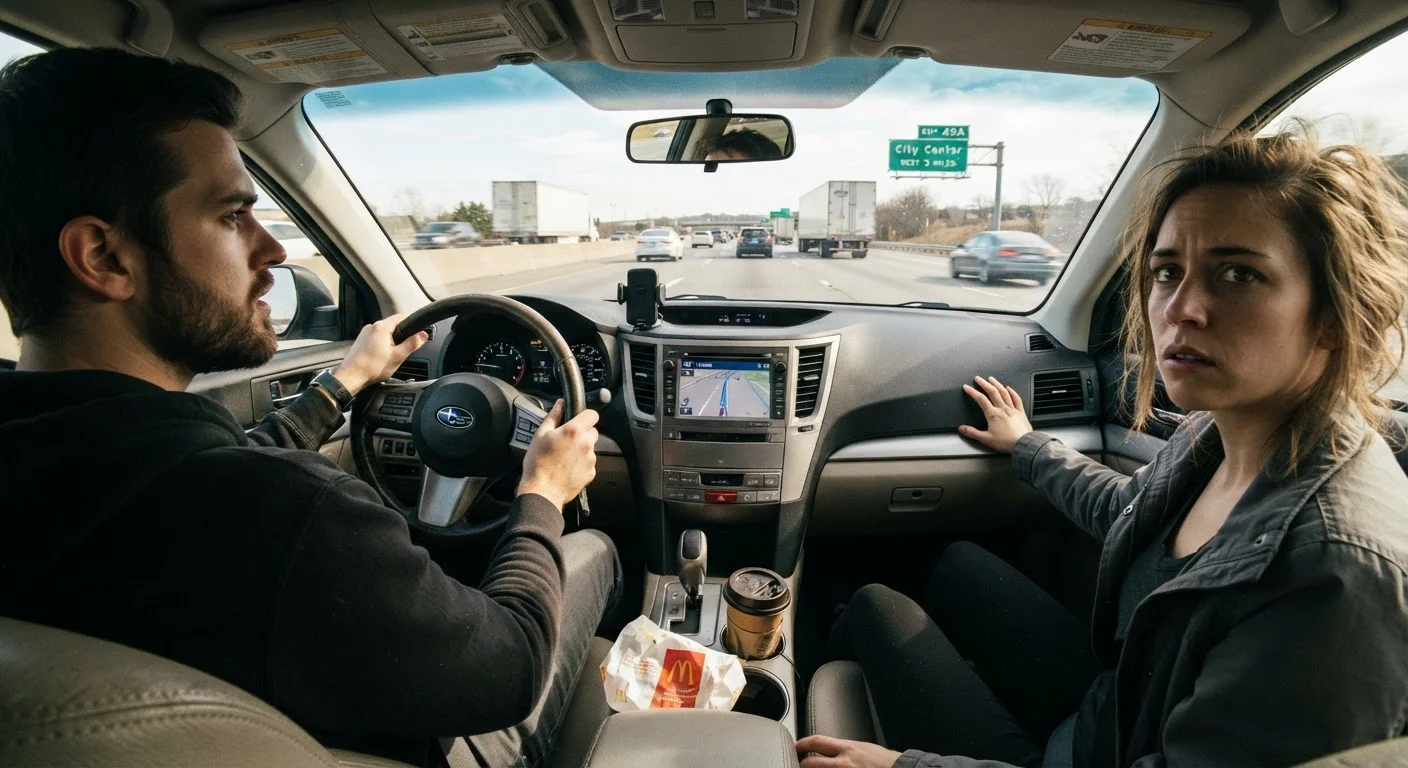
The Full Spectrum of In-Car Distraction
Distraction while driving falls into three overlapping categories: visual (eyes off the road), manual (hands off the wheel), and cognitive (mind off the task of driving). Most public safety messaging focuses on smartphones because they trigger all three simultaneously. That framing, while accurate, inadvertently trains drivers to believe that putting the phone away resolves the problem. It doesn't — not completely, and not immediately.
The sources of distraction in a modern vehicle are numerous: climate and audio controls, navigation adjustments, heated seat buttons, conversations, food, grooming, and even deeply engaging music. Each of these can impair hazard recognition, increase reaction time, and reduce lane-keeping precision. Understanding the full picture is the first step to managing it on every trip.
Myth
If I put my phone down, I'm no longer distracted.
Fact
Cognitive residue from a phone conversation or notification can linger for up to 27 seconds after the phone is set down, according to research cited by the AAA Foundation for Traffic Safety.
Distraction isn't a switch that flips off the moment a device leaves your hand. Your brain continues to process the interrupted task — a phenomenon sometimes called cognitive residue. During that recovery window, your attention to the road is measurably reduced even though you appear to be 'phone free.' Giving yourself a full half-minute of focused driving before re-engaging with traffic decisions after any phone interaction is a practical safeguard.
Myth
Passengers are just company — they don't affect my driving.
Fact
Passenger conversations are a leading source of driver distraction, and the nature of the conversation matters as much as its presence.
Unlike phone conversations, passengers in the vehicle can modulate their demands — they see traffic slow, they pause when you merge. However, emotionally charged conversations, backseat passengers (especially children) seeking attention, and peer pressure dynamics among young drivers can compound distraction significantly. Studies on teen driving have consistently found peer passengers to be a higher-risk factor than phones in that age group. Ask passengers to hold complex discussions until you reach your destination or are stopped safely.
Myth
Eating at the wheel is only a problem if I'm messy.
Fact
Eating requires at least one hand off the wheel, diverts visual attention, and introduces unpredictable startle moments — spills, heat, or falling food — at the worst possible times.
A spilled hot drink or a dropped taco at 60 mph can trigger an involuntary startle response that causes a driver to jerk the wheel. Beyond the physical mechanics, the cognitive anticipation of managing food — unwrapping, biting, checking the cup — occupies working memory. If a meal or snack is necessary on a long trip, pull over at a rest area. Even a five-minute stop is a negligible cost relative to the risk reduction.
Myth
Using my car's built-in touchscreen is safer than using my phone.
Fact
In-vehicle touchscreens can demand longer periods of eyes-off-road time than a comparable smartphone task, depending on interface design.
Research from institutions including the UK's Transport Research Laboratory has found that some native infotainment systems require drivers to keep their gaze off the road for longer than tasks performed on a handheld phone, because touchscreens lack tactile feedback and menus can be deeply nested. Learning your system's voice-command capabilities before you drive — and using them for navigation or audio changes — significantly reduces this risk. See how to use infotainment without driving distracted for practical guidance. For a broader look at which features genuinely add value versus which create hazards, this overview of daily-driving infotainment features is a useful reference.
Myth
Distraction is a young driver problem — experienced drivers handle it better.
Fact
Experienced drivers are susceptible to overconfidence, which can actually increase risk-taking behaviour around distractions.
Years of driving can create a false sense of multitasking competence. Experienced drivers may underestimate how much a conversation or an infotainment adjustment affects their hazard detection because their conscious mind is not receiving distress signals. The underlying neurological limitation — the brain's inability to fully process two demanding tasks simultaneously — does not improve with driving experience. Complacency is itself a cognitive risk factor worth monitoring.
Building Habits That Reduce Distraction Before You Leave
The most effective distraction management happens before the vehicle moves. A brief pre-departure routine costs less than two minutes and eliminates many of the in-trip temptations that catch drivers off guard.
- Set navigation before moving: Enter your destination while parked. If a route change is needed mid-trip, pull over or use a voice command.
- Configure audio and climate: Adjust temperature, seat position, and your preferred audio source while stationary. Navigating nested touchscreen menus at speed is a documented risk — see the complete infotainment reference for a breakdown of control types and their cognitive demands.
- Enable Do Not Disturb: Most smartphones include a driving mode that silences notifications and sends automatic replies. Activate it as a default.
- Secure loose items: Objects that roll, slide, or fall tempt drivers to reach for them. Stow beverages in cupholders, bags in the footwell or boot.
Fatigue amplifies distraction considerably — a tired driver is less able to suppress the impulse to respond to stimuli. If you notice the early signs of drowsiness, recognising driving fatigue before your reactions slow explains when and how to stop safely. Head-up displays can also help reduce eyes-off-road time for navigation glances — understanding how to read a head-up display effectively covers the technique.
Hands-Free Does Not Mean Risk-Free
Research consistently shows that talking on a hands-free phone while driving produces cognitive distraction similar in magnitude to a handheld call. The conversation itself — not the physical act of holding a device — diverts the mental resources needed for hazard detection. Treat any active phone conversation while driving as an elevated-risk activity, even when it is legally permitted.
Every trip involves some level of cognitive load. The goal is not to eliminate all stimulation — it is to make deliberate choices about what competes for your attention so that the road always takes priority.