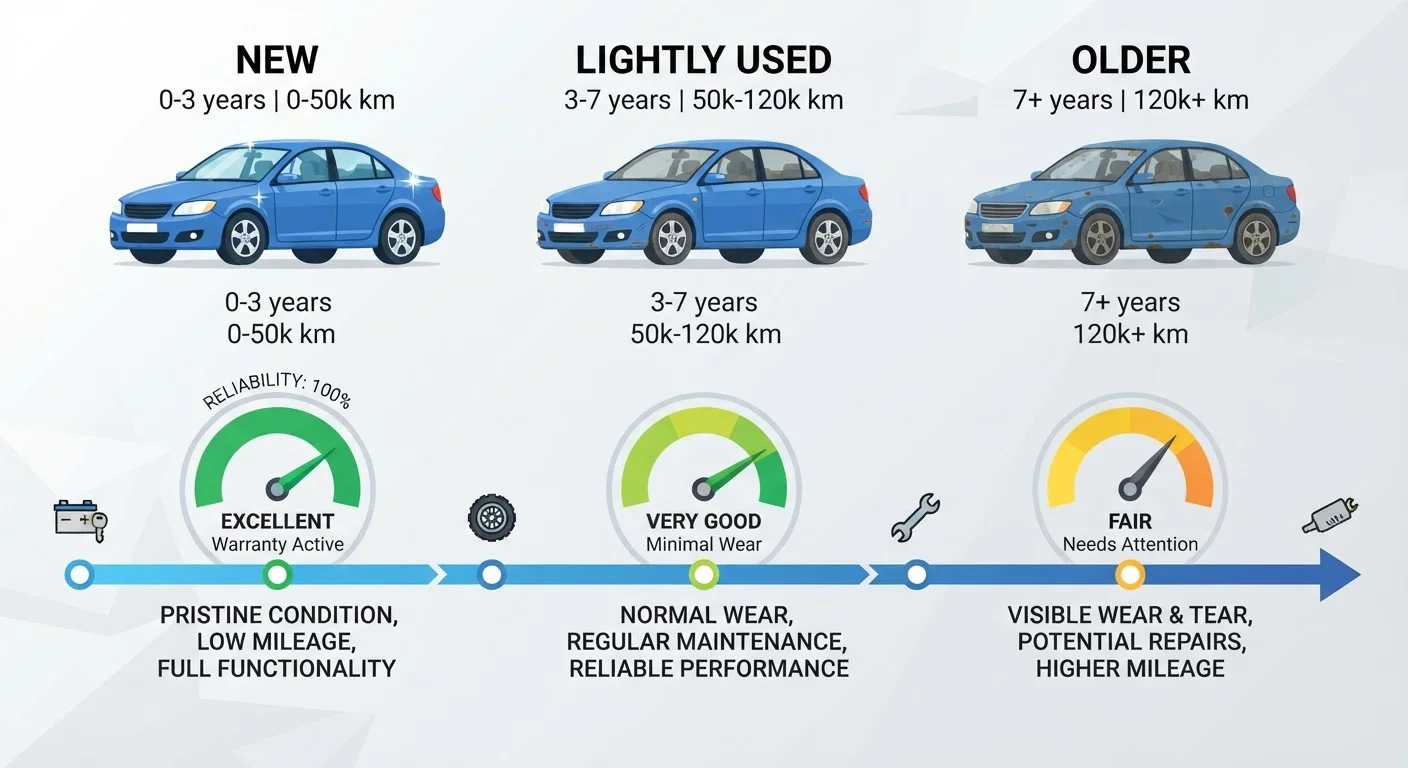
How Reliability Typically Shifts as a Vehicle Ages
Reliability is not a fixed trait - it changes as a vehicle accumulates miles and years. Understanding that arc helps buyers set realistic expectations whether they're shopping new, lightly used, or fully depreciated pre-owned cars.
Most vehicles follow a broadly predictable pattern. New cars benefit from fresh components and manufacturer warranties, but some models experience early teething issues that only appear in the first year or two of production. Lightly used vehicles - generally one to three years old - often represent the sweet spot where initial defects have been worked out under the original warranty, yet significant mechanical wear has not yet accumulated. Older vehicles, typically beyond the five- to seven-year mark, require more attentive maintenance and carry a higher probability of age-related component failure.
It's important to note that this is a general pattern, not a universal guarantee. Model-specific reliability, maintenance history, and usage conditions all introduce significant variation. See how reliability indices are compiled and applied before drawing conclusions from any single data point.
| Typical new car bumper-to-bumper warranty | 3 years / 36,000 miles (Common industry standard; terms vary by manufacturer) |
| Typical powertrain warranty (new car) | 5 years / 60,000 miles (Common industry standard; terms vary by manufacturer) |
| Peak depreciation period | Year 1 of ownership (Broadly reported across automotive valuation guides) |
| Lightly used "sweet spot" age range | 2-5 years old (General industry framing; varies by model) |
| Age at which factory warranty typically expires | 3-5 years (bumper-to-bumper) (Varies by manufacturer and coverage tier) |
| Key wear items to inspect on older vehicles | Belts, seals, cooling system, electronics (General mechanical guidance) |
The Three Reliability Phases Buyers Should Know
Phase 1: New (0-2 Years)
New cars carry full manufacturer warranties - typically a 3-year/36,000-mile bumper-to-bumper and a 5-year/60,000-mile powertrain warranty, though terms vary by brand. Covered repairs cost buyers little out-of-pocket, which reduces financial risk during this phase. However, first-year production runs can surface design or manufacturing issues that early adopters absorb before a mid-cycle correction. Depreciation is also steepest here - a new vehicle can lose a significant portion of its value in the first year alone. Depreciation varies considerably by segment, which directly affects whether buying new makes financial sense for a particular vehicle type.
Phase 2: Lightly Used (2-5 Years)
This window is where many analysts argue buyers find the strongest value-reliability balance. Early issues have surfaced and been addressed, factory warranty coverage may still apply or can often be transferred, and per-mile ownership costs drop sharply compared to buying new. A structured five-year cost comparison shows how maintenance, insurance, and financing interact across this range. Buyers should still obtain a vehicle history report and consider a pre-purchase inspection, as condition varies widely even within the same model year.
Phase 3: Older Pre-Owned (6+ Years)
Vehicles beyond six years old are generally out of factory warranty and entering a phase where wear-related repairs become more common. Rubber seals, belts, cooling system components, and electronic modules all degrade with time regardless of mileage. That said, a well-maintained older vehicle with documented service records can remain highly reliable. Mileage, age, and condition must be read together - a low-mileage older vehicle isn't automatically safer than a higher-mileage one that has been regularly serviced.
Common misconceptions about older vehicles are addressed in this overview of used car assumptions. Buyers considering a used truck specifically can learn what a service history reveals about future truck reliability.
This article provides general educational information about vehicle reliability patterns and is not a guarantee of any specific vehicle's performance or condition. Always consult qualified automotive professionals - including a licensed mechanic for a pre-purchase inspection - before making a purchase decision.