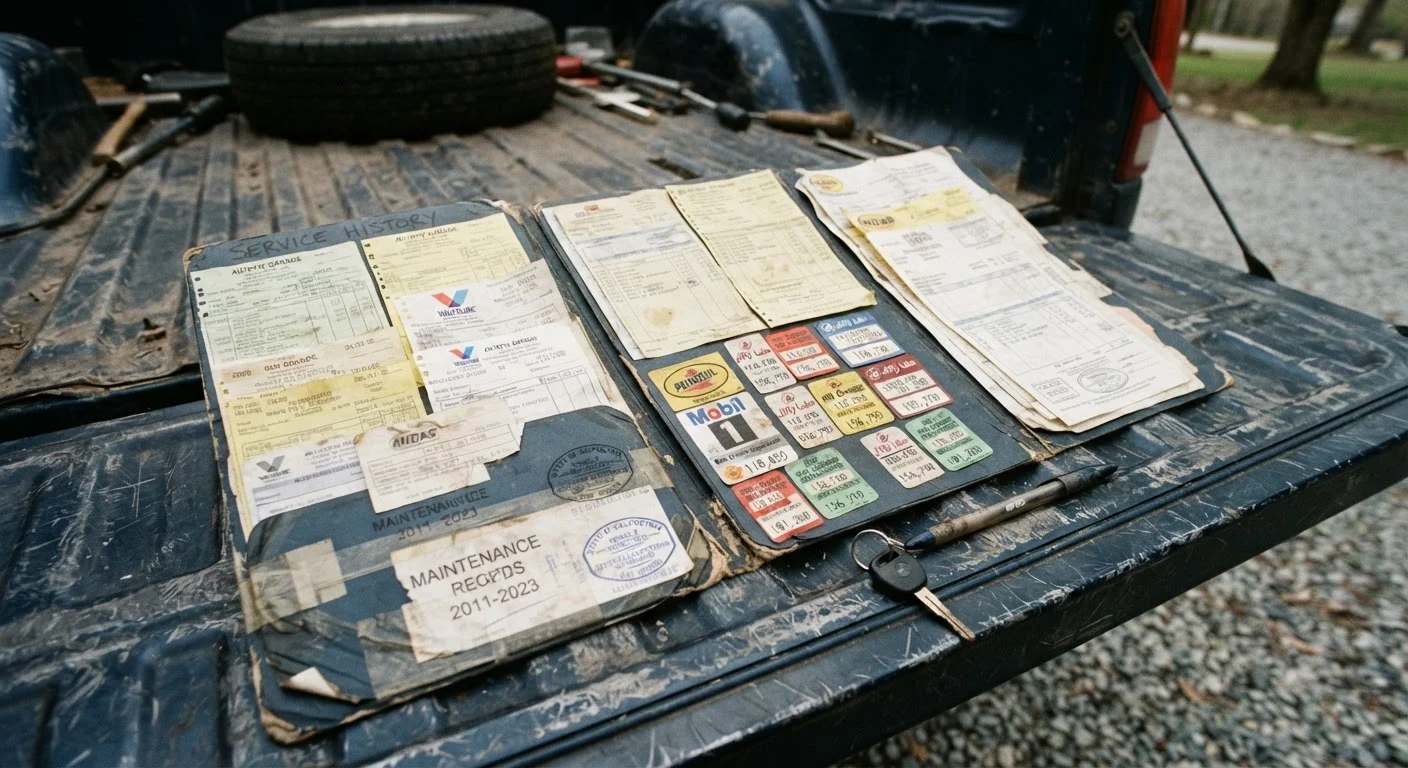
Why Service Records Matter More on Trucks Than Passenger Cars
A used pickup truck is rarely a pampered commuter vehicle. Trucks haul cargo, tow trailers, endure job-site abuse, and sometimes spend time on unpaved roads. Each of those duties places unique stress on mechanical components - and that stress accumulates silently unless regular maintenance has been performed and documented.
Mileage alone tells only part of the story. A 90,000-mile truck serviced on schedule at a dealership may be in significantly better mechanical condition than a 60,000-mile example with spotty records and evidence of hard use. Service history bridges that gap by showing how the miles were accumulated and whether the truck was cared for along the way.
For a deeper look at how reliability evolves as vehicles age, see how reliability changes across a vehicle's life.
What to Look for in a Truck's Maintenance Records
When reviewing service documentation, focus on four core areas:
- Engine oil changes: The most fundamental indicator of ownership discipline. Look for consistent intervals - typically every 5,000 to 10,000 miles depending on the manufacturer's specification and oil type used. Extended gaps between changes can accelerate sludge buildup and accelerate wear on critical engine components.
- Transmission and differential fluid: Trucks that have towed or hauled heavily generate significantly more heat in these systems. Most manufacturers recommend fluid changes at or before 60,000 to 100,000 miles under towing conditions. Missing these intervals on a truck advertised as a former work or towing vehicle is a meaningful warning sign.
- Coolant and brake fluid flushes: Often overlooked but important for long-term system health. Degraded coolant can accelerate corrosion inside the engine block; old brake fluid absorbs moisture and can affect stopping performance.
- Timing belt or chain service: On trucks with timing belts (less common but present on some older models), evidence of replacement at the recommended interval is critical. A failed timing belt can cause catastrophic engine damage.
Decoding a used vehicle's full service history walks through how to interpret partial records and what each documentation scenario signals.
Red Flags, Gaps, and How to Respond
Missing records don't mean a truck was neglected - some owners maintain vehicles carefully but discard receipts. However, gaps require a proportional response: the larger the gap, the more rigorous your inspection should be.
Be cautious of service histories that are suspiciously uniform - every entry from a single shop with identical mileage intervals can occasionally indicate records have been reconstructed rather than organically accumulated. Cross-reference service dates against ownership history using a vehicle history report. Understanding what a vehicle history report actually tells you explains how to read those records accurately.
Also keep in mind that history reports have real limitations. What vehicle history reports don't tell you covers the blind spots that make independent inspection essential regardless of how clean a report appears.
Using Service History Alongside a Pre-Purchase Inspection
Service records provide context; a qualified mechanic provides confirmation. No paper trail substitutes for a physical inspection of the drivetrain, undercarriage, and fluid condition. Have an independent technician - one with no financial stake in the sale - lift the truck and inspect for frame rust, leaks, worn suspension components, and any evidence of deferred maintenance that isn't reflected in the documents.
Ask the mechanic specifically to check for evidence of towing stress: wear patterns on the hitch receiver, transmission temperature sensor data if accessible via an OBD-II scan, and rear suspension condition. Trucks used for heavy towing often show subtle but meaningful wear that no service record will explicitly document.
If a seller is reluctant to allow a pre-purchase inspection, treat that hesitation as meaningful information in itself. For additional guidance on evaluating what a listing tells you before you visit, see reading a used car listing effectively.
This article provides general educational information for used vehicle shoppers. It does not constitute mechanical advice. Always consult a qualified automotive technician before making a purchase decision.