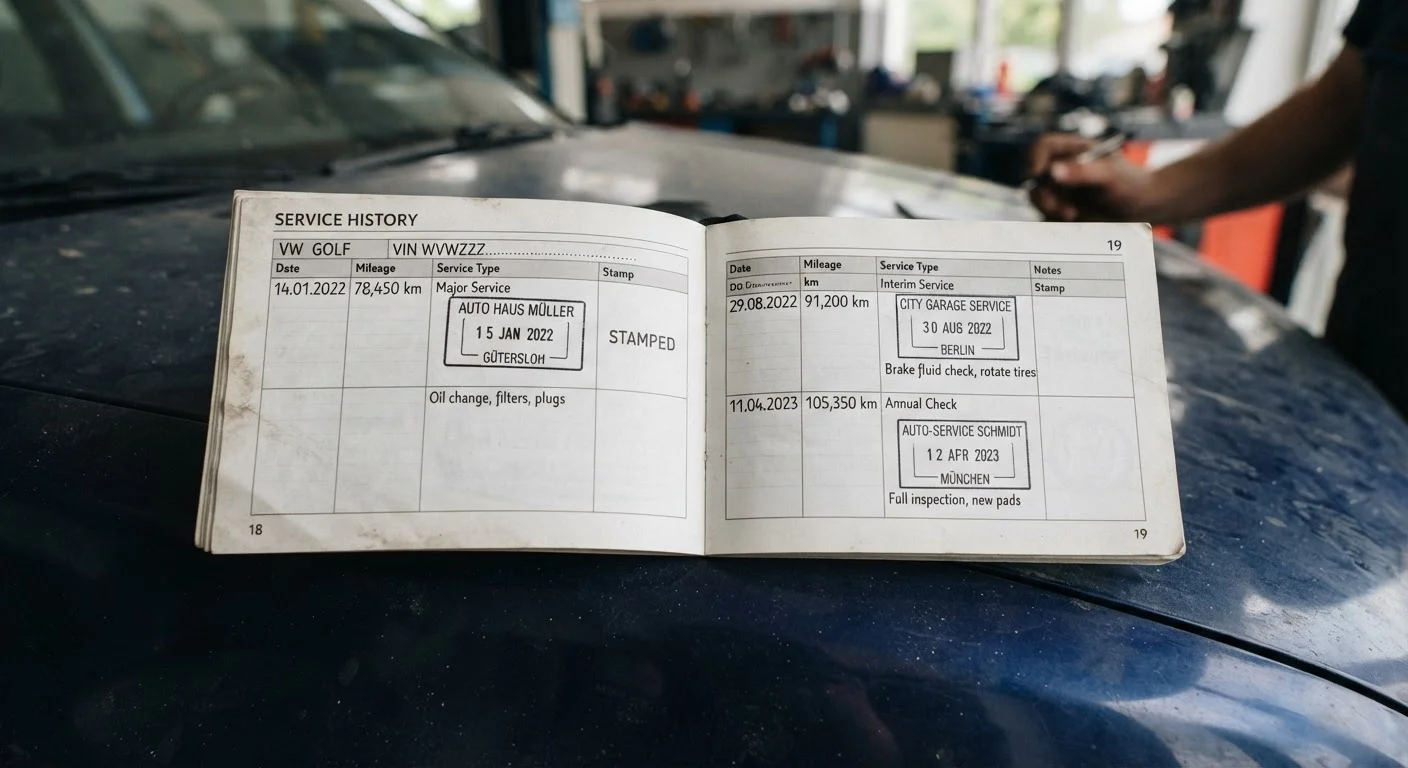
What You're Actually Looking At
A service logbook is a paper trail that answers a fundamental question: has this car been looked after? Each entry should record the date, current odometer reading, work completed, and a stamp from the servicing business. Together, these entries form a chronological picture of the vehicle's maintenance life.
The first thing to check is mileage progression. Entries should increase logically over time. A stamp showing 45,000 miles followed by one at 38,000 miles is a red flag — it suggests tampering or that pages have been swapped. Similarly, entries that show large mileage jumps without corresponding service intervals may indicate the car was driven hard between services or that records are missing.
Next, assess the interval consistency. Most manufacturers recommend service every 10,000–15,000 miles or annually, whichever comes first. Consistent intervals signal disciplined ownership. Irregular gaps — say, 28 months between services — don't automatically condemn a car, but they warrant an explanation from the seller.
For more on what documented records reveal beyond the logbook, see what a vehicle history report actually tells you.
Full, Partial, or No History — What Each Scenario Signals
Full service history (FSH) is the benchmark. Every scheduled interval is recorded, stamps are legible, and the mileage progression is consistent. This scenario reduces — but does not eliminate — buyer risk. Even an FSH vehicle should be verified, not taken at face value.
Partial service history is common and doesn't always mean neglect. A car may have changed hands, lost the original logbook, or had early services done by a previous owner who didn't keep records. What matters is whether the gap period is explainable and whether current condition reflects reasonable care. Ask the seller to provide invoices or workshop receipts that cover the missing period.
No service history removes one of the most useful tools buyers have. Without it, you can't verify whether high-wear items — timing belts, coolant, brake fluid — were replaced on schedule. In this case, a pre-purchase inspection by a qualified mechanic becomes essential rather than optional. Budget for that cost before committing.
~30%
Used cars sold with incomplete or no service history
Industry estimates from used car market analyses suggest roughly one in three used vehicles changes hands without a complete documented service record.
Up to 20%
Price premium for full service history
Used car valuation guides commonly note that documented full service history can support a noticeably higher asking price compared to equivalent vehicles without records.
1 in 4
Buyers who verify service stamps independently
Consumer research in the used car sector suggests most buyers accept service records at face value without contacting the listed workshops to confirm entries.
How to Verify What's in the Book
A physical logbook can be forged. Stamps can be purchased online or replicated. Treat the book as a starting point, not a conclusion.
Step 1 — Match the VIN. The vehicle identification number stamped in the logbook should match the VIN on the dashboard, door jamb, and title documents. Any discrepancy is a serious red flag.
Step 2 — Contact the workshop. Call or email the garages listed in the book and ask them to confirm they serviced that specific VIN on the recorded date. Most legitimate businesses maintain customer records going back several years.
Step 3 — Cross-reference with a history report. Vehicle history reports sometimes capture service events and mileage readings recorded at dealerships or chains. Discrepancies between the report and the logbook deserve explanation. The blind spots in vehicle history reports are worth understanding before you rely on either document alone.
Step 4 — Inspect the car's condition against the claimed history. A car with a claimed FSH but visibly degraded brake fluid, dirty engine oil at service time, or a worn cabin suggests the records may not reflect the reality. Physical evidence carries weight.
For buyers researching trucks specifically, what a used truck's service history tells you covers how service records map to reliability risk in high-load vehicles.
Using Service History Alongside Other Research
Service history is one layer of due diligence, not the whole picture. Pair it with a full reading of the vehicle history report to check for title issues, odometer discrepancies, and past accident disclosures. Then evaluate the listing itself — what a used car listing tells you before you visit can help you filter out higher-risk vehicles before you spend time on an in-person inspection.
Understanding what a logbook service actually covers helps you assess whether the items listed in each entry are plausible for the mileage shown. If a 60,000-mile service stamp doesn't mention a timing belt on an engine known to require one at that interval, that's worth probing.
Used car research rewards methodical buyers. Service history, when genuine and complete, gives you meaningful evidence of a vehicle's past. When it's absent or inconsistent, that's a signal to investigate further — not necessarily to walk away, but to price the uncertainty into your decision.
This article is for general informational purposes only. For guidance specific to your situation, consult a qualified mechanic or automotive professional before purchasing any used vehicle.