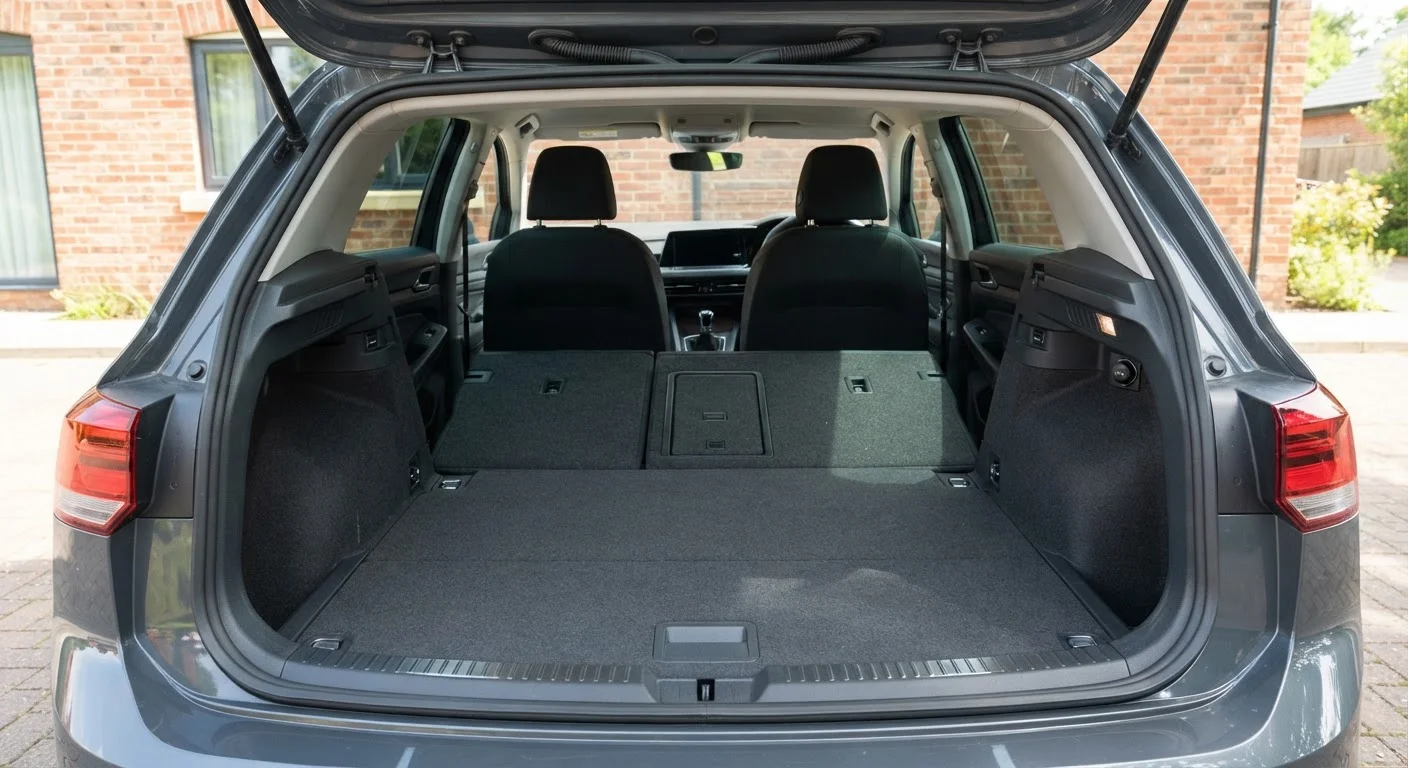
Why the Folded Number Matters More Than the Trunk Figure
When shoppers browse hatchback specs, they often focus on the seats-up cargo figure - the volume measured with all passengers in place. In most everyday carrying situations, however, it is the seats-folded number that reflects what the car can actually do. A hatchback with a modest 13 cubic feet of trunk space can expand to 45 or more cubic feet with the rear seatbacks lowered, fundamentally changing what the vehicle can carry.
This expandability is the core argument for hatchbacks over comparably sized sedans. A sedan's trunk is structurally fixed; the rear parcel shelf and package tray cannot open to the cabin. A hatchback removes that barrier. Understanding how different fold configurations and floor designs affect real-world loading is the key to evaluating whether a given model will serve your needs. For broader context on how body styles compare across multiple dimensions, see our guide to matching body style to your life.
Split-Fold Ratios: What 60/40 and 40/20/40 Actually Mean
The fold ratio describes how the rear seatback is divided. A 60/40 split - the most common configuration - divides the seatback into two sections of unequal width. The larger 60% section folds independently of the 40% section, so you can carry a passenger on one side while lowering the other to transport longer items like flat-pack furniture or sporting equipment.
Some models offer a 40/20/40 configuration, where the center section folds separately from both outer thirds. This is especially practical when the center armrest is in use - the outer sections remain as seating while the narrow center panel drops to pass long, thin items like skis or lumber through from the trunk.
Entry-level trims of some hatchbacks may offer only a single-piece folding bench, which provides the volume benefit but forces an all-or-nothing choice: either all rear seats fold, or none do. For buyers who regularly carry a mix of passengers and cargo, a split-fold configuration is worth prioritizing.
~3x
Typical cargo expansion factor when folding rear seats
Many compact hatchbacks triple their seats-up trunk volume when rear seatbacks are fully lowered, based on published SAE-measured figures across common models in the segment.
60/40
Most common split-fold ratio in the hatchback segment
The 60/40 split is the standard configuration across mid-range and higher hatchback trims, with single-fold benches more common on entry-level variants.
2-4 in
Typical load floor step height when seats fold imperfectly
A step of this range between the folded seatback and the trunk floor is common in models without a dedicated flat-floor design, based on general industry observation.
Load Floor Flatness and Liftover Height
Two physical dimensions define how usable a folded cargo floor actually is: floor flatness and liftover height.
When the rear seatback folds forward, it should ideally sit level with the trunk floor, creating one continuous, step-free surface. In practice, many hatchbacks create a noticeable step or ridge - sometimes 2-4 inches - where the folded seatback meets the existing cargo floor. This matters when sliding heavy items like appliances or moving boxes, where a raised lip can make loading significantly harder.
Liftover height - the distance from the ground to the cargo floor lip at the tailgate opening - is equally important. Hatchbacks generally sit lower than SUVs at this point, which reduces the effort needed to hoist items in and out. However, models with a sportier, sloped roofline may compensate with a narrower tailgate aperture, which can limit the width of objects you can slide through horizontally.
These physical realities rarely appear on spec sheets. The common misreads when comparing spec sheets article covers additional traps buyers encounter when reading cargo data.
Real-World Loading Scenarios
Abstract volume figures become meaningful when tied to specific tasks. Consider a few common situations:
- Airport run for two: Both rear seats up, standard trunk volume is sufficient. Fold configuration is irrelevant here.
- Transporting a bicycle: With the front wheel removed, most compact hatchbacks with fully folded rear seats can accommodate a standard adult bicycle. A step in the floor creates a complication; a flat floor does not.
- One passenger plus long cargo: A 60/40 split lets one person ride in the rear while the adjacent section folds to carry curtain rods, a rolled rug, or fishing rods through from the trunk.
- Home improvement haul: Standard sheet goods (4×8 feet) will not fit in any car-segment hatchback, but lengths of lumber up to six feet are often accommodable with a 40/20/40 fold and the front passenger seat slid forward.
These examples illustrate why the fold configuration and floor design matter as much as the headline cubic-foot figure. For a contrasting view of how a completely different vehicle class handles cargo trade-offs, our article on three-row SUV cargo trade-offs provides useful perspective.
How to Evaluate Cargo Versatility Before You Buy
Rather than relying solely on published specs, use a practical checklist when assessing a hatchback's cargo versatility at the dealership or during a test drive:
- Check the fold mechanism. Does each section fold independently? Is the release lever or button accessible from the trunk, the cabin, or both?
- Measure the step. Place your hand flat at the junction of the folded seatback and the cargo floor. A meaningful ridge is a real-world inconvenience.
- Note the aperture width. The widest point of the tailgate opening determines the maximum width of any object you can slide in horizontally.
- Test the liftover height. Simulate lifting a heavy bag or appliance to the load floor height. Is it comfortable, or does it require an awkward overhead lift?
- Look for cargo floor accessories. Some models offer a reversible cargo floor panel or a removable shelf that creates a two-tier system, useful for keeping flat items below and lighter bags above.
Published volume figures remain a useful rough comparison, but the how automakers measure cargo volume resource explains why those numbers should be cross-referenced rather than taken at face value. Ultimately, the hatchback's cargo versatility advantage is structural and architectural - it is a function of design decisions, not marketing figures.
This article provides general educational information about vehicle features and is not a guarantee of any specific vehicle's performance or suitability for your needs. Consult manufacturer specifications and conduct your own assessment before making a purchase decision.