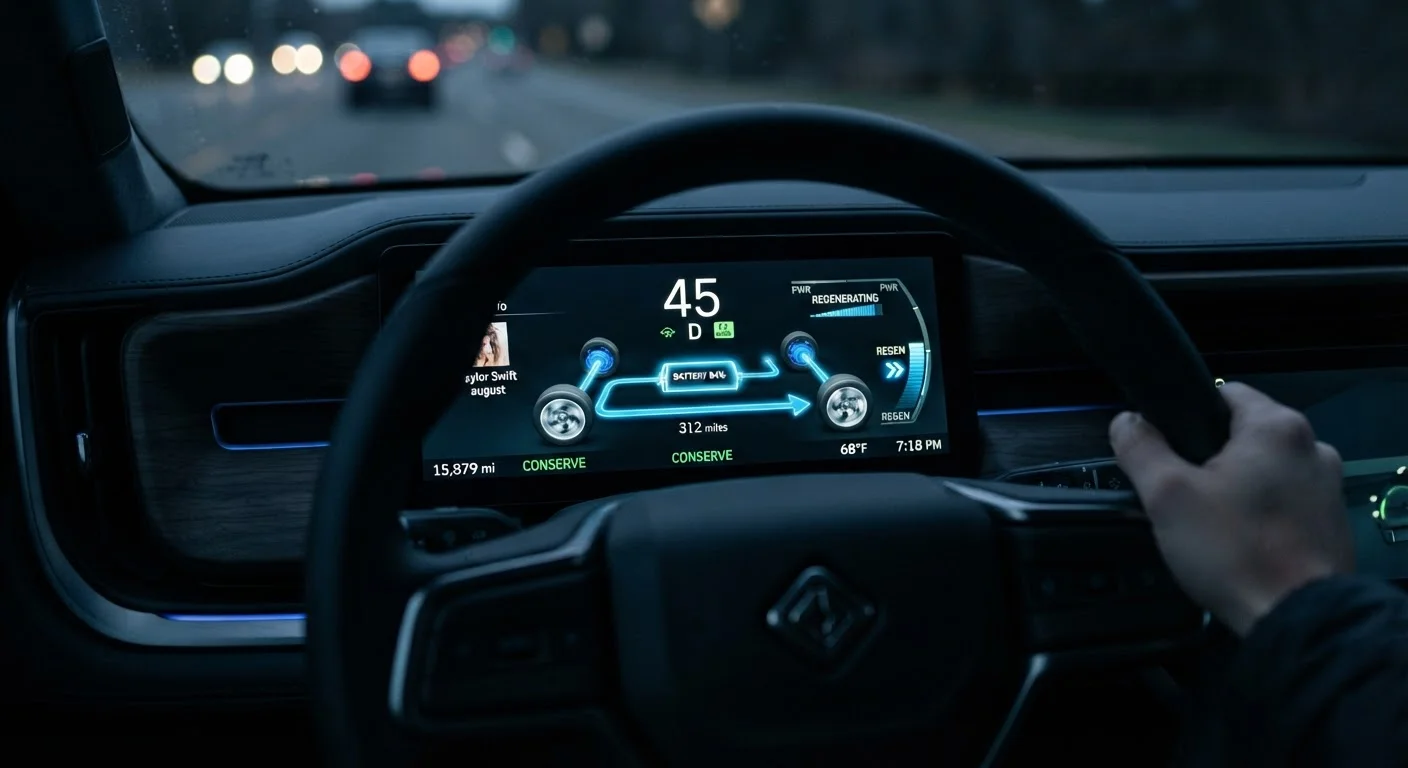
How Regenerative Braking Actually Works
In a conventional vehicle, every time you press the brake pedal, kinetic energy — the energy your car built up by accelerating — is converted into heat through friction between the brake pads and rotors. That heat dissipates into the air and is lost permanently. Regenerative braking takes a fundamentally different approach.
In hybrid and electric vehicles, the electric motor that drives the wheels can also operate in reverse as a generator. When you lift off the accelerator or press the brake pedal, the motor switches into generator mode. The spinning wheels now drive the motor instead of the other way around, and that mechanical energy is converted into electrical energy, which flows back into the battery.
The friction brakes remain fully operational and engage automatically when braking demands exceed what the electric motor can handle — such as during hard stops — or at very low speeds where regenerative braking becomes less effective. The transition between the two systems is managed electronically and is generally seamless.
To understand how this fits into different electrified powertrain types, see our plain-English breakdown of hybrid and EV powertrains.
Try Different Regeneration Levels Early
If your vehicle has selectable regeneration modes, experiment with them during your first few weeks of ownership across different driving environments. Highway driving often suits lower regeneration for a smoother coast, while city and suburban driving benefits from higher settings where energy recovery is most frequent. Your owner's manual will describe how to access these settings.
What It Feels Like to Drive With Regenerative Braking
Many first-time hybrid or EV drivers notice a subtle difference in how the car decelerates. When you ease off the accelerator, the car slows more noticeably than a conventional vehicle would — this drag is regenerative braking at work. In vehicles with high regeneration settings, this effect can be strong enough that experienced drivers rely primarily on accelerator modulation to control their speed in traffic.
This is what manufacturers call one-pedal driving: the ability to slow the car significantly, and in some models nearly to a complete stop, simply by releasing the accelerator. It is an acquired skill but one many drivers find intuitive after a short adjustment period.
The brake pedal itself may also feel different. Because friction brakes and regenerative braking must be blended together electronically, some drivers describe the pedal feel as firmer or slightly less linear than they are used to. This is normal and by design.
If you are evaluating a hybrid or electric vehicle and want to know what to focus on during a test drive, our guide on evaluating an EV test drive covers exactly what to pay attention to.
Adjusting Regenerative Braking Strength
Most modern hybrid and electric vehicles offer selectable regeneration levels, often accessed through drive mode settings or paddle shifters behind the steering wheel. A typical range might include low, medium, and high settings — or sometimes labeled as comfort, normal, and sport.
- Low regeneration: The car coasts more freely when you lift off the accelerator, feeling closer to a conventional vehicle. Useful on highways where smooth, gradual deceleration is preferred.
- High regeneration: The car slows firmly as soon as you lift off the accelerator. Maximizes energy recovery and suits stop-and-go city driving.
Some vehicles also include an automatic setting that uses navigation data and sensors to adjust regeneration dynamically — increasing it before a known stop sign or curve, for example.
Choosing the right level is largely a matter of preference and driving context. There is no single correct setting, and experimenting across different environments is the best way to find what suits your habits.
Up to 70%
Kinetic energy potentially recoverable during braking
Engineering estimates suggest regenerative braking systems can recover up to 70% of kinetic energy in optimal conditions, though real-world figures vary by system design and driving pattern.
10–30%
Range improvement in city driving from regeneration
Industry assessments indicate regenerative braking can contribute roughly 10–30% additional range in urban stop-and-go conditions compared to highway driving, where opportunities to recapture energy are fewer.
Practical Benefits and Realistic Expectations
Regenerative braking contributes measurably to real-world efficiency, particularly in urban driving where frequent stops are common. On a highway with few slowdowns, its contribution is more limited. Drivers who commute in cities or suburban traffic tend to see the greatest benefit in extended range or reduced fuel consumption.
From a maintenance perspective, friction brake components in hybrids and EVs often last longer than in conventional vehicles because they are called on less frequently. However, an interesting counterpoint exists: rotors and pads on lightly used friction brakes can sometimes develop surface corrosion more readily due to infrequent use. Periodic checks remain important regardless of reduced wear.
Regenerative braking does not eliminate the need for routine brake inspections. Always follow your vehicle manufacturer's maintenance schedule and have a qualified technician inspect your brake system at recommended intervals.
For a broader comparison of how these efficiency systems factor into real-world ownership costs across different powertrain types, see our article on choosing the right powertrain for your situation. If you are specifically weighing hybrid options, our overview of hybrid powertrains in the sedan and hatchback segment explores how different hybrid architectures handle energy recovery.