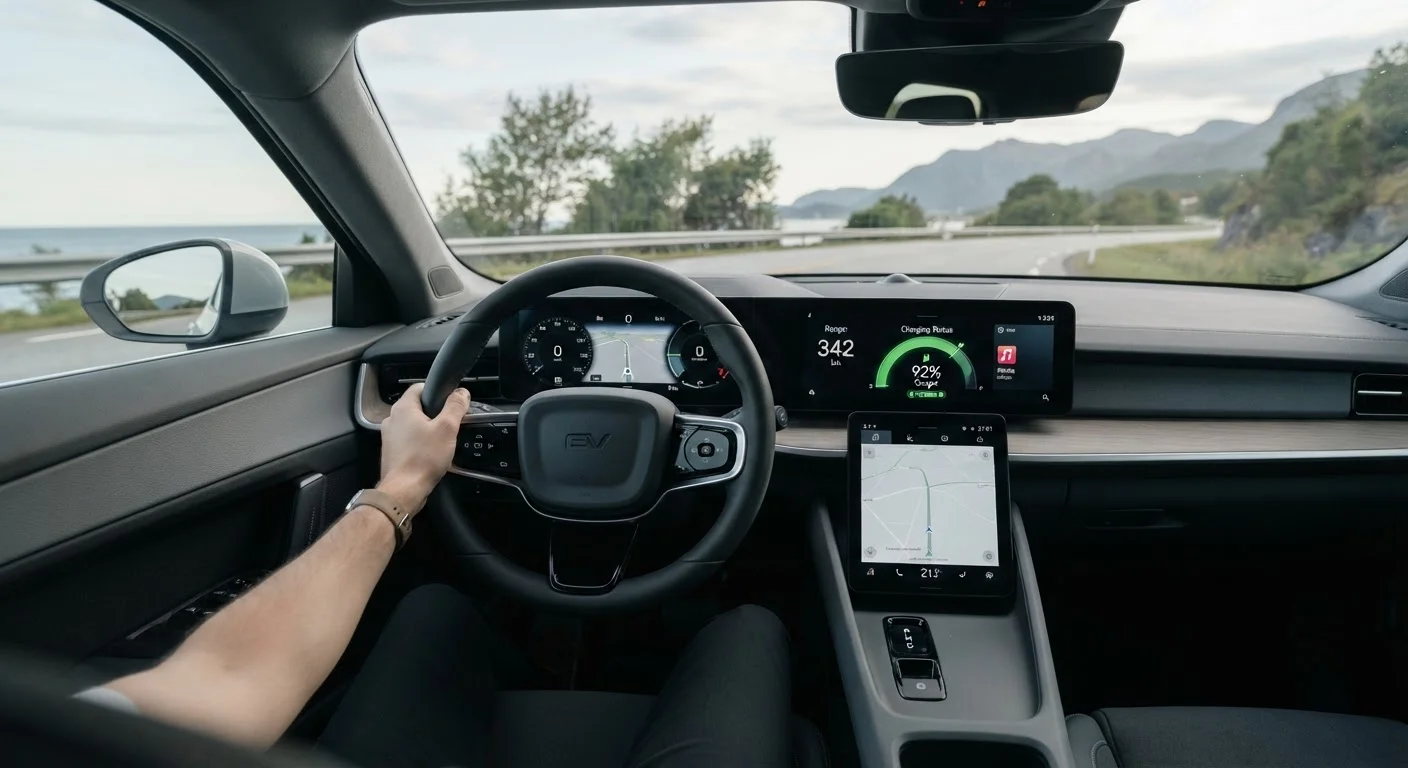
Why an EV Test Drive Is Different
A test drive for a conventional vehicle tells you about engine smoothness, gear transitions, exhaust note, and clutch feel. None of those apply to an electric car. What you're evaluating instead are characteristics unique to EV ownership: power delivery linearity, regenerative braking behavior, cabin sound at speed, software responsiveness, and whether the real-world range estimate matches your actual driving patterns.
These aren't just novelty factors - they directly affect how livable the car is day to day. For a structured baseline on evaluating any car during a test drive, see our side-by-side test drive checklist. The checklist below layers in the EV-specific items you'll need on top of that foundation.
Before you book the drive, confirm the battery will be charged to at least 70% state of charge. A low-battery EV may artificially restrict performance output, giving you a distorted impression of how the car actually drives.
Don't Skip the Highway Segment
Many dealership test drives default to slow, local-street loops that don't reflect how an EV performs - or how loudly its tires and wind noise register - at highway speeds. Specifically request a route that includes at least a short highway or fast-road segment. This is where range consumption accelerates and cabin refinement differences between models become most apparent.
What to Assess During the Drive
Use this checklist systematically. Work through each group during the drive itself, not from memory afterward. Bring a notes app or a printed copy.
Power Delivery and Acceleration
Regenerative Braking
Cabin Noise and Refinement
Range Display and Energy Monitoring
Software, Screens, and Controls
Charging and Practical Setup
Regenerative braking deserves particular attention because it's one of the most polarizing aspects of EV driving. Our guide to regenerative braking covers how the system works and why the sensation varies across models. Most EVs offer adjustable regen levels - test each setting to find what feels natural for your style.
For a deeper look at what powertrain sounds and sensations signal during any test drive, the powertrain health checklist provides useful context, even for electric motors.
Tools and Resources to Bring
You don't need specialized equipment to evaluate an EV test drive well, but a few items make the process more systematic.
Smartphone with notes app
Record impressions, range figures, and questions in real time rather than relying on memory after the drive.
Your daily commute distance (written down)
Use as a concrete benchmark when evaluating the live range estimate shown during the test drive.
This checklist (printed or on-screen)
Work through each evaluation group systematically so nothing is missed during a short drive window.
EV charging app (e.g., PlugShare or the manufacturer's app)
Explore the charging network coverage in your area before or after the drive to assess real-world charging accessibility.
After the Drive: Questions to Ask the Dealer
The test drive surfaces feelings and impressions. The follow-up conversation should convert those into verifiable data. Ask specifically about the vehicle's rated range under EPA testing conditions, not the figure shown on the window sticker under ideal scenarios. Ask how the onboard range estimate is calculated - some systems are more conservative than others.
Inquire about home charging installation requirements: the amperage of the recommended home charger, whether the vehicle supports DC fast charging, and at what maximum rate. These details shape your total cost of ownership. For a broader view of what public charging infrastructure looks like in practice, see our guide to public charging networks.
Also consider whether the EV fits your broader lifestyle - not just your commute distance. Where buyers go wrong when assuming an EV suits any lifestyle is worth reading before you make a final decision. And when you're comparing manufacturer range claims to third-party reviews, our guide to reading EV reviews without being misled explains which test conditions actually matter.
This article provides general informational guidance for car buyers and does not constitute personalized financial or purchasing advice. Consult qualified professionals for decisions specific to your circumstances.