How Passive Entry Actually Works
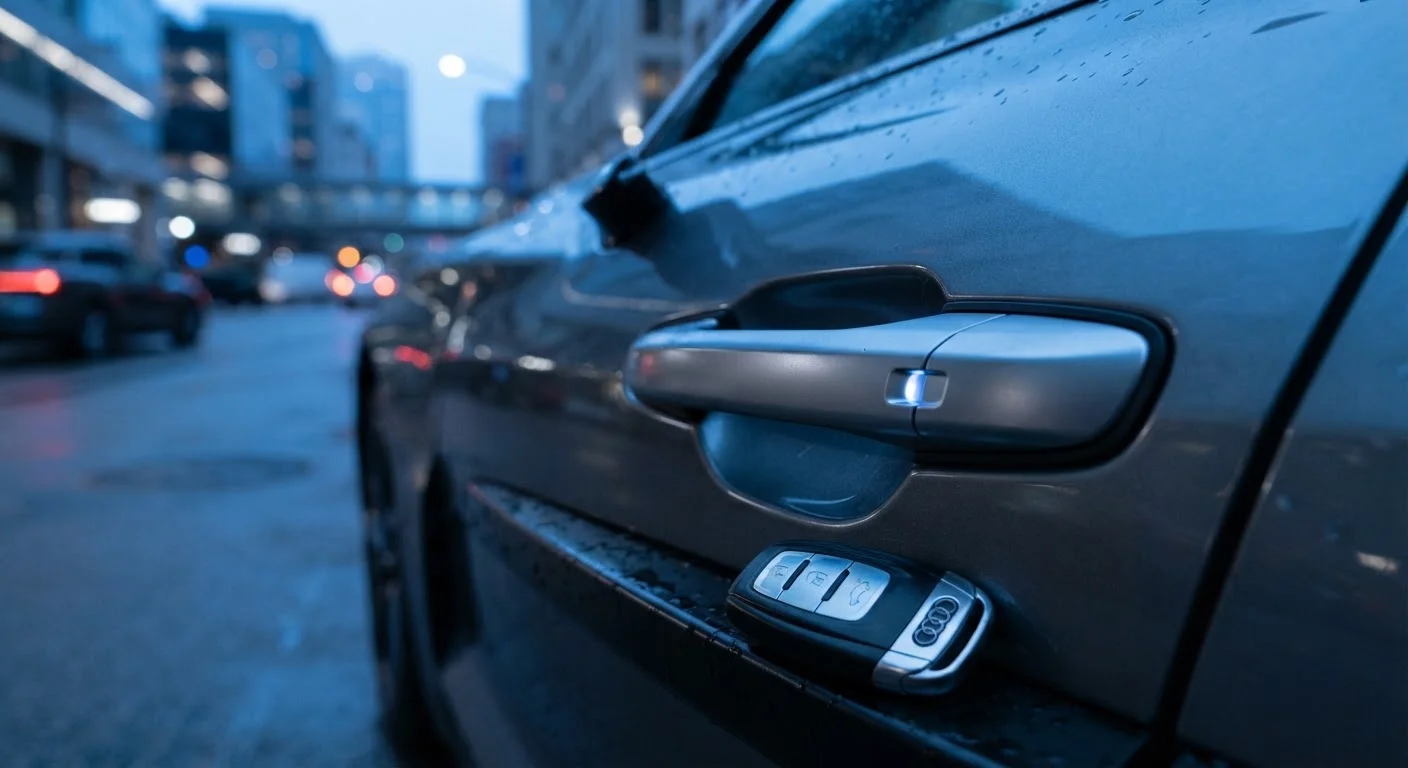
Passive entry — sometimes called keyless entry or smart entry — removes the need to press anything on your fob. When you approach the vehicle with the fob in your pocket or bag, antennas embedded in the door handles broadcast a low-frequency radio signal. Your fob receives that signal, authenticates itself, and transmits a unique encrypted code back to the car. The whole exchange happens in milliseconds. If the code matches, the door unlocks as soon as you grip or touch the handle.
Passive Entry
A system that automatically detects your key fob as you approach the car and unlocks the doors without you pressing any button.
Key Fob
The small electronic device you carry that communicates wirelessly with your vehicle to enable locking, unlocking, and starting functions.
Proximity Sensor
A short-range antenna built into the door handle or surrounding area that detects when your key fob is within a set distance.
Push-Button Start
An ignition system that replaces the traditional key-turn with a button press, using the fob's wireless signal to authorize the engine to start.
Relay Attack
A theft technique where criminals use electronic devices to amplify and relay your fob's signal from inside your home to your parked car, tricking it into unlocking.
Faraday Pouch
A small bag lined with signal-blocking material that prevents your key fob from broadcasting its radio signal, protecting against relay attacks.
Detection range is typically between one and three feet of the door handle, so you usually need to be quite close before anything happens. This is intentional — a tighter range reduces the chance of accidental unlocking when you walk past your car without intending to enter.
Locking works similarly but varies more between manufacturers. Some vehicles lock automatically once you move beyond a set distance with the fob. Others require you to tap a small capacitive sensor pad on the door handle exterior or press a button on the handle itself. Knowing which method your vehicle uses avoids the frustrating experience of walking away and wondering whether the car actually locked. For a broader look at how modern car tech features interact, see our guide to familiarizing yourself with a new car's technology before you head out.
Using Push-Button Start Correctly
Once inside the vehicle, starting the engine requires two things simultaneously: the key fob must be inside the cabin, and your foot must be firmly on the brake pedal. With both conditions met, pressing the start button sends the ignition signal and the engine turns over.
If you press the start button without your foot on the brake, most systems cycle through accessory and ignition modes instead of starting the engine — useful for running the radio or checking systems without the engine running. A single press typically activates accessory power; a second press brings the ignition on; a third (with foot on brake) starts the engine. Your owner's manual will confirm the exact sequence for your vehicle.
Always Keep Your Backup Key Accessible
Most key fobs contain a removable physical key blade — locate it before you ever need it. Store it somewhere accessible but separate from your fob, such as in your wallet or bag. If the fob battery dies unexpectedly, you'll be glad you know exactly where the backup key is without having to puzzle it out in a parking lot.
Shutting down is straightforward: with the vehicle in Park, press the start button once. The engine stops and most systems automatically lock if you exit with the fob. However, some vehicles will continue running if you step out without pressing the button first — always confirm the engine is off before walking away.
Common Situations and How to Handle Them
Dead fob battery: The fob's internal battery is typically a CR2032 coin cell that lasts two to four years under normal use. When it weakens, detection range shrinks noticeably before the fob stops working entirely. To start the car with a fully dead fob, most manufacturers build an emergency start method directly into the push-button housing. Holding the fob flat against the button face allows the car's internal coil to power and read the fob passively. The physical key blade hidden inside the fob lets you unlock the door mechanically first.
Multiple fobs in the vehicle: If two people each carry a paired fob, the system typically responds to whichever fob is closest to the relevant antenna. There's no conflict — both fobs are independently valid.
Fob left outside: If you accidentally leave your fob on the roof or hand it to someone outside while the engine is running, the vehicle will generally warn you through a chime or dashboard message. Most systems won't shut off mid-drive, but they'll alert you so you can retrieve the fob before stopping. This is also relevant for EV drivers — for more on how keyless systems integrate with electric vehicles, see our complete EV walkthrough.
Security Considerations You Should Know
Passive entry's convenience comes with a specific vulnerability: the relay attack. Thieves work in pairs — one person stands near your front door to capture the fob's ambient signal through the wall, while the other stands near your car with a receiver that relays that signal. The car interprets this as the fob being present and unlocks. The entire process can take seconds.
Don't Leave a Running Engine Unattended
Carbon monoxide is colorless and odorless — an idling engine in an enclosed or semi-enclosed space is dangerous. Never assume your car has shut itself off automatically after you exit. Glance at the start button indicator light or listen for engine noise before walking away, especially in a garage.
The most practical countermeasure is a Faraday pouch — a small, inexpensive signal-blocking bag you drop your fob into when at home. It stops the fob from transmitting entirely. A metal tin with a tight-fitting lid works on the same principle. Placing your fob away from exterior walls and doors also reduces signal leakage.
Some manufacturers now offer motion-sensing fobs that go into a sleep mode when stationary for a period of time, effectively self-protecting against relay attacks. Check whether your fob supports this feature in your owner's manual or the manufacturer's companion app.
For context on how vehicle security features fit alongside other driver assistance systems, our plain-language safety tech field guide covers the broader landscape of modern protective technology.