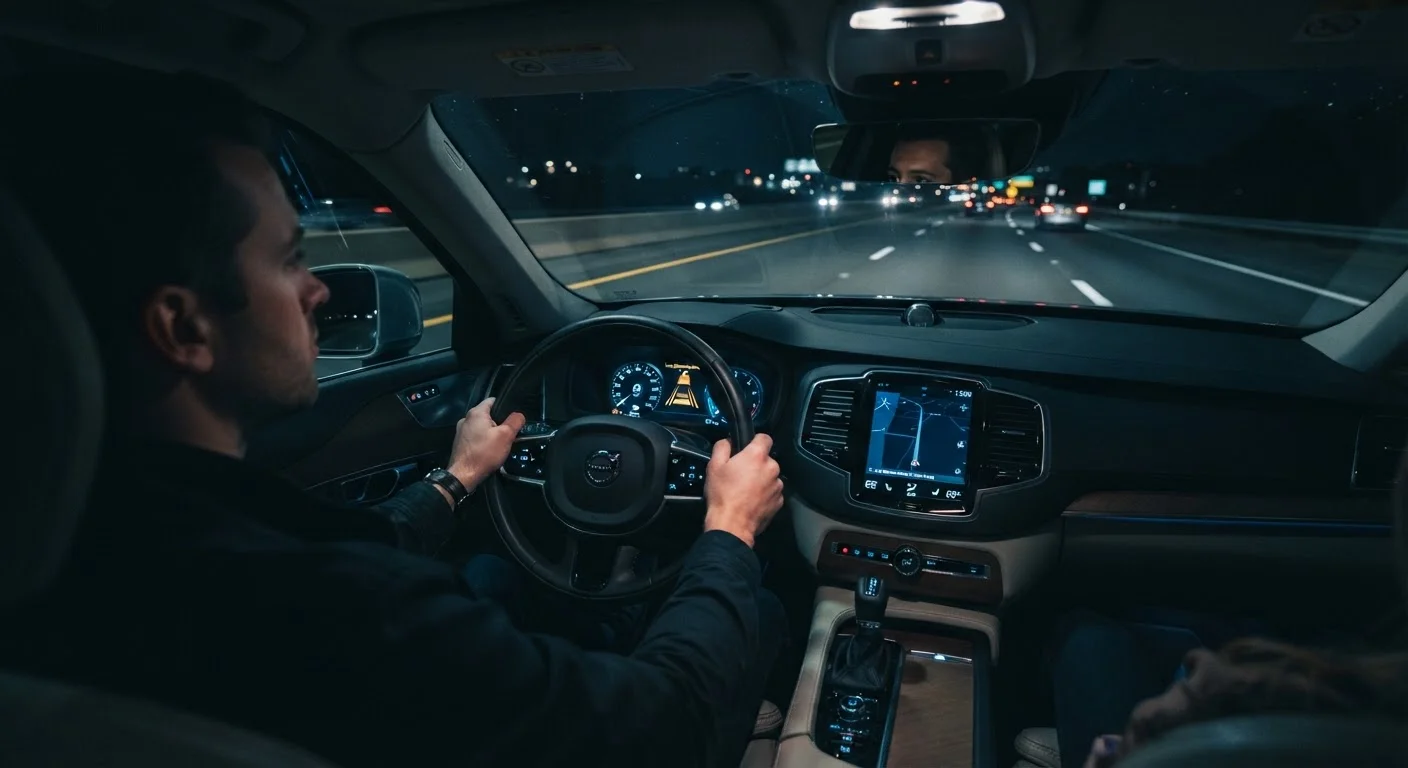
Three Systems, Three Different Jobs
Walk through any new-car brochure and you'll likely see Lane Departure Warning (LDW), Lane Keep Assist (LKA), and Lane Centering Assist (LCA) listed under the same safety umbrella. They all watch the lane markings ahead of you — but what they do when you drift varies significantly, and that difference shapes how each one feels in daily driving.
Think of the three systems on a spectrum from purely advisory to actively corrective:
- Lane Departure Warning — tells you something is wrong
- Lane Keep Assist — briefly intervenes to correct drift
- Lane Centering Assist — continuously steers to hold the middle of the lane
For a broader look at how these fit alongside other driver assistance technologies, see our plain-language field guide to modern car safety tech.
Lane Departure Warning: The Alert-Only System
Lane Departure Warning is the most passive of the three. A forward-facing camera continuously tracks the painted lines on either side of the car. If the vehicle begins to cross a line without a turn signal activated, the system triggers an alert — typically a chime, a flashing icon on the dashboard, a vibration in the seat, or a buzz in the steering wheel.
That's where its involvement ends. LDW does not steer, does not brake, and does not slow the vehicle. The response is entirely up to the driver. This makes LDW useful as a fatigue or distraction nudge — it interrupts complacency without wrestling control from the driver.
Use Your Turn Signal to Suppress Interventions
All three lane assist systems are designed to stand down when you activate your turn signal, because the car interprets the signal as an intentional lane change rather than unintended drift. Making it a habit to signal before every lane change — even when traffic is light — keeps the system from working against you and reinforces a safe driving practice regardless of technology.
One practical limitation: LDW requires clearly painted, high-contrast lane markings to work. Construction zones, rural roads with faded lines, or lanes dusted with snow can cause the system to go quiet precisely when you most want it watching. Road and weather conditions can significantly degrade ADAS performance — something worth knowing before you rely on any lane system.
Lane Keep Assist: The Brief Intervention
Lane Keep Assist takes a step further. When the system detects that a lane line is being crossed, it applies a brief corrective input — either a nudge through the power steering motor or a pulse of braking on the appropriate wheel — to guide the vehicle back toward the center of the lane. The intervention is intentionally light-handed: the system is not trying to take over, just redirect.
In practice, LKA feels like a gentle suggestion. It works best as a secondary safeguard during highway driving and is not designed to hold a lane indefinitely. If the car continues to drift — because the driver is incapacitated, for example — the system will typically escalate with more urgent alerts rather than continue steering.
Most implementations suppress LKA when you activate your turn signal, which prevents the system from fighting you during intentional lane changes. If yours doesn't, check your vehicle's settings menu — many allow you to customize this behavior.
Lane Centering Assist: Continuous Steering Support
Lane Centering Assist — sometimes called lane centering control or active lane centering — is the most capable of the three. Rather than waiting for a drift to occur, it continuously adjusts steering to keep the vehicle near the center of the lane. It's the lane-management component of what many automakers call a driver attention support suite or pair with adaptive cruise control to form a combined highway assist feature.
Lane centering is primarily a highway feature, typically activating above 40–45 mph. On well-marked interstates, it can meaningfully reduce steering effort on long drives. On winding roads or in areas with ambiguous markings, it may apply corrections that feel counterintuitive, and most drivers learn to turn it off in those environments.
It's important to understand that lane centering is a driver assistance tool, not an autonomous system. Hands must remain on or near the wheel, and the driver is fully responsible for the vehicle at all times. The system will issue escalating warnings — and eventually disengage — if it detects driver inattention.
~85%
New U.S. vehicles equipped with LDW
According to NHTSA data, Lane Departure Warning has become one of the most widely available driver assistance features on new vehicles sold in the United States.
Level 1–2
SAE automation level for lane assist systems
Lane assist features — including lane centering — are classified by SAE International as Level 1 or Level 2 driver assistance, meaning a human driver must remain in control and attentive at all times.
40–45 mph
Typical minimum speed for lane centering activation
Most lane centering systems are calibrated for highway use and require the vehicle to exceed a minimum speed threshold before the continuous steering function becomes active.
What to Look for When Comparing Vehicles
When evaluating which lane system a vehicle has, the name alone isn't always enough — confirm what the system actually does by reviewing the owner's manual description or asking a sales consultant to demonstrate it. Key questions to ask:
- Does the system alert, intervene, or continuously steer?
- Can the sensitivity or response strength be adjusted?
- Does it integrate with adaptive cruise control for combined highway assist?
- How does it behave when turn signals are used?
- Does it remember your on/off preference between ignition cycles?
A higher trim level doesn't always mean a more capable lane system — some entry configurations include LDW only, while LCA may be reserved for premium packages or optional bundles. Comparing trim specs line-by-line pays off here, much like evaluating the distinction between forward collision warning and automatic emergency braking.
This article is for informational purposes only. Driver assistance features vary by vehicle make, model, trim, and software version. Always consult your vehicle's owner manual and drive attentively regardless of which systems are active.